I attended segregated schools. Trump’s assault on the Education Department should terrify us all.
While we were all watching the Reflecting Pool, the White House has been gutting the agency that fought for equal education. This is a civil rights catastrophe.
Having attended segregated schools in Birmingham. Ala., from 1959 to 1970, I know what a poorly funded public education system looks like. But I didn’t know my schools were being shortchanged until a federal court desegregation order closed all-Black Ullman High School in 1970, and I was reassigned to Ramsay High, which for most of its 60-year existence had been all-white.
Only a trickle of Black students began attending Ramsay in 1963, when Richard Walker became the first African American student there. But after Ullman closed, Ramsay abruptly went from being nearly 5% to about 50% Black. Both Black and white students experienced some serious culture shock as a result, but I don’t recall any major racial incidents during my one year on that campus.
What I do recall is that Ramsay’s books weren’t worn-out, hand-me-downs, that its science classes had enough working lab equipment for every student, and that its smaller student-teacher ratio made it easier for academically struggling children to get the attention they needed. In fact, to this day, I applaud all of my Ramsay teachers, including several reassigned there from Ullman.
My reminiscing about poorly funded schools was sparked by the Trump administration’s efforts to shut down the federal Department of Education, which has played a crucial role over the years not only in lessening the impact of past racism in America’s schools but otherwise ensuring adequate educational opportunities exist for all children, including those with financial or health disadvantages.
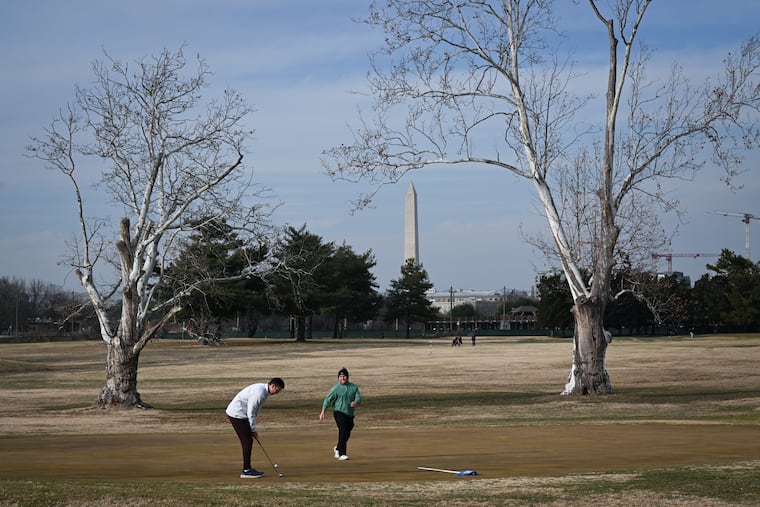
More Americans should be raising hell about what’s happening to the Education Department. But it’s hard to keep track of what to be upset about with this president. Every day, Americans are flooded by often inane news out of Washington that diverts their attention. So what if President Donald Trump has botched the repairs of the Lincoln Memorial Reflecting Pool? He messes up almost everything he touches.
The amount of news coverage given to that story was not only undeserved but a disservice. It also plays into the hands of Trump, who most likely would prefer to have people talking about algae in the Reflecting Pool instead of how much his ill-conceived war with Iran has cost in dollars and lives. The Iran war reminds me of a satirical movie released in 1997, Wag the Dog, in which a fictional U.S. president, after being caught trying to seduce an underage girl inside the Oval Office, fabricated a war in Albania to distract the American public from the sex scandal.
There’s nothing fake about our war with Iran. More than 3,600 Iranians and 4,000 people in Lebanon are believed to have been killed as a result of military attacks by our country and Israel. Thirteen U.S. service members and at least 39 Israelis have also died since the fighting began on Feb. 28. That’s why it’s so disheartening but necessary to question the war’s true intent.
“If we didn’t do what we’re doing right now, you would have had a nuclear war, and they would have taken out many countries,” Trump said while meeting with German Chancellor Friedrich Merz on March 3. Our president would have us believe he started the war because Iran, which wasn’t close to having nuclear attack capability, was a greater threat to America than Russia or China, which already have advanced nuclear weapons. Or North Korea, which is way closer than Iran to achieving that status.
I pray Trump isn’t employing a horrific Wag the Dog ploy to divert attention from a war that has cost thousands of real lives and billions of dollars. But whether it was his intent or not, the American public’s understandable focus on the Iran war and its ancillary impact on consumer costs such as the price of gasoline and food has allowed Trump to push forward some dubious goals that more Americans might otherwise have vehemently rejected.
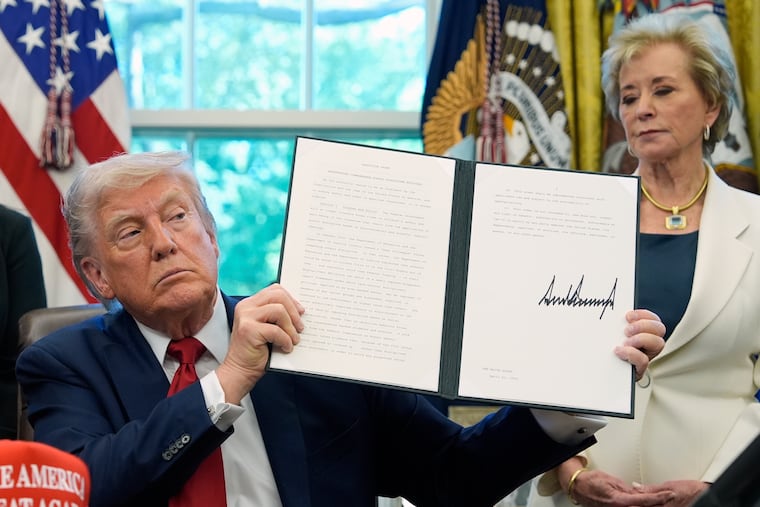
That includes Trump’s ongoing dismantlement of the Department of Education, which he tried but failed to do during his first term. Trump appointed billionaire Betsy DeVos, who had no background in education, to be his education secretary in 2016 so she could cripple the department. His current education secretary, billionaire Linda McMahon, is just as ill-equipped for the job as DeVos, but she, too, seems hell-bent on finishing what her predecessor started.
McMahon announced last month that her department will no longer enforce rules meant to protect civil rights in education and will discontinue oversight of special-education programs. Those functions are being transferred, respectively, to the U.S. Department of Justice and the U.S. Department of Health and Human Services. There was no mention of personnel being transferred to those departments to perform those additional duties.
McMahon earlier announced plans to transfer two of her department’s largest units, the Office of Elementary and Secondary Education and the Office of Postsecondary Education, to the U.S. Department of Labor, move the Office of Indian Education to the U.S. Department of the Interior, transfer responsibility for childcare access and a foreign medical program to the U.S. Department of Health and Human Services, and shift a foreign language education program to the U.S. Department of State.
Trump has never fully explained his zest to kill the Education Department, but it fits the states-rights attitude of some of his supporters, especially down South, who have long resented federal intrusion into how they run their public schools. Such resistance to federal involvement was about segregation when I was a child; today it’s more about encouraging vouchers and other programs that drain tax dollars and students from traditional public schools.
It’s not wrong to reassess the role the federal government plays in running local schools, but educating American’s children should remain a national priority.
It’s not wrong to reassess the role the federal government plays in running local schools, but educating Americans’ children should remain a national priority — one that requires significant input from Washington to ensure some uniformity in educational opportunities and outcomes no matter where a family lives.
Congress passed the 1965 Elementary and Secondary Education Act with that in mind. Known as Title I, the law provides additional federal funding to schools with large numbers of students living in poverty. Changing Title I to a block grant program — without federal oversight — risks that the money won’t be spent where it is most needed. Misuse of taxpayer money led the Department of Health and Human Services to freeze access to more than $10 billion in block grants for California, Colorado, Illinois, Minnesota, and New York earlier this year.
The National Education Association warns that handing out block grants without clear restrictions would allow states to divert tax money to voucher programs — and essentially turn the clock back 60 years on education policy and progress. “While one would like to think that we can trust every state to do the right thing on behalf of all students, history tells us differently,” the NEA said. “States would not have to answer to anyone about whether or how they are following the law.”
As a product of the public schools in New Bern, N.C., population 34,000, McMahon should know better than to participate in any effort to divert taxpayer money from neighborhood schools. Public schools whose funding is based on enrollment lose money they can’t afford to lose when students using vouchers leave them. With less funding, public schools don’t get better. And children in families who, even with vouchers, can’t manage the logistics of getting a child to a supposedly better school outside of their neighborhood will be hurt.
Harold Jackson, who served as editorial page editor for The Inquirer from 2007 to 2017, was awarded the Pulitzer Prize for editorial writing in 1991 and retired from the Houston Chronicle in 2020. His memoir, “Under the Sun: A Black Journalist’s Journey,” was published by the University of Alabama Press.