How the world can stop ICE from hijacking the World Cup
The World Cup’s success in North America will hinge not only on logistics and policing, but on whether teams and supporters feel welcome, safe, and able to move across borders within tight time frames.
The 2026 Winter Olympics in Milan may be over, but the political storm and protests stirred by the presence of U.S. Immigration and Customs Enforcement have not faded. With the FIFA World Cup set to bring millions of international fans to North America next, the Milan backlash now feels less like an isolated controversy and more like a warning of what could lie ahead.
The last World Cup in Qatar drew about one million international visitors. The 2026 tournament — hosted across the United States, Canada, and Mexico — is expected to attract several times that number, making it the largest in soccer’s history. Its success will hinge not only on logistics and policing, but on whether teams and supporters feel welcome, safe, and able to move across borders within tight time frames.
That confidence is now under scrutiny. ICE acting Director Todd Lyons has said the agency will be a “key part of the overall security apparatus” for the World Cup. Yet, when immigration enforcement becomes visibly woven into the staging of a global tournament, it ceases to look like routine security and instead risks appearing as a projection of domestic policy onto an international stage.
Already, there are increasing calls to boycott the event for safety reasons, with fan groups like Football Supporters Europe expressing concern about the “ongoing militarization of police forces in the U.S.”
Meanwhile, supporters from Latin America, Africa, and the Middle East are already asking whether a valid visa will be enough. Could minor paperwork errors lead to detention? For mixed-status families living in the United States, the anxiety is sharper still. A major German team has reportedly canceled a U.S. tour, and online fan forums openly debate boycotts.
Sport has always intersected with politics. The 1936 Berlin Olympics were carefully orchestrated by the Nazi regime to project ideological confidence and international legitimacy, even as discriminatory policies continued at home. Decades later, the global boycott of apartheid South Africa — leading to the country being barred from the 1964 Olympic Games — showed that tournaments can reflect moral choices.
But there is a difference between holding regimes accountable and turning sporting events into stages for domestic enforcement policy. This point carries particular weight in the U.S., a country whose global appeal has long rested on openness and pluralism.
The World Cup is a soft-power moment. For one month, North America will present itself to billions of viewers not just as a host, but as a harmonious society — a rare global moment when rival nations share rules, rituals, and space on equal terms.
That is precisely why international bodies have treated soccer as a tool for cohesion rather than division. The United Nations has repeatedly promoted sport as a mechanism for refugee integration and social stability, while organizations working on counter-extremism and discrimination, including the Muslim World League, have similarly highlighted how athletics can cultivate “understanding, empathy and respect” across communities.
MWL’s secretary general, Mohammad bin Abdulkarim Al-Issa — who was recently recognized in the United States for his efforts to combat hate — has repeatedly warned that weak integration and social division are the biggest threats facing humanity today. Global sporting events, by contrast, offer rare shared civic spaces where diverse societies meet on equal terms, reinforcing inclusion rather than suspicion.
If enforcement spectacle overshadows the 2026 World Cup, the consequences will be economic as well as social. Travel hesitancy, empty seats, and reduced tourism would be immediate effects.
But the deeper risk is political: Visible exclusion at a global event reinforces narratives of division and grievance that extremists on all sides are quick to exploit. When people feel unwelcome in shared civic spaces, mistrust grows — and the integrative power that sport is meant to provide begins to erode.
The 2026 tournament presents an extraordinary opportunity to show that security and openness can coexist.
That makes clarity from federal authorities essential. The U.S. Departments of Homeland Security and State and host city governments should coordinate to publish tournament-specific guidance covering visa processing timelines, entry procedures for ticket holders, and the scope of enforcement activity around official venues.
Clear assurances that immigration sweeps will not be conducted at stadiums, accredited fan zones, or public watch sites would reduce uncertainty without compromising border security.
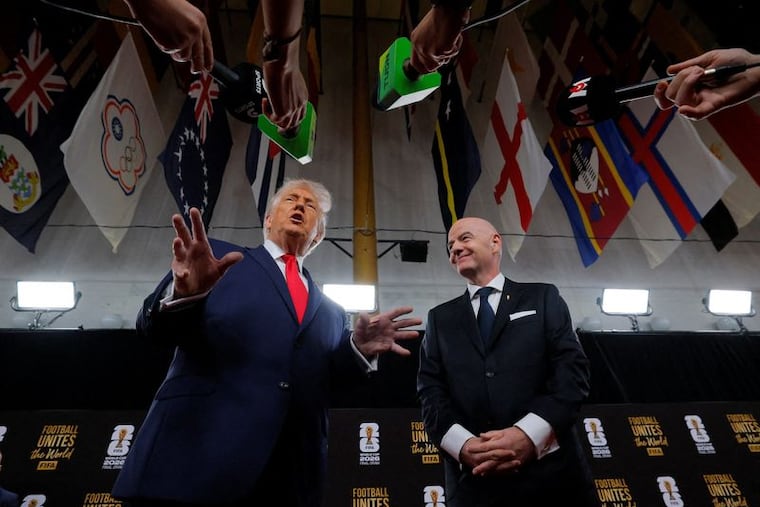
For a country that prides itself on being a nation of immigrants — and for a president who places great stock in ratings, turnout, and global spectacle — the 2026 tournament presents an extraordinary opportunity to show that security and openness can coexist. Full stadiums and strong international attendance would reinforce the image of a confident, welcoming host nation.
If instead, travel hesitancy, empty seats, and visible enforcement dominate the optics, the tournament risks projecting exclusion rather than unity.
That outcome would not only diminish the World Cup’s global appeal but squander a rare moment of soft power that no amount of security planning alone can restore.
Khalid Sayed is the leader of the opposition for the African National Congress in the Western Cape Provincial Parliament in South Africa, now serving his second term. A former provincial leader of the ANC Youth League, he is an activist committed to social cohesion and democratic renewal in a postapartheid society.