‘Vectors of displeasure’ are closing in on Pete Hegseth
The controversy, confrontation, and chaos the “secretary of war” has brought to the Pentagon are rapidly catching up with him, writes a retired U.S. Army lieutenant colonel.
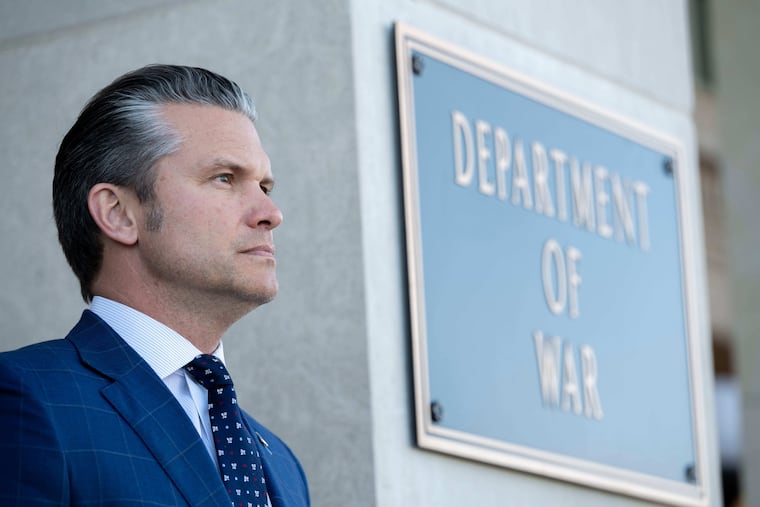
Pete Hegseth will not be the secretary of defense much longer. Hegseth might well deserve to be the president’s fall guy for a war that is going sideways, but to focus his dismissal on that would be a mistake. It would ignore the fundamental and institutional dimensions of the issue — the fact that he should never have been nominated for the post in the first place, let alone confirmed.
Hegseth’s incompetence was evident from the get-go. In what we might now call “normal times,” he should have been fired just two months into his tenure for his role in “Signalgate,” when it was revealed that senior administration officials were exchanging texts about imminent airstrikes against the Houthis in Yemen on Signal. Despite the troubling things this egregious breach signaled to America’s allies (with whom we share sensitive intelligence), Hegseth survived. Since then, he has run the Pentagon by the “Three C’s”: controversy, confrontation, and chaos.
Hegseth’s exit will be the result of three disparate but rapidly converging “vectors of displeasure,” emanating from within the Pentagon, from Capitol Hill, and from the defense ministries of NATO.
The Pentagon: The “institutional exhaustion” vector. Surely senior uniformed leaders have long tired of Hegseth and his purge of senior officers (over two dozen), the latest of which included Gen. Randy George, the Army chief of staff (anticipate that the next general fired will be from the Judge Advocate General’s (JAG) Corps over problematic targeting decisions); his over-the-top “Hooah” posturing and “War Department” and military base renaming nonsense; his obsessions with woke, DEI, and fat generals (there were few happy faces in the auditorium during his borderline bizarre 45-minute address to flag officers in Quantico, Va., last September); threats of polygraphs for alleged leaks; his dismissive and dangerous comments regarding rules of engagement (particularly after a tragic targeting error that reportedly killed 168 Iranian schoolchildren), international human rights law, and his call to show “no quarter” to our enemies; his unconstitutional attempt to muzzle the Pentagon press corps; and his wartime Christian proselytizing, which got the attention of Pope Leo XIV.
Embracing the president’s vendetta with the Ivy League, Hegseth dismantled the department’s decades-long association with the country’s top schools. He struck four officers (two were Black, two were women) from the brigadier general promotion list. He quashed an Army inquiry into the AH-64 Apache helicopter incident with Kid Rock.
These all take a cumulative toll that erodes confidence, morale, discipline, and readiness. With few allies in the Pentagon, leaks that are damning for Hegseth have already started regarding who briefed what to the president in the days leading up to the war. Expect such leaks to continue.
Whomever the president selects to succeed Hegseth needs to be a seasoned professional who is known and trusted by both the U.S. military establishment and our allies.
The Senate: The political “you-gotta-do-something” vector. Republican senators knew that Hegseth was unqualified to lead the U.S. Department of Defense, yet only three put country before party and voted nay to his confirmation. If this war doesn’t end soon with positive outcomes, they will lose seats and the majority. Expect to see a growing chorus from congressional Republicans urging a quicker-than-graceful exit for Hegseth.
NATO: The “reality compels” vector. What will bring things to a head — and soon — will be the twin challenges of opening the Strait of Hormuz and ensuring safe passage through the Bab-el-Mandeb Strait on the Red Sea, to which this regional conflict now threatens to spread.
The president has been begging Europe to join the fight. Though rightly annoyed that Trump started this war without consulting them, NATO allies (perhaps the United Kingdom and France), compelled by concerns related to prolonged economic disruptions, might join a coalition of the wary-but-willing under certain conditions.
First, their warships would operate under national command, not as part of a U.S.-led coalition. Second, they would deploy their warships to ensure freedom of navigation into and through the Red Sea, but would prefer to leave the mess in the Strait of Hormuz for the U.S. Navy to sort out. Finally, they will insist (as much as they can) that a serious person take the reins of the Pentagon.
The way ahead
In terms of a successor, several candidates come to mind. The first is retired Adm. James Stavridis. A former NATO commander, Stavridis previously commanded a carrier strike group in the Persian Gulf in support of Operations Iraqi Freedom and Enduring Freedom. The second is retired Gen. Curtis “Mike” Scapparrotti, the quintessential professional and another former NATO commander. Because repairing relations with NATO is essential, a third candidate might be R. Nicholas Burns. Most recently the U.S. ambassador to China, Burns previously served as U.S. ambassador to NATO.
Whomever the president selects to succeed Hegseth needs to be a seasoned professional who is known and trusted by both the U.S. military establishment and our allies. Strong bipartisan support in, and swift confirmation by, the Senate will be essential.
Lessons learned
Many lessons may be gleaned from all of this. Among them are these:
Competence matters.
Congressional oversight and Senate confirmations matter.
Confidence in our senior leaders matters.
In other words, the other “Three C’s.” Pretty basic stuff.
Meanwhile, with the NATO alliance in tatters, the big winner is Vladimir Putin.
Yes, sadly, it’s “Russia, Russia, Russia!”
Thomas J. Raleigh is a retired U.S. Army lieutenant colonel who served in the infantry, the Defense Intelligence Agency, and as a State Department strategic planner at the U.S. Embassy in Baghdad.