With kora and words, West Philly stands with West African detainees
In an event infused with both urgency and tenderness, West Philly community and Reclaim members gathered to write letters to West African immigrant neighbors detained by ICE.
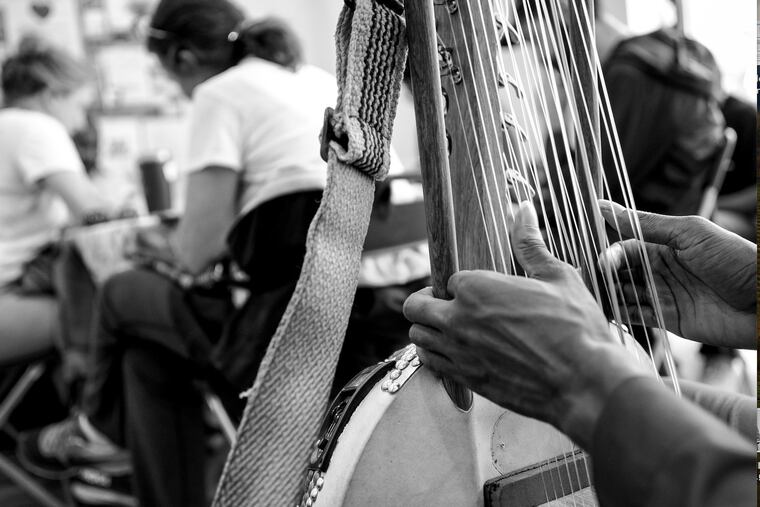
This past Sunday, at a special West Philadelphia letter-writing event, live kora music filled the room where community members gathered to pen letters of support to detained neighbors.
Played by Youba Cissokho, a 72nd-generation master musician of the kora, a guitar-like instrument with 21 strings that was developed in West Africa, the lilting sounds of the music carried with them centuries of history. In West Africa, where the detained neighbors originate, the griot is not only a musician but a living archive; a keeper of memory who recounts the struggles and triumphs of a people. Cissokho brought that tradition to the small space where we had gathered.
His notes rose and fell like a prayer, grounding us for the work ahead.
The event, hosted by Marcie J. Wood and organized in affiliation with Reclaim Philadelphia’s West/Southwest Neighborhood branch, was infused with both urgency and tenderness. With Cissokho’s kora music surrounding us, neighbors and community members sat down to write letters of support — in English, French, and Fulani — to Yero, a beloved community member who worked and lived in West Philadelphia before being unexpectedly detained by U.S. Immigration and Customs Enforcement during his annual check-in.
We wrote to other detained West African community members, as well.
Despite the growing number of West African detainees, their struggles are rarely the focus of stories on the immigration crisis.
Many of these detainees are asylum-seekers from Mauritania, a country that abolished slavery only in 1981. There, a lighter-skinned Arab-Berber elite continues to dominate darker-skinned sub-Saharan groups, including the community to which Yero belongs.
Because Yero resisted the racist power structure in Mauritania, he became a target of that very system. His outspokenness left him vulnerable to persecution, forcing him to flee his homeland in search of safety.
His act of resistance against this system mirrors the tradition of American activism, where people have long risen against injustice.
For some older Black American participants, who recalled their own journeys, or those of their parents, fleeing the violence of the Jim Crow South during the Great Migration when millions left in search of safety and opportunity in the North, the act of writing was not abstract solidarity, but something shaped by lived memory.
Whether crossing internal borders or national ones, the experiences echo each other. Having also endured the devastation of mass incarceration, which has long separated Black families and destabilized entire neighborhoods, many of the diverse group of participants — from longtime West Philadelphians to recent arrivals — felt a deep empathy for ICE detainees and their families, who now face the same rupture of family bonds.
This intergenerational, intercultural presence gave the room a rare power.
The music of the kora, the cadence of shared stories, the rustle of paper as letters took shape, the art-making — it all combined into something greater than any single act. It was a chorus of solidarity, saying to Yero and others detained: You are not forgotten, you are ours.
The most moving moment came when I got a call from Yero at the detention center. I passed the phone to Yero’s uncle, who was at the letter-writing event with us. In Yero’s response, we could hear the shock and emotion of being greeted in Fulani by someone beloved and familiar.
And as his uncle then translated for the room, Yero thanked everyone for the support he had received. The room fell into silence, and tears rolled as he told us he and the other West African detainees were deeply touched by the simple act of strangers writing to them.
What might seem small, like a few pages of ink and a handful of envelopes, was, for them, a lifeline.
As the two-hour event drew to a close, people lingered. Conversations spilled over onto the sidewalk. Some asked how they could do more: volunteer, donate, bring others into the work.
Others shared their own stories of migration.
What began as a letter-writing gathering became something larger: a reaffirmation of community. Through words and music, we reached across walls and razor wire, reminding our detained neighbors that they are not forgotten, and that they are very much a part of us.
As the last notes of the kora faded, I thought of Cissokho’s role as a griot: a witness, a keeper of memory, a bridge across generations.
At that Sunday event, all of us became griots in our own right. Together, we carried forward the story of resistance, dignity, and care. And we promised, with our letters and other actions, to keep telling it.
Octavia McBride-Ahebee is a Philadelphia-based author, poet, and educator who spent many years living in the Ivory Coast.