Palestinian Americans silenced at N.J. Statehouse. Is your free speech next?
Enshrining the conservative-backed IHRA into state law would empower the government to decide whose perspectives are valid and whose can be ignored.
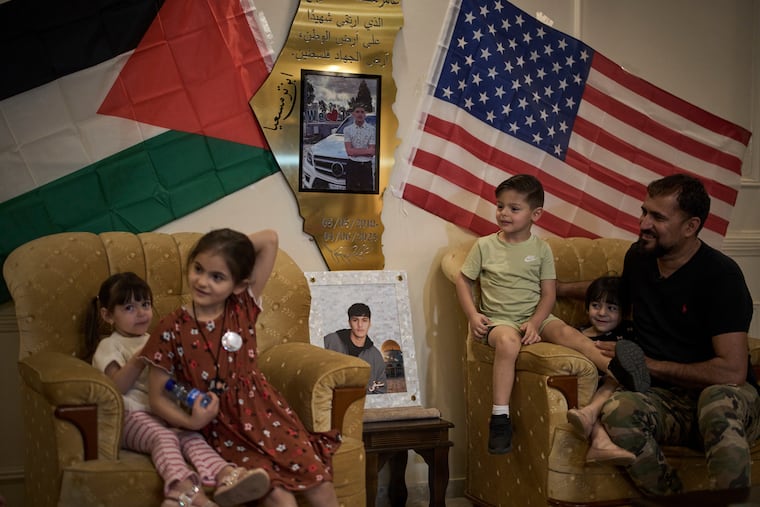
Amer Rabee, a 14-year-old Palestinian American from Saddle Brook, N.J., was shot and killed by the Israeli military this April.
In July, his grieving brother, Mehdi, waited for hours in an overflow room at the Statehouse in Trenton to testify against a bill to adopt the controversial International Holocaust Remembrance Alliance (IHRA) definition of antisemitism. He explained that restricting criticism of Israel would suppress his family’s ability to seek justice.
The presiding lawmaker cut him off mid-testimony and told him to “stay on the bill.”
How would you feel if your representatives silenced your plea for justice?
I previously served in the New Jersey General Assembly and on the committee considering this legislation. I returned to Trenton to testify because IHRA poses a grave risk to free speech and academic freedom at a moment when students like Rümeysa Öztürk are being arrested, immigrant communities face detention, and federal authorities plan to classify what they define as “anti-Americanism, anti-capitalism, and anti-Christianity” speech as a national security threat.
Institutional hostility
As one of the first Muslim Americans to serve in the New Jersey Legislature, I know institutions can be hostile to minority communities.
Yet, nothing prepared me to see grieving Palestinian Americans and allies systematically discriminated against by their own elected representatives. This is the danger of enshrining IHRA into law: It empowers the government to decide whose perspectives are valid and whose grief can be ignored.
The IHRA definition, introduced in the U.S. by a 2019 Trump executive order, has been widely criticized by the American Civil Liberties Union, legal scholars, and human rights advocates for conflating criticism of Israeli policy with antisemitism. It chills the speech of Palestinians, Arabs, Muslims, Jews, and allies who oppose Israeli state violence. Moreover, there are no legislated definitions for anti-Black, anti-immigrant, or anti-LBGTQ hate. Alternative frameworks, like the “New Jersey Statement,” address antisemitism without conflating the Jewish community with Israel.
Champions of IHRA include the Heritage Foundation, the Trump administration, and Israeli Prime Minister Benjamin Netanyahu.
Controversial support
In New Jersey, some sponsors have faced controversy. Assemblyman Gary Schaer, the prime sponsor, was forced to fire his chief of staff for anti-Black, anti-Palestinian, misogynistic, and anti-Muslim statements.
Assemblywoman Melinda Kane invoked IHRA to shut down a preapproved student walkout in Camden County, claiming the phrases “Free Gaza” and “Stop Bombing Gaza” are antisemitic. Assemblyman Roy Freiman reportedly sent police to a pro-Palestine activist’s home for expressing interest in running against him.
These are not hypotheticals. IHRA will give legal force to discrimination.
Public hearings are meant to allow residents equal opportunity to testify. I witnessed the opposite. Supporters of IHRA were given advance notice of a room change and priority seating. Critics, many of them people of color, were told seats were reserved and were relegated to overflow rooms.
What happened in Trenton is a preview of how speech in support of Palestinians could be stifled nationwide.
The Rabee family was denied entry into the main chamber even as seats sat empty for hours. Mehdi Rabee ultimately waited more than seven hours with only an audio feed before being allowed to speak.
When clergy, teachers, journalists, and scholars testified that the bill would stifle discussion of human rights violations in Palestine, they were heckled and cut short. Even Holocaust and genocide studies professor Raz Segal and Pulitzer Prize-winning journalist Chris Hedges were cut off mid-testimony by the chair.
Despite the hostility, Rabee ended his testimony with grace: “In remembrance of my brother who is now in heaven, thank you.”
Some supporters responded, “We see you, and we love you.”
The chair reprimanded the audience and slashed speaking time for the remaining witnesses to one minute. This disproportionately impacted more than 250 people who had signed up to oppose IHRA, many of whom had not yet testified.
What happened in Trenton is a preview of how speech in support of Palestinians could be stifled nationwide.
A moral obligation
Combating antisemitism is a moral obligation, as is confronting anti-Palestinian racism, anti-Muslim bigotry, and all forms of hate. Silencing Palestinians, Muslims, Jews, and allies who oppose Israeli policy does not combat prejudice.
The Rabee family’s ordeal is a warning. If lawmakers can suppress a grieving family, they can silence any one of us. Laws that curb dissent on Israel will be used to penalize other perspectives disfavored by those in power. Already, scholars are fleeing the country due to threats.
At this critical moment, lawmakers must reject censorship and defend every person’s right to speak freely.
Sadaf Jaffer is a former New Jersey assemblywoman and former mayor of Montgomery Township. She was the first Muslim woman to serve as mayor of a municipality in the United States and in the first cohort of Muslim Americans elected to the New Jersey Legislature.