I was there when ICE stormed Gigante. I can attest to the raid’s traumatic aftermath.
Those who support ICE's actions ignore the fact that many of the people now being detained have existing asylum cases or green-card applications. Others have seen their legal statuses stripped away.
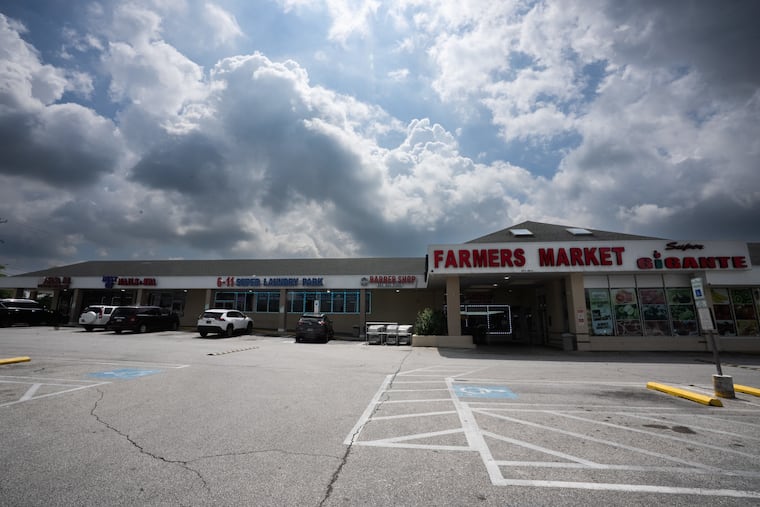
I was present for the recent U.S. Immigration and Customs Enforcement raid on the Gigante market near Norristown.
Twenty masked officers dressed in full body armor with heavy weaponry in their hands stood outside, creating a perimeter, while their colleagues stormed the building, supposedly to enact a warrant for someone on tax evasion.
Instead, looking like they were busting up a terrorist cell, they charged in and arrested “collateral” detainees wielding lettuce.
To say the community was terrorized is an understatement. Fourteen people — none of whom had an outstanding arrest or warrant — were snatched from their jobs and disappeared into the ICE detention system.
A few days later, I sat in the offices of Unides Para Servir Norristown listening to the firsthand stories of those left behind and the secondhand stories of those taken, who agreed to share their experiences here if identified only by their initials.
M.A. didn’t hear from her husband for 36 hours, and only learned of his fate when he called to tell her he had been deported to Mexico.
B.A., frantic to find her husband, called everyone she knew, including lawyers, politicians, and the press. She eventually found him in the ICE system, only to learn there was no opportunity for bail, and she would have to make do — caring for her two children, paying for a lawyer, arguing his case — on her own.
In another case that took place a few days before the Gigante raid, ICE officers stopped a car looking for a particular person who, they claimed, had an outstanding warrant for a crime. They took A.V.’s husband, who happened to have a similar name. They didn’t bother to check if they had the right guy. The ICE agents eventually acknowledged their mistake, but the unfortunate person remains in their custody. And the guy they were actually looking for? He had served his time for the crime he was convicted of and was out on parole.
In another case, R.D.’s cousin has a U Visa — a special permit to be in the United States while assisting the authorities with a prosecution or to solve a crime — and is in his third month of detention. He has a clean record, a pending asylum case, and has yet to meet the child who was born to his partner shortly after his detention. No one can tell his family why he is in detention.
Once in the system, those who are detained get transferred from one facility to another, often without explanation or preparation. They may end up far from home — in Texas or Louisiana. Or, like many from the Norristown area, at the largest immigrant detention center in the state, the 1,800-bed Moshannon Valley Processing Center in Philipsburg, Pa., where an ICE detainee was recently found dead by hanging.
Officials at Moshannon — a facility that a report by a Temple University legal clinic called “inhumane and dangerous” — have been accused of overusing solitary confinement and not providing detainees with adequate access to medical care and legal representation. With no chance for bail, detainees languish at Moshannon, waiting, sometimes for a few weeks, sometimes for as much as nine months.
All the while, they and their families are in limbo, scrambling to make up for lost income, to pay for lawyers, and to make deposits into the commissary accounts that allow them to purchase the necessities the facility refuses to supply.
Another of R.D.’s family members, who was detained and then released, gave her receipts for many of the items. It costs 35 cents to send a text, $11 for the ear buds they are required to buy to use any available tablets, $4.20 for a pair of boxers if they have the desire to wear underwear, $1.55 for a bag of sardines to supplement the meager protein and nearly inedible food provided by the facility’s kitchens.
And detainees said that the whole time they are there, the guards taunt them with threats of sexual abuse and worse. If detainees complain, they might be pepper-sprayed and sent to the “hole.” If one person complains, the entire cell may be pepper-sprayed and threatened with solitary confinement. One former detainee, A.L., received a phone call from those still inside reporting this exact scenario recently at Moshannon.
A.V.’s partner also told her that every night, in the wee hours of the morning, the guards come around asking if anyone wants to sign the papers and leave, or, as the Trump administration describes it, “self-deport.”
When the goal is self-deportation, cruelty and capriciousness become an art form. This isn’t about justice. It’s not even about protection and safety. It is simply about eliminating as many people in the shortest time possible. We have words for this system: concentration camps, roundups, disappearances.
We claim to be a country of laws, of due process. The Fifth and 14th Amendments promise due process for all persons — not only citizens, not only white people, but all persons in the land. We claim to care about human and civil rights, but these things are happening right under our noses.
And yes, the immigration system has been broken for decades.
Since the Chinese Exclusion Act of 1882, we have been finding ever more creative ways to make it harder for some people to get here than others, and even more difficult for some people to stay.
Deportations have happened under both Democratic and Republican administrations. But the level of glee and enjoyment among those enforcing these policies, the outrageous investment in a detention and deportation infrastructure this administration is making, has made this an obsession of unfathomable cruelty and injustice.
Many of those who support this so-called crackdown on illegal immigration say, “If only they came the right way, the legal way” — completely ignoring the fact that many of the people now being detained have existing asylum cases or green-card applications in process. Or that they are here as refugees from a natural or political disaster under Temporary Protected Status, or as international students, only to have that legally defined status ripped away overnight with no warning and no options.
No one is benefiting from this system — except, of course, the shareholders of CoreCivic and the GEO Group, the two primary corporations that operate the private detention centers across the country under contract with ICE. And, of course, the Donald Trump lackeys who are beholden to them.
The GEO Group reportedly earns $3 million per month at the Moshannon facility, and that’s before the proceeds from the exploitative commissary are added in.
With expansions and new facilities planned in almost every state, and significant recruitment efforts to hire tens of thousands more ICE agents and enforcement removal officers, there is much more money to be made. But only if those beds can be kept full with more and more detained people whose very bodies grease the wheels of this system.
With an opportunity like that, concepts such as due process, fairness, and human dignity can only be seen as obstacles to be overcome.
The United States has always been good at building. Only now, we are building a massive detention/deportation industrial complex that has, at its heart, cruelty for profit.
We should be ashamed.
Rabbi Elyse Wechterman is a local immigrant activist and member of HIAS’s Rabbinic Advisory Council. A statewide coalition of activist and immigrant advocacy organizations is holding a protest in Philipsburg, Pa., near the Moshannon detention center this Sunday from 2 to 4 p.m. to convince the Clearfield County Commissioners to end its contract with the GEO Group, which operates the Moshannon facility. More information here.