On immigration, Trump doesn’t have a copyright on cruelty
On both sides of the Atlantic, migrants are regarded as a problem at best, a danger to national security at worst, writes German journalist Adrian Schulz.
Detention camps, violent rhetoric, physical harm, deportations to third-party countries under brutal regimes — Donald Trump did not invent the playbook on callousness toward immigrants.
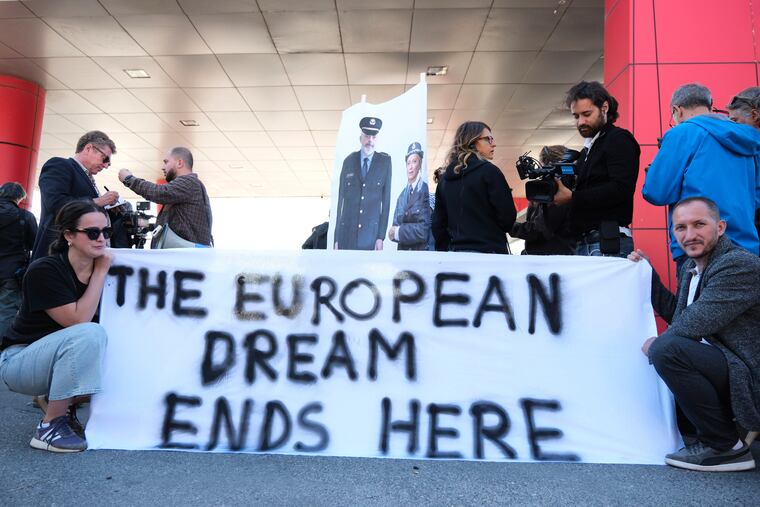
The European Union, winner of the 2012 Nobel Peace Prize, got there ahead of him.
As I read the news about the U.S. government’s continuing assault on people whose sole fault is not having the right documents to legally live in a country that is otherwise happy to exploit their labor, I also follow the German debate around the 10th anniversary of the so-called refugee crisis. In 2015, more than a million people came to Germany seeking refuge, many of them fleeing from war-torn Syria.
What I see is not so different. On both sides of the Atlantic, migrants are regarded as a problem at best, a danger to national security at worst. Trump has no copyright on cruelty. Europeans just put on a friendlier face.
Vanished optimism
The decision of then-Chancellor Angela Merkel not to close the borders in 2015 is seen today by many as a cardinal sin that fundamentally changed the German political landscape, leading to the rise of the far-right Alternative für Deutschland party, known as the AfD. It came in second place in the recent federal elections.
Of course, it remains unclear how the 500-mile border with Austria should have been completely “closed,” a gentler word perhaps for militarized. “The options were, we take them in, or we try … to edge them off, perhaps with water cannons or some sort of violence,” Merkel said in a recent TV documentary.
She chose the former. Her phrase, “Wir schaffen das,” or “We can make it,” endeared her to liberals and outraged conservatives, but for a short moment, most Germans celebrated a Willkommenskultur, a culture of welcoming. People brought truckloads of stuffed animals to train stations where the refugee families arrived.
The optimism soon vanished, though. As in other European countries, the debate started to focus on radically limiting the number of asylum-seekers. The rhetoric became hostile.
Conservative politicians called out supposed “asylum tourism.” Former Interior Minister Horst Seehofer noted with glee that on his 69th birthday, 69 Afghans were deported.
The efforts were not merely rhetorical. The budget of the European border patrol agency Frontex skyrocketed from $7 million in 2005 to $133 million in 2015. Today, it stands at more than $1 billion.
The abuses by U.S. Immigration and Customs Enforcement agents, many of them caught on video, mimic those by European officers. In more than a dozen documented cases, Frontex was involved in pushing back migrants into the Aegean Sea between Greece and Turkey. The agency put immigrants in “life-threatening situations on the open sea, left adrift on inflatable vessels without engines until the Turkish Coast Guard picked them up,” as detailed by the journalism nonprofit Lighthouse Reports in 2022.
That same year, former British Prime Minister Boris Johnson planned to deport and relocate asylum-seekers permanently to Rwanda, even if their cases were approved. He was stopped by a judge. Italy’s prime minister, Giorgia Meloni, now runs a camp in Albania whose construction cost almost $85,000 per bed.
In Germany, Chancellor Friedrich Merz, elected in February, promised a pivot in migration policies. Deportations to Afghanistan had already resumed in 2024. Interior Minister Alexander Dobrindt recently said he wants to talk directly to the Taliban to ease the process. The coalition also aims to start deporting rejected asylum-seekers to Syria, now home to a government under a former Salafist rebel commander.
Overlooked
I don’t want to minimize the problems that do exist with immigration. The war in Syria was not the last. Since Russia’s invasion of Ukraine in 2022, 1.3 million Ukrainians now live in Germany. One-third of cities and counties said in late 2024 that they are “at a limit” when it comes to providing support for refugees; 5% saw themselves in an “emergency mode.”
Ten years after Merkel’s “We can make it,” that spirit is gone. In September 2015, only one in three Germans said the country “should take in fewer refugees”; in January, two in three agreed.
Key to that change in attitudes is a media environment in which news of immigrants failing to integrate garners much more attention than their economic and cultural contributions. Also, while most migrants are law-abiding, acts of violence committed by immigrants have shocked the country — and contributed to a general suspicion toward them. In a self-fulfilling prophecy, the rise of the far-right contributes to a climate in which journalists and politicians would rather talk extensively about the dangers of migration than risk being accused of avoiding the topic.
Merkel’s border policies made her “the AfD’s midwife,” according to political journalist Robin Alexander, but it was the degree to which the mainstream legitimized the far-right’s talking points that has cemented its hold on German politics.
In this difficult environment, something essential is lost: More than 32,000 people have died or disappeared since 2014 attempting to cross the Mediterranean Sea, according to the United Nations’ Missing Migrants Project. The vast majority drowned.
One of them was 2-year-old Alan Kurdi. The photo of his lifeless body, washed ashore on a Turkish beach after a failed boat passage to Greece, made worldwide headlines in September 2015.
Ten years later, what is widely remembered and frowned upon is Merkel’s promise, not the death of a toddler on Europe’s doorstep.
What happened to him should never happen again. Yet, the only thing we seem to learn — in the U.S. and Europe — is the lessons in cruelty.
Adrian Schulz is a journalist with Der Tagesspiegel in Berlin and an Arthur F. Burns fellow at The Inquirer.