The 5 principles Trump should have considered before attacking Iran
Lacking a definitive “end” for the war prior to beginning the conflict, the unanticipated actions by Iran led to U.S. threats that, if executed, would break a fifth principle of war: the rule of law.
The Iranian conflict spotlights five principles a U.S. commander in chief should always consider before deciding to use his military:
Militaries can stop a problem; they can’t fix a problem.
Know how it will end before you begin.
Heed the words of the traveling salesman in The Music Man: “You gotta know the territory.”
Take the eight-year Iraq War, with similar goals of “regime change” and removal of weapons of mass destruction (WMD) as in today’s Iran conflict. Finding no WMD, the elimination of Saddam Hussein stopped him, but also created Iraq’s Islamic State that soon metastasized throughout the Middle East and into Africa.
Regrettably, it also freed up Saddam’s ardent foe — Iran — to spur terrorism throughout the region without having “fixed” Iraq.
The fourth principle is: The enemy always gets a vote.
» READ MORE: Iran looks likely to win strategically despite U.S. tactical military gains | Opinion
Since this war is a “home game” for Iran, it’s proved adroit at using the region’s “territory” for asymmetrical advantage. It kept the U.S. Navy outside — and Middle East oil and gas inside — the Persian Gulf. Initially, this was effected by 25 undetectable minisubmarines inside of — and more than 1,000 anti-ship cruise missiles alongside — the Gulf’s coast.
In addition, there was Iran’s devastating economic weapon: the threat to lay mines easily using fishing boats. Our minesweeping capability is hampered — we have only four outdated surface minesweepers, a squadron of 40-year-old helicopters in the process of being decommissioned, and a few unmanned vehicles.
Other asymmetric weaponry includes drones — low, slow, and immensely plentiful — causing damage to U.S. bases, weapon systems, and troops, as well as to the infrastructure of regional partners that included oil and gas facilities.
Iran’s territory — four times the size of Iraq’s — permits a wide dispersion of its sophisticated weapon systems, creating a mandate for more U.S. air sorties and munitions.
The efficiency and effectiveness of strikes are further complicated by regional nations not allowing the use of U.S. bases in their territories, nor of their airspace to fly through for strikes (a few recently shifted to a minimal level of support).
However, porous air defense systems resulted in U.S. troops and their dependents being sheltered off base for safety, while the failure to provide our regional partners a fully integrated and shared picture of the aerial battle space resulted in their misidentifying and shooting down American aircraft.
All this forced an unanticipated redeployment of the U.S. military’s already depleted inventories of critical munitions and defensive air systems from Europe and East Asia to the Middle East.
There are reportedly only 425 JASSM-ER air-to-surface extended range missiles remaining worldwide. If JASSM-ER production is ramped up by another 700 missiles per year, its inventories may be replenished by 2028.
However, for Patriot air defense missiles — after repeated 600-missile single salvos by Iran, each consuming up to four years of missile production in a single day — even tripling production to 2,000 missiles annually means inventories will be replenished only sometime in 2032-2035.
For THAAD air defense interceptors, it will take three to eight years just to replace the stocks fired in the last few months.
And after firing over 850 Tomahawk cruise missiles, total replenishment will take at least five years.
Unfortunately, all require what’s known as heavy rare-earth elements (HREE) that are 99.9% controlled by China, which also manufactures 95% of HREE magnets — the sale of all of which it now forbids to the U.S. military, even via other nations.
» READ MORE: Don’t let the battlefield optics fool you: America’s overall national security has been harmed | Opinion
America’s production of the HREE magnets will begin only after 2030. Meanwhile, for these and numerous other munitions, aircraft, ships, and ground vehicles, the U.S. military breaks the most basic of military axioms: Don’t bring an unloaded gun to the fight.
Since the enemy gets a vote, the commander in chief must best assess the challenges presented by the “territory” of the battle, which mandates setting the specific end state for the war. Otherwise, piss-poor planning will mean piss-poor execution.
Unfortunately, the “end” has consistently shifted from a “new and better deal” to global peace and threatened elimination … then total military destruction … a popular uprising and regime change … finally, a regional stability and negotiation for a new “real agreement.” Each is a different end, and each requires a different plan and resources.
» READ MORE: Trump’s war on Iran is already a muddled mess | Editorial
Lacking a definitive end for the war prior to beginning the conflict, the unanticipated “voting” by Iran apparently led to U.S. threats that, if executed, would break a fifth principle of war: the rule of law.
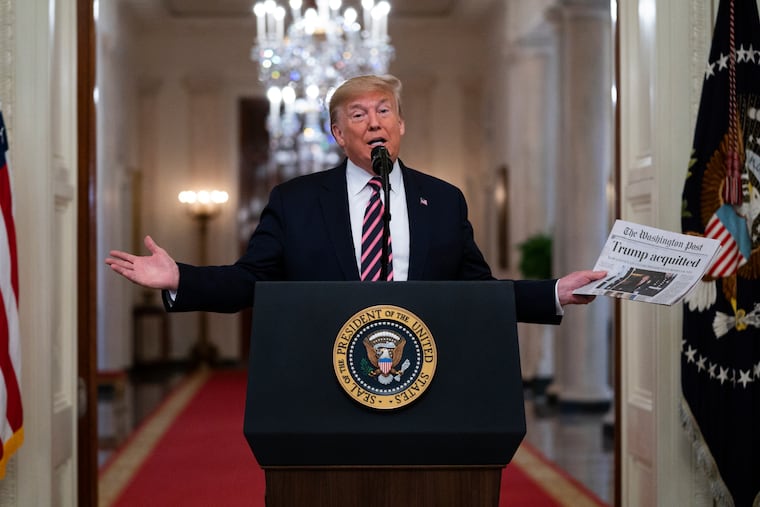
The commander in chief threatened intentional targeting of civilian infrastructure and the obliteration of all Iranian “electric generating plants, oil wells and Kharg Island (and possibly all desalinization plants!).” Later threats to bomb Iran back to the Stone Age, and “a whole civilization will die tonight, never to be brought back again,” were promised to end the war.
The “law of war” that the United States helped craft after World War II — available in the Defense Department’s Law of War Manual — makes clear that civilian infrastructure can lose its protection only if it is used by the enemy for military purposes, and its destruction “offers a definite military advantage.” But even then, it can still only be attacked if, after analysis, the “concrete and direct military advantage anticipated” outweighs the civilian suffering that will result.
The most valued asset in international relations is trust.
An instruction from the chairman of the Joint Chiefs of Staff sets down the process of determining the collateral damage when striking various civilian targets — it’s why the State Department determined in 2022 that Russia had committed war crimes in attacking Ukrainian critical infrastructure. As would we, if the commander in chief’s threats were followed through.
As for our valued allies who chose not to support the Iranian conflict?
The most valued asset in international relations is trust. Because of that, America and its allies successfully removed nuclear weapons or ended nuclear weapon programs by signing agreements with Libya, South Africa, Ukraine, Belarus, Kazakhstan, Taiwan, South Korea, Argentina, Brazil — and Iran.
The entire European Union was our cosignatory of the nuclear accord that removed 98% of Iran’s enriched uranium — with 24/7 visual, sound, and heat surveillance of its facilities so it could not cheat.
Diplomacy worked in the long term for each of the aforementioned nuclear “wannabes” because of trust, except for the Iranian nuclear accord — but only because America broke its word during President Donald Trump’s first administration by pulling out of it. The EU did not.
Moreover, as America makes clear that we are “headed home,” telling bruised allies left behind that “it’s a wrap” for our alliances with them, China is unchecked as it exploits its freedom to impose its illiberal values of “might makes right” through its expanding Sino-centric institutions.
And we now mirror — in Iran’s and Venezuela’s interventions — the stated rationale of China for its readiness to forcefully take Taiwan by 2027: “regime change.”
Joe Sestak is a former Navy vice admiral, a former U.S. representative for Pennsylvania’s 7th Congressional District, who served on the House Armed Services Committee, and was director for defense policy on the National Security Council staff.