Between Philadelphia and Ireland, a new book asks: Which side of the ocean counts as home?
The conflict in Northern Ireland might have gone very differently had it not been for a small, ragtag band of carpenters, family men, and fugitives in Philadelphia.
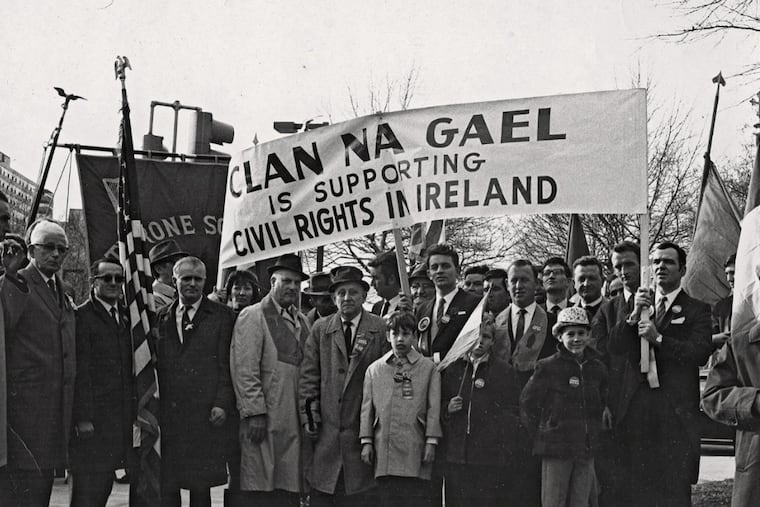
Three years ago, I was in a reporting stalemate at a Jenkintown pub that might’ve stopped this op-ed from being written. Tucked in the corner of the MacSwiney Club, I was making a high-stakes pitch to a group of Irish Americans in Philadelphia. In the 1970s, the pub in which we sat had been the scene of one of the most sweeping gun-smuggling rings in America. It was a little-known story, lost to history, and I had come before them with a proposal: I wanted to write about it.
The group was cautious but amenable — all except for one woman, who eyed me suspiciously. She wanted to see ID. She quizzed me on my family connections. She didn’t know me, she certainly didn’t trust me, and didn’t want me sniffing around 50-year-old stories. It would be a bellwether of things to come.
Skepticism is part of this city’s DNA, forged from centuries of being the overlooked underdog, eclipsed by the power of Washington, D.C., and the sweep of New York. Rather than wallow in self-pity, Philadelphia is gleefully petulant and righteously indignant. No one likes us. We don’t care. Now who the hell are you?
There’s an inherent sussing out that happens when a stranger appears, claiming to be of this place. Where’d you go to school, locals ask. Where’s your family from? What parish? It’s a line of inquiry that unmasks impostors, outed by a slip of pronunciation or missed colloquialism. How quickly someone “from Philly” is forced to admit they’re actually from outside Philly, that nebulous descriptor that swallows geography up to two hours away.
Admittedly, I am the meme. Living now on the island of Ireland, folks often ask where I’m from, and I almost always say Philadelphia. I wouldn’t dare claim such bona fides in a room of Philadelphians. To them, I’m from “near Reading,” and the rest doesn’t matter. I’m not from here.
Still, Philadelphia means a lot to me, as a place. It’s where my beloved grandmother grew up, where my mother was born, and where my brother and I both started our own adult lives (my first real bylines were as an intern at the Daily News). In the years since I lived there, the city has become a magical touchstone that lives somewhere between reality and romanticism. I muse at Irish pubs about Citywide Specials. I stay up overnight for the Eagles and search far and wide for transatlantic Yuengling. I remember the pretzels, the personality, the way my mom reverts her “ohs” to “ooehwts” whenever we get south of the Conshy exit.
It’s perhaps the perennial struggle of those who leave the place they’re from. Home stays frozen however we left it, and all of its complicated nuances get usurped by nostalgia. It’s the same emotional struggle at the heart of my book, The Next One Is for You: A True Story of Guns, Country, and the IRA’s Secret American Army, about that little-known group of gunrunners who smuggled hundreds of Armalites from Philadelphia to the Provisional Irish Republican Army in the early 1970s.
This city is a tapestry of immigrant stories. My own history drove me to tell this one, in part because Philadelphia deserves its rightful place in the pantheon of Irish Americana, Boston be damned. Philadelphia is perhaps the most authentically Irish of them all. The city fostered a community of radical rebels in America, many of whom sought safe harbor here as fugitives.
When the Provisional IRA — one of the most formidable guerrilla outfits of the 20th century — sought to first arm itself with American guns in 1969, it did not go to New York or Boston. It went to Philadelphia, where America had started its own rebellion against the British empire so many years before. The city of the underdog picked up the torch, led by an insular group of suburban dads who moonlit as gunrunners.
The men propped up the Provisional IRA at a crucial moment, an effort that almost certainly changed the course of history. Without those Philadelphia men, it’s hard to say what the Troubles — the decades-long sectarian conflict that wracked Northern Ireland until the early 2000s — might have been, or what the Provisional IRA might have become, for better and for worse.
These gunrunning men were Irish, and all of them had fled to Philadelphia to escape British oppression and Ireland’s dismal midcentury economic straits. But even as they took on a sinister mission, they were endlessly wrestling a profound question: Am I Irish or am I American, and can I be both? How far will they go to feel close to home, and what are the moral compromises they make to do so?
While reporting along the Northern Irish border, I faced the same onslaught of questions as I did in that Philadelphia barroom. Who are you? Where’s your family from? Why are you here?
Fair questions, and ones I’m still not sure how to answer. The struggle is universal for anyone who has ever left a place they love. I write this as an immigrant now, having returned to the island my family was forced from more than a century ago. It’s a strange sort of circle in the end. I’m not sure which side of the ocean counts as “home.”
The woman from the pub passed away before she could see the finished book, though she kept tabs on my progress. She remained deeply suspicious, periodically voicing concern I was an undercover cop or federal agent.
We did have a small breakthrough, though. That afternoon in the pub, I eventually stopped her cold with a name: Peter Drumm, my great-grandfather, who had fled to Philadelphia after serving in the Irish Republican Army in the 1920s. The woman didn’t just know the name — she knew the man’s son and daughter-in-law and had lived next to them. She had been neighbors with my own family, all these years.
The next time I visited my great-aunt, I stopped in to say hello. The woman still didn’t trust me. But this time, we slipped into a more familiar cadence. I was no longer a stranger. It’s all this city — all any of us, really — ever wants: to know and be known.
Ali Watkins is a New York Times reporter, a Pulitzer finalist, and the author of “The Next One Is for You: A True Story of Guns, Country, and the IRA’s Secret American Army.” She will be giving a book talk at the Pen and Pencil Club on March 12 at 7 p.m. and at Chester County History Center on March 13 at 6 p.m.