The restaurants that raise us: What a strip mall Chinese restaurant reminded me about family, memory, and time
Some places — like Joe’s Peking Duck House in Marlton — remain standing long enough to witness your life.
This is not an essay about the best Chinese food in New Jersey. Although it could be, because Joe’s Peking Duck House is the GOAT.
This is an essay about the rare places that remain standing long enough to witness your life. Philadelphia lost Bistrot La Minette after 16 years, Pumpkin after 20, Devon Seafood after 25. In South Jersey, the Pop Shop — a Haddon Township institution — closed after decades. In a world where restaurants open and close before you can make them a habit, one that outlasts your childhood is something special.
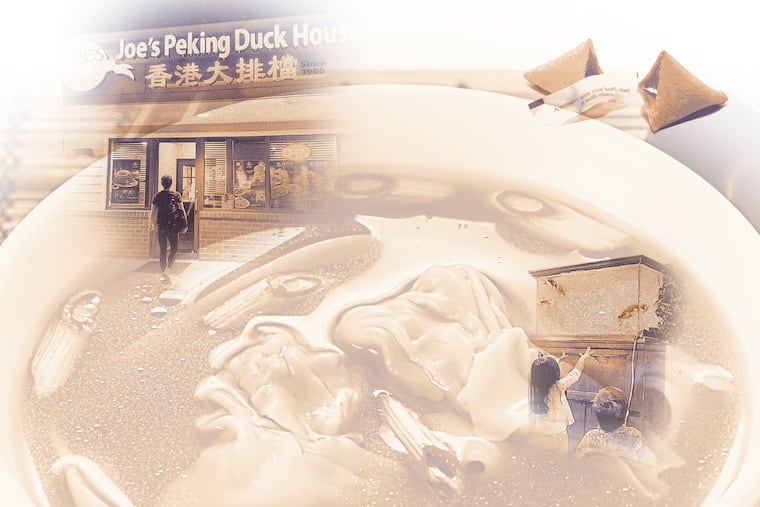
Joe’s Peking Duck House sits in a deeply suburban Marlton strip mall, flanked by a Nothing Bundt Cakes, a dance studio, a mature women’s dress shop, and a nondescript pizza place.
Its green sign with red letters and a cartoonish duck is unassuming. The windows are plastered with glossy photos of dumplings and bowls of long noodles and hanging poultry. There is nothing about it, from the outside, that suggests it might matter, except, maybe, the small “Since 1986” tucked into the sign, quietly insisting it is a relic.
My family stopped there recently on the way back to New York City from my parents’ house, needing dinner before the long, trafficky drive. My children are half-Chinese, and whether it’s cultural or coincidence, they love Chinese food, which means I can count on them to actually eat. Joe’s happens to sit just off the turnpike, so it’s a convenient dinner stop.
Millie and Cooper ran in ahead of us, making a beeline for the enormous fish tank by the entrance. It was Easter Sunday in Cherry Hill, and the restaurant was full of people like us, not egg hunting.
Every time I walk into Joe’s with my children, I have the disorienting feeling that I am entering two timelines at once. Jack, who worked there when I was a kid, now owns the restaurant. My children gobble the fried rice I once ate at their age. And for the length of a meal, it feels like my whole life is sitting at the same table.
We Liebermans first found Joe’s through the Herman family. I went to Hebrew school with Jacob Herman, and our parents carpooled, which is the most suburban Jewish sentence I have ever written. Somewhere along the way, they introduced us to this old-school Cantonese restaurant, and then we just … kept going.
I can still picture the wonton soup arriving in enormous steaming bowls, portioned out tableside. An older man, with the confidence of someone who had done this 10,000 times before, would expertly divide the long egg noodles and shrimp-and-pork-filled wontons into smaller bowls while I practically vibrated waiting for mine.
Even once it landed in front of us, it was too hot to eat, so my sister and I would toss in ice cubes, and then burn our mouths anyway.
My father always loved the duck. Nobody else in the family really ate it except me, which made ordering the half duck slightly impractical, so we usually didn’t. It came as a full set — duck, wonton noodle soup, fried rice, vegetables — meant for two or four.
I was the only one who would help him eat it, pulling apart glossy pieces of crisp, lacquered skin while everyone else reached for spring rolls and fried rice.
The rest of us would happily eat everything else, which meant my dad often didn’t get to order the thing he actually wanted. He didn’t get a lot of chances to do that, with a wife and two daughters.
So sometimes, we ordered it anyway.
Over the years, life has rearranged itself in every direction. Jack, once a familiar face moving through the dining room, became the owner. He became a parent. I became a parent. My parents became grandparents. And somehow, Joe’s stayed exactly where it was, waiting for us to come back and take our places again.
Now I bring my husband and children there, and I watch my kids eat the same fried rice I once inhaled. We order the duck. My son, Cooper, tears into it without hesitation. He and my dad make a good pair.
There is something deeply disorienting about watching your children become regulars in a place where you are still, in some corner of yourself, a child.
At the end of the meal, Jack sets down the bill, entirely in Chinese, along with a plate of orange slices and four fortune cookies. The oranges are always impossibly sweet, firm enough to pull cleanly from the pith, juicy enough to feel like a reward. My husband’s grandparents give us oranges like this, too, and I’m always struck by the seemingly Chinese superpower of selecting perfect citrus.
The world is changing so fast, and it rushes by in milestones and weekends and deadlines and summer camp sign-ups. But sometimes you step into the rare places that don’t change. We tend to imagine our core memories as cinematic things like a sun-drenched beach, a perfect holiday table, a grandmother’s kitchen. But sometimes they’re tucked between a dance studio and a pizza place in suburban New Jersey, their windows crowded with faded photos of dumplings and hanging ducks.
And still, they hold your whole life.
Frani Chung is a Philadelphia-area native who writes about the profound, intersecting truths of motherhood, womanhood, and identity — where they overlap, clash, and redefine us. A mom of two now based in New York City, she balances her work in integrated brand marketing with a relentless pursuit of the perfect bite, an insatiable love for entertainment and pop culture, and the ever-elusive art of staying present. www.franichung.com

Inquirer Opinion Newsletter