The Supreme Court is deciding your future. Pay attention.
Rarely has the high court been charged with ruling on so many cases that could dramatically change the fundamental ways Americans live their everyday lives.
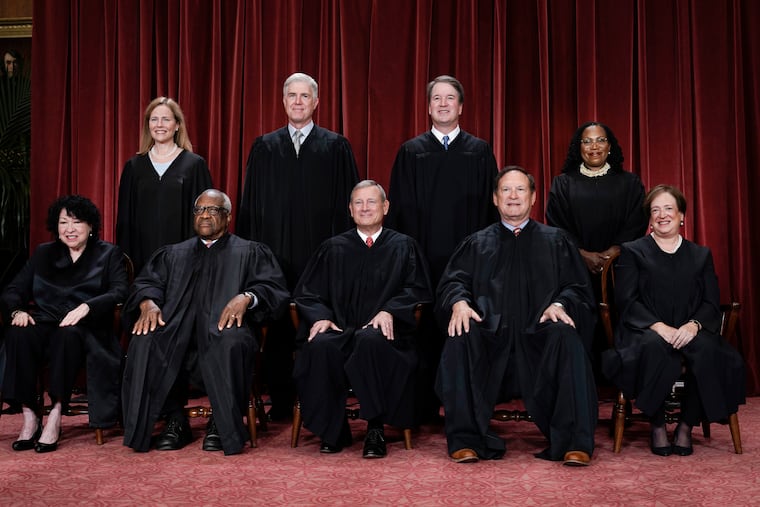
For most Americans, the U.S. Supreme Court occupies a seat on the back burner. We know it is important, but so much of what it does seems unconnected to our daily lives.
Every now and then, it pops up in the news when something major is on the table and briefly grabs our attention — overturning Roe v. Wade and the constitutional right to choose to have an abortion grabbed the headlines, as did throwing out Donald Trump’s tariffs. But, outside of the circles of lawyers, judges, and academics, most of what the court does goes unnoticed. For a brief moment, the nation pays attention. Then the spotlight moves on.
Enduring consequences
Over the next two to three weeks, before the justices depart for their four-month summer recess, the court will issue a series of decisions in cases it has been considering for months. They have listened to the lawyers argue their cases for hours, reviewed thousands of pages of briefs submitted by lawyers, interested organizations, and government officials, and debated among themselves.
Any day now, decisions will be handed down that could alter the legal landscape for decades to come. These cases will affect millions of people, directly and indirectly. These decisions become the law of the land, and their impact will endure for decades. While the court can later reverse its own decisions, it rarely does. So the decisions it makes in the next two to three weeks will endure long after many of us are dead. In 1954, for example, the court’s decision in Brown v. Board of Education finally ended desegregation, 50 years after the same court had infamously approved it in Plessy v. Ferguson.
More recently, in 2022, the court reversed Roe v. Wade, ending a constitutional right to abortion that had been established since 1973.
In short, the decisions it makes in the next couple of weeks are not likely to change for half a century or more. Given what the court is about to decide, all of us have a stake in the outcome.
One of the most pressing issues it is considering is “birthright citizenship.”
President Trump signed an executive order ending automatic citizenship for those born in the United States unless they meet certain conditions, despite the Constitution (in the 14th Amendment) explicitly conferring it to “all persons” born in the United States.
The stakes in this case extend far beyond immigration policy or the end of birthright citizenship.
The issue is not simply whether birth in the United States confers automatic citizenship. More fundamentally, it asks whether a president may effectively amend the Constitution, eviscerating rights and guarantees formerly entrenched in American society, literally with the stroke of a pen.
Any day now, decisions will be handed down that could alter the legal landscape for decades to come.
The Constitution is meant to endure and survive political winds — and it has for 250 years. In that time, aside from the Bill of Rights, there have been only 17 amendments. The Constitution provides a process for changing its provisions. It is purposefully neither quick nor easy. The framers understood that fundamental rights should not fluctuate like a weather vane depending on who occupies the White House. Constitutional rights are meant to endure and survive political winds — and they have for 250 years.
Executive orders signed by the president, any president, are not among the methods the Constitution provides for rewriting its guarantees.
Critical decisions
The decision is critical. If a president’s signature on an executive order can override constitutional guarantees in one area, where does that authority end? What’s next? The right to remain silent? Free speech? The freedom to practice your religion, safe from government interference? The right to counsel? The guarantee of a fair trial? Presidential term limits? Can Trump end the constitutionally mandated two-term limit with his signature?
Free speech is a central issue. Can students be punished for participating in peaceful demonstrations on college campuses because officials disagree with their views? Does freedom of expression apply equally to all viewpoints, or only to favored ones? If the government can silence one unpopular group today, what prevents it from silencing another tomorrow?
Among the issues that will be decided in the next few weeks are whether states can exclude transgender women from participating in female athletic competitions. Earlier, the court addressed whether states may prohibit licensed therapists from discussing certain issues relating to gender identity with their patients — can they prohibit some of it, or all of it, or none of it. The First Amendment won that battle. Surprisingly. But transgender rights are not a favored policy, and the administration is unashamedly hostile to them, and civil liberties advocates are not hopeful.
These are not abstract legal debates. They are questions that go to the heart of citizenship, liberty, equality, and the limits of governmental power.
The court was asked to revisit long-standing Fourth Amendment protections against unreasonable searches and seizures. Under what circumstances may police officers enter a person’s home without a warrant, probable cause, or judicial authorization? How far may a warrant reach before it undermines the constitutional guarantee that people should be secure in their homes?
The Second Amendment and gun control remain among the most active areas of constitutional law. If school shootings and the murder rate are important to us, we need to be paying attention.
Beyond individual rights, the courts are increasingly confronting questions concerning executive power and the structure of the federal government itself. May a president deploy National Guard troops without the consent of state officials? Can federal employees be dismissed without cause? Does the president have the authority to remove senior agency officials at will, or are there constitutional limits on that power?
Shaping lives
The fundamental right to vote is also at stake, as the plethora of decisions already announced on redistricting and voter rights will undoubtedly shape the political landscape. In the next few weeks, the court’s decisions on mail-in ballot restrictions will add to that mix.
These are not abstract legal debates. They are questions that go to the heart of citizenship, liberty, equality, and the limits of governmental power. They will shape lives, influence public policy, and define constitutional rights long after today’s political battles have faded from memory.
The Supreme Court may not dominate our daily conversations, but the decisions it issues in the coming days will touch every American in one way or another. Whether we agree with the outcomes or not, this is one of those moments when paying attention is not merely advisable — it is essential.
Susan Sullivan is a lawyer and professor of constitutional law and politics at Temple University.