Trump lies and stokes fear about ‘roving bands of youth’ in D.C.
The administration’s heavy-handed actions last week are a performative show of force in search of a problem, write Riya Saha Shah and Marsha Levick.

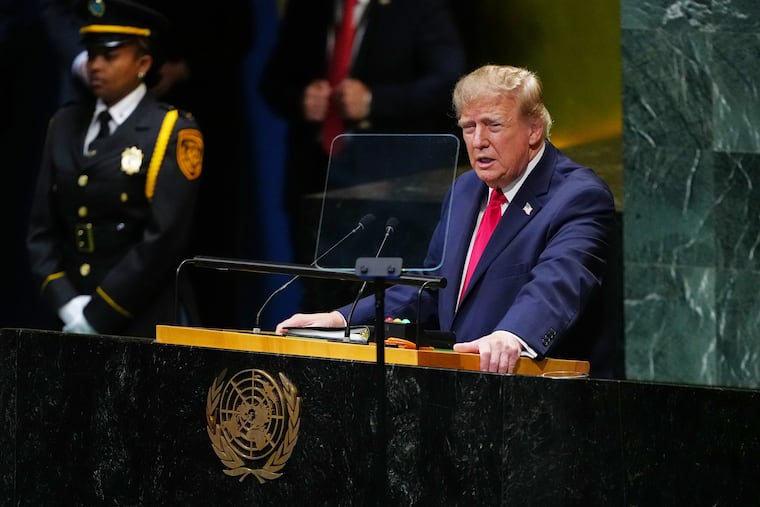
Last week, in a news conference filled with lies and disinformation, President Donald Trump chose to double down on failed policies of the past.
In the face of a steeply declining crime wave, the administration has decided to federalize the D.C. police force and call out the National Guard to patrol the D.C. streets and chase down “roving bands of youth.”
This response stokes fear of young people by calling for the prosecution of more children as adults in criminal court.
We have seen this scenario before. Thirty years ago, researchers falsely predicted we were on the cusp of a violent youth crime wave that would terrorize our communities as we turned the corner on the 21st century.
No sooner had the lie been perpetrated than violent crime — by teens and adults — began a steady decline, year after year, until it reached record lows in 2019, just before the pandemic shutdown.
If we set aside the two years of extraordinary societal disruption and upheaval our communities experienced during the pandemic, the crime rate has continued its downward trend since 1994.
But the effects of that 1990s lie were catastrophic.
Hundreds of thousands of young people were prosecuted as adults and faced the same severe sentences — including the death penalty and life without parole — as their adult counterparts.
For youth who remained in the juvenile legal system, they also faced increased rates of incarceration. And the vast majority of youth who bore the brunt of the ’90s lie were Black and brown.
Fortunately, as the crime rate marched steadily down over the last 25 years, incarceration rates and adult prosecutions of youth followed. The numbers of youth in juvenile correctional settings fell by approximately 75% and states saw substantial savings in closing many of their youth facilities. Youth subject to adult prosecution fell by nearly 80% during the same time period. And yes, all the while crime continued to fall.
We cannot succumb to yet another lie.
The administration’s heavy-handed response last week is a performative show of force in search of a problem. Today, children as young as 15 can be tried as adults under D.C. law for any felony. If convicted, they are subject to adult sanctions.
The call to sweep 14-year-olds into the criminal legal system is contrary to the facts on the ground — and contrary to how the rest of the world deals with young people who commit crimes. Across the world, most countries treat kids as kids, and invest in programs, services, and communities to help all young people — even those who engage in criminal activity — make successful and productive transitions to adulthood.
It is not just the wasteful expenditure of tax dollars that we should care about.
While it is a folly to always think we can incarcerate and arrest our way out of a problem — the United States still has the highest rate of incarceration in the world — it is illogical to jump on that bandwagon when the purported crime wave we think we are addressing is bogus.
And it is not just the wasteful expenditure of tax dollars that we should care about. Research has shown over and over again that kids tried in the adult system have higher recidivism rates than those in the youth justice system, and that extended periods of incarceration for young people are counterproductive, causing more harm and compounding whatever trauma they may already be experiencing.
Research also has established that young people are unsurprisingly prone to making poor, immature decisions as they make their way through adolescence and early adulthood, and that more responsible decision-making begins to take root by the time they reach their mid- to late 20s.
For victims of crime, a downward crime rate offers little solace. But it is important that our elected officials make decisions and policy choices rooted in facts and research rather than their own flawed perceptions and misguided prejudices.
Riya Saha Shah is the CEO of Juvenile Law Center. Marsha Levick is the co-founder and Chief Legal Officer at Juvenile Law Center. Both have decades of experience in the fight for youth rights and justice.