In Delaware, one university president welcomes another to the work of creating opportunities for First State college students
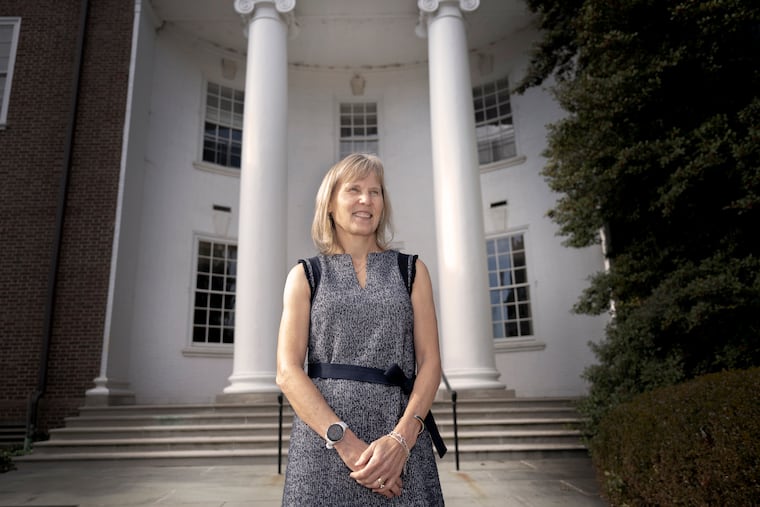
Tony Allen, the president of Delaware State University, praises Laura Carlson, his counterpart at the University of Delaware, for her commitment to “welcome with promise.”
I first set foot on the campus of the University of Delaware as a high school student from William Penn in New Castle through the Forum to Advance Minorities in Engineering — FAME — a program founded in 1976 by African American executives at the DuPont Co. FAME put us on UD’s campus, in UD’s classrooms, doing UD-level work, before we had any reason to believe we belonged there. By the fall of 1988, I enrolled as a first-generation college student with a charge that was clear, even if the path was not: Go to college, get it done, and bring somebody with you.
I went on to earn my doctorate at UD’s Biden School of Public Policy, serve on UD’s board of trustees for eight years, and partner with provost emeritus Dan Rich on the education reform work that became the Wilmington Education Improvement Commission.
That partnership — a UD professor and a UD alumnus, working from different perches on the same problem — was, in some measure, what convinced me to make the career change to Delaware State University, where I serve as president.
All of which is to say: When the University of Delaware inaugurates Laura A. Carlson as its 29th president on Friday, I will be paying very close attention. And I am genuinely encouraged by what I see.
Carlson is a Dartmouth-educated cognitive psychologist who spent 28 years at the University of Notre Dame. Her scholarly life has been devoted to spatial cognition: How we mentally represent the places and objects around us. There is something fitting about that expertise landing at a university in a small state that has always had to think carefully about how it positions itself.
But what distinguishes Carlson is her disposition. She came to UD as provost in 2022, built relationships, listened — genuinely listened — and earned the community’s trust so thoroughly that when the board named her the permanent president in December, it was the first time in 50 years UD had elevated an internal candidate.
She has said publicly that her top value is purpose, and that she wants to lead not with what UD needs from Delaware, but with what Delaware needs from UD. When she says UD should “welcome with promise,” I hear a leader who understands that a great university is measured not only by what it achieves for itself, but by what it makes possible for others.
That conviction matters enormously to me — because the history between our two universities demands it.
In 1890, Congress passed the second Morrill Act. The law required states to either admit Black students to their land-grant colleges or establish separate ones. Delaware chose separation. In 1891, the Delaware College for Colored Students was established on a 95-acre farm south of Dover. That institution became Delaware State University. Our two universities were born from the same federal act and divided by the same failure of moral imagination.
But there is also a history of partnership — imperfect, intermittent, and real. Rich recently shared with me a photograph from the UD “President’s Report” for 1969-70: E.A. Trabant, seated with Luna I. Mishoe of Delaware State College and Paul K. Weatherly of Del Tech, formalizing a voluntary Council of Presidents. They were already developing cooperative programs, including a tripartite teacher education initiative. That was more than half a century ago. The architecture for collaboration is not new. What has been missing, at times, is the will.
Mishoe led Delaware State for 27 years, transforming it from a college of fewer than 400 students into a thriving institution. He fought off efforts to have UD absorb it entirely. When I became DSU’s 12th president in 2020, I succeeded his daughter, Wilma Mishoe — the first woman to hold the role. The thread is unbroken.
Today, real things are being built that would have made Trabant and Mishoe recognize the echo of what they started.
The dual-degree engineering partnership sends DSU students to UD for master’s-level work, a descendant of that 1970 teacher education program.
The competition to build Delaware’s first medical school, with Jefferson and the Philadelphia College of Osteopathic Medicine submitting bids funded by $42.5 million in federal dollars, is an arena where DSU’s health sciences programs in Dover and UD’s research infrastructure in Newark could be transformative together.
Every UD president I have known has expressed a genuine commitment to access and equity. The question has never been intent. The question is whether this moment demands something structural: a partnership that outlasts any single presidency.
I believe Carlson brings that possibility. Her instincts are right. Her intelligence is evident. And her framing — purpose over prestige, service over self-regard — is exactly what Delaware needs from the leader of its largest university.
She is a scholar who studies how people build cognitive maps of where they are and where they might go. I have spent my life trying to expand the map of possibilities for people who look like me. Those commitments are complementary. And in a state as small and as consequential as Delaware, they must be.
President Carlson, welcome to The Green. Welcome to the work. And know that 53 miles south, on a campus whose history is inseparable from your own, we are ready to build something together that neither of us could build alone.
The shoulders upon which we both stand demand nothing less.
Tony Allen is the 12th president of Delaware State University. He earned his bachelor’s and doctoral degrees from the University of Delaware and is a Whitney M. Young Awardee for the Advancing Racial Equality, the National Urban League’s highest honor.