Why I resigned as a trustee of the Library Company of Philadelphia
Ceding the 300-year-old institution to Temple threatens its independence and identity.
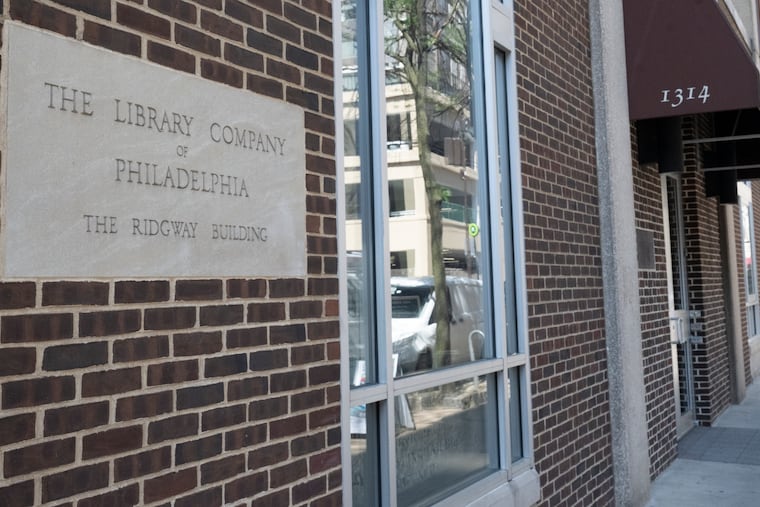
The Library Company of Philadelphia is a national treasure.
Founded in 1731 by Benjamin Franklin and some of his contemporaries, the Library Company has been an important institution throughout its history: In the decades leading up to American independence, in the early years of the new republic, and then during the country’s rise as a global power. Ordinary Philadelphians could borrow books on everything from Greek philosophy to animal husbandry.
The Founding Fathers also consulted its books, which influenced the writing of the U.S. Constitution. Notably, the Library Company served as the nation’s first Library of Congress from 1774 to 1800.
Today, the Library Company is a research library, housing an extraordinary collection of items that were acquired at the time they were published. It is where you go to experience an authentic representation of 18th- and 19th-century material culture.
For example, you can read an original copy of Richard Allen and Absalom Jones’ “Refutation,” a pamphlet the founders of the African Methodist Episcopal and African Episcopal Churches, respectively, self-published in 1794, defending Black Philadelphians from accusations of stealing from white victims of yellow fever.
That pamphlet, which denounced the claim that Black people were immune to yellow fever, is more deeply understood by accessing the Library Company’s contemporaneous materials, which promoted scientific racism.
Unlike rare books in institutional collections, the Library Company offers readers an organic opportunity to access its core collection acquired when the items were new.
Sadly, like many nonprofits, it has struggled in recent years to meet its operating costs. The board was advised in 2023 that it would need to close its doors in a few years unless there was a dramatic infusion of unrestricted funds for paying staff and keeping the lights on.
A vote to cede oversight
On Oct. 9, trustees of the Library Company of Philadelphia voted to cede the independence of this nearly 300-year-old institution to Temple University. The vote was far from unanimous, but the majority prevailed.
The Library Company retains its name, but loses its historical identity as a shareholder-driven entity founded by Franklin 300 years ago; it becomes simply one of a dozen Temple University libraries. Viewing the potential affiliation (“potential” because this transaction remains subject to ratification by the Library Company shareholders) as more of a death knell rather than a lifeline, I voted against what amounts to an acquisition of the Library Company by Temple, and now resign as a trustee of its board.
This venerable institution is as equally worthy of protection as the Liberty Bell and Independence Hall.
As has been reported, this deal will end three centuries of independence, and I am uncertain whether the collections will remain on Locust Street and be open to the community. Will Temple relocate or even sell off part of these collections? Will Library Company librarians who have cultivated a deep knowledge of these collections remain, or be reassigned once they become staff at Temple libraries?
In addition to my concern for the library’s loss of independence and identity, my decision is further driven by my substantial fear that any affiliation with a public university at this tumultuous time raises the possibility of political interference that could ultimately harm the Library Company’s collections and their public accessibility.
Temple has asserted that its finances are strong and that its commitment to diversity, equity, and inclusion and academic freedom remains firm.
But in recent months, I have seen many of the nation’s finest colleges and universities bend a knee to political pressure and abandon their core values in order to avoid the loss of substantial government largess.
Chill on study of history
My fear is also grounded in the reality that there is a nationwide chilling of the study of history in favor of a narrowly focused view of America, which excludes Black history and gender studies.
I am confident that if left in the hands of an independent Library Company, the programs in African American history and women’s history will continue to thrive.
However, while conceding Temple may always wish to act with good intentions, given the current pressures on academic institutions, I do not have a similar confidence in the university.
Just as I am horrified by the demolition of the East Wing of the White House, I am deeply disappointed that Franklin’s city and those who honor free thought and scholarship cannot protect the Library Company as an independent research library.
This venerable institution is as equally worthy of protection as the Liberty Bell and Independence Hall.
Michelle Flamer served as a senior attorney with the city of Philadelphia for four decades before she retired. She is a former board member of the Library Company of Philadelphia.