In this year of milestones for Pennsylvania, let’s forge another first: a statewide law promoting a local news revival
Our state has seen deep cuts in its local news and some of the nation’s most promising innovations. It’s time for lawmakers to build on this momentum by enacting First Amendment-friendly legislation.
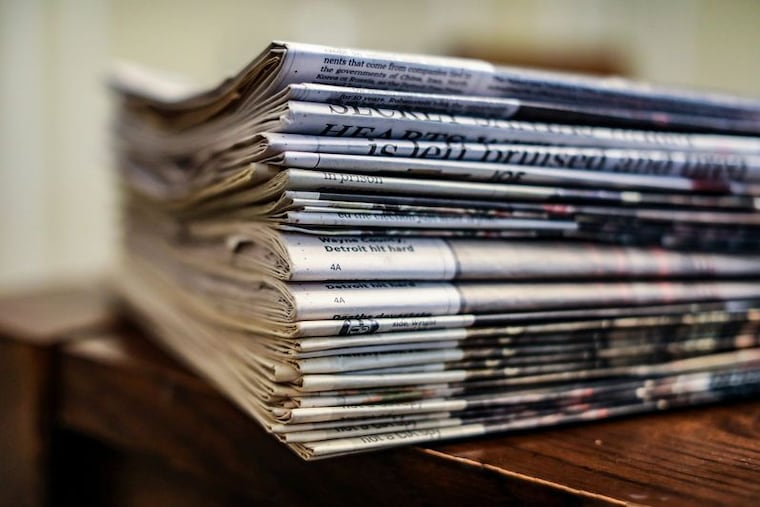
The residents of Pittsburgh are appropriately focused on what to do about the announced closure of the Pittsburgh Post-Gazette — but the real story is bigger than any single newspaper. Across Pennsylvania, communities are losing access to reliable local news, and the consequences are deeply felt.
Thursday is Local News Day, a national moment to recognize the essential role local journalism plays in our communities. In Pennsylvania, it should be a call to act.
Pennsylvania has seen both devastating cuts in its local news and some of the most promising innovations in the country. It’s time for the state to build on this momentum by enacting First Amendment-friendly legislation to ensure the revival of community news throughout the commonwealth.
The internet has undercut the traditional business models of local news, devastating outlets of all shapes and sizes across the state. According to a study by Muck Rack and Rebuild Local News, there were roughly 5,000 Pennsylvania journalism positions in 2002 and roughly 1,300 today, a loss of about 3,700 over two decades — a decline of about 75%.
This is not a normal market shift; it is a collapse with consequences so broad that we will need business model innovation, philanthropy, and, yes, smart public policy.
There are practical, bipartisan approaches available. In a politically divided state like Pennsylvania, one promising model is what the New Hampshire legislature is considering: a matching program of tax subsidies for restaurants, hardware stores, and other small businesses that advertise in local news. This would help small businesses reach customers while also strengthening local news outlets.
Or Pennsylvania could adapt a model from Illinois, which provides payroll tax credits to news organizations — both for-profit and nonprofit — that invest in employing local journalists.
There were roughly 5,000 Pennsylvania journalism positions in 2002 and roughly 1,300 today, a loss of about 3,700 over two decades — a decline of about 75%.
State Rep. Christopher M. Rabb (D., Philadelphia) has proposed a local news grant and fellowship program that would place journalists in local newsrooms.
These approaches share a crucial feature: They are First Amendment-friendly. Each policy is structured to prevent the government from rewarding or punishing news outlets based on coverage. Public policy must be — and can be — designed to strengthen independent, accountability reporting, not weaken it.
The good news is that these kinds of policies can build on real momentum already underway in Pennsylvania.
In Philadelphia, cable television entrepreneur and philanthropist H.F. “Gerry” Lenfest gifted The Inquirer to a nonprofit, the Lenfest Institute for Journalism, which has provided resources to transform it into a modern, sustainable public-interest news organization.
Since its founding in 2016, the institute has raised and awarded $117.6 million in grants to The Inquirer and dozens of other Pennsylvania news organizations. The institute also helped establish Spotlight PA, an innovative nonprofit news enterprise based in Harrisburg that provides statehouse and statewide coverage to 125 news outlets across the state free of charge.
» READ MORE: Can Pittsburgh rally to save its newspaper? | Opinion
In Lancaster, the Steinman Foundation and the owners of LNP/LancasterOnline worked together to find a sustainable path forward by converting to independent nonprofit ownership. Just last month, a new nonprofit, Local Matters, announced the purchase and revitalization of the Pittsburgh City Paper alternative weekly to help fill the local news gap there.
The Center for Media Innovation at Point Park University formed the Pittsburgh Media Partnership through which recent college graduates provide reporting for more than 30 newsrooms across 10 counties in Southwestern Pennsylvania.
Pennsylvania philanthropy has been among the most active in the country in addressing the challenges to local news. A 2025 survey of journalism funders conducted by Press Forward, a national coalition of foundations and individuals supporting journalism, showed local and national philanthropies invested more than $26 million in local news in Pennsylvania over the past two years.
Donors are broad-based and geographically diverse, including:
From Pittsburgh: the Benter Foundation, the Heinz Endowments, the Henry L. Hillman Foundation, the Pittsburgh Foundation, and the Posner Foundation of Pittsburgh.
From Central Pennsylvania: the Centre Foundation, the Steinman Foundation, and the Lancaster County Community Foundation.
From Philadelphia and Eastern Pennsylvania, including the Lenfest Institute: the Wyncote Foundation, the William Penn Foundation, and the Berks County Community Foundation.
But philanthropy is not enough to serve a state as large and diverse as Pennsylvania. Public investment must help close that gap — and it can pay real dividends. Strong local news means less polarization, better-informed voters, and more responsive local governments. And strong local news is good for economic development. It helps small businesses thrive, it reduces municipal borrowing costs, and it supports local consumers and commerce of all kinds.
In that sense, local journalism is not just another industry — it is civic infrastructure, akin to libraries and schools: a public good that cannot be sustained by the market alone.
Pennsylvania has led the nation in many facets of local news revival. It should now lead on public policy. First Amendment-friendly programs like those described above could help these local efforts thrive — ensuring Pennsylvanians are better served, and offering a model for the rest of the country.
Jim Friedlich is CEO and executive director of the Lenfest Institute for Journalism, the nonprofit, noncontrolling owner of The Inquirer. @jimfriedlich