The hidden link between mummers and Pennsylvania’s most notorious labor rebels
Ten Irish Catholic miners, all “Molly Maguires,” were hanged 149 years ago this week. The key to understanding who they really were lies in a holiday tradition still celebrated in Philadelphia today.
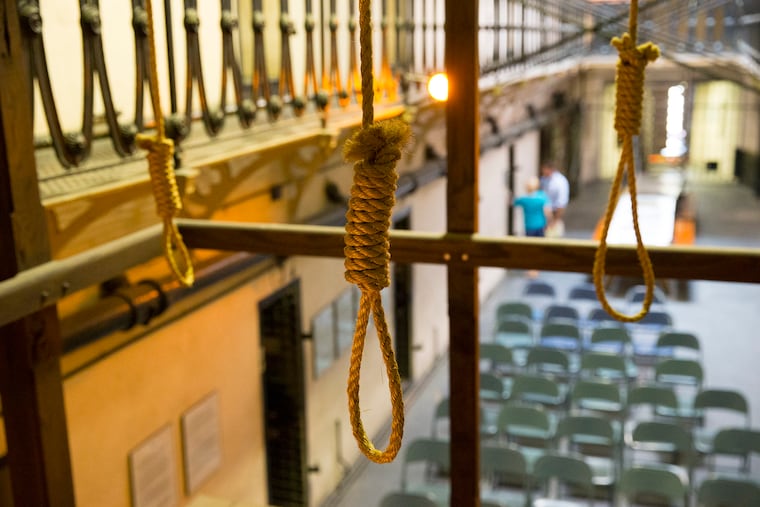
The biggest mass execution in Pennsylvania’s long history took place 149 years ago this week.
Ten Irish Catholics from the hard coal region went to the gallows, convicted of murder in a long-running labor war against the all-powerful coal companies. Another 10 would be hanged over the next few years, for a total of 20. Their trials made a mockery of justice, with a coal company president as prosecutor, a Pinkerton detective hired by the company as the star witness, and Irish Catholics excluded from the jury.
The hanged men were called Molly Maguires, a name straight out of Ireland, where a secret society using that moniker battled the landlords on behalf of starving peasants during the horror of the 1840s potato famine. These Mollies disguised themselves in women’s clothing, or straw clothing, or whiteface or blackface. And they timed their killings around major holidays.
That’s because the Molly Maguires were merely the flip side of a group quite familiar to Philadelphians — the mummers. The connection explains many of the mysteries about the Mollies — where the name came from, why the Mollies wore odd disguises, why they did their killing around high points of the calendar, and why they were revived in Pennsylvania amid resistance to the Civil War draft.
In Ireland, mummers were more actors than musicians. They visited every home in a district around New Year’s and collected money by putting on a skit that always featured a killing. The money paid for a party for the whole community. Groups like the mummers performed this kind of trick or treat around other big holidays — St. Brigid’s Day on Feb. 1, Easter, the summer solstice and Halloween.
During the potato famine, small bands of men — dressed in the women’s clothes or the straw of the mummers — began going from house to house, collecting money for the hungry. But these men weren’t mummers. They were Molly Maguires. And when they didn’t get what they wanted, or when landlords evicted tenant farmers, the mock killing of the mummers became the very real violence of the Molly Maguires.
The killings often took place around the days that the mummers celebrated, to signal that the Mollies were acting on behalf of the community. The three most celebrated Molly murders in Ireland came within a day or two of St. Brigid’s Day, the summer solstice, and Halloween.
The name itself sounds like something from the mummers’ play. A female character often had names that began with the letter M — Molly Masket or Mary Ann McMonagle. And, curiously, Molly Maguire wasn’t always Molly — a number of death threats were signed “Mary Ann Maguire.” The similarity between “Mary Ann McMonagle” and “Mary Anne Maguire” underlined the links between the mummers and the Mollies.
Famine emigration led many from the Molly Maguire heartland to the booming anthracite industry in Northeastern Pennsylvania. It was one of the few rural places in the United States where famine immigrants settled in such concentrated numbers that the folkways of the Irish countryside were transplanted wholesale, including mummery — and its associated pattern of violence. In 1848, a man acquitted of killing an Irishman was murdered in Schuylkill County, on Dec. 30. The killer, an Irishman, had whitened his face like a mime or a mummer.
Mummery had long been established in Philadelphia, but a peculiar offshoot, called the fantasticals, emerged in Northern Liberties before the Civil War, as a protest against mandatory militia service. At the time, able-bodied men between ages 21 and 45 were regularly required to muster for militia drill. This meant a day without pay — and the fantasticals protested by making a mockery of it.
They showed up for drill in ridiculous costumes, with giant wooden swords, or in some cases the leg of a deer. This mockery widened from muster day to mummers parades around Christmas and the Fourth of July and Halloween, and spread beyond Philadelphia.
In 1855, the Pottsville militia was called out after a mine boss was beaten in Branchdale, Schuylkill County. Though just four men attacked him, the militia rounded up 28 Irish Catholics. Adding insult to arrest, the militia then played a Protestant anthem from Ulster, “The Boyne Water,” which celebrated the defeat of Catholic Ireland.
It just so happened that the fantasticals made their first appearance in Schuylkill County that very year, marching in Pottsville on Christmas Day. The whole performance mocked the Pottsville militia and its music. The captain wielded a giant wooden sword, the rest were dressed in “every imaginable burlesque costume,” and the band was drunk — and played that way. In 1857, when the militia was used to break a strike by largely Irish mine workers in Cass Township, the fantasticals appeared in Schuylkill Haven on the Fourth of July and in Cressona on Dec. 26.
A few short years after those anti-militia mummers parades, opposition to compulsory militia service in the Civil War led to the revival of the Molly Maguires. The man who administered the 1862 militia draft in Schuylkill County was a nativist Republican who saw conscription as a way to sweep large numbers of Irish Catholic Democrats into the maw of a bloody war. He set unfairly high conscription quotas for heavily Irish Cass Township, then urged that the draftees be shipped out before a crucial election.
In response, Irish mine workers went out on strike, marching under arms with a fife and drum from mine to mine. Two months later, they went out on strike again, calling themselves Molly Maguires. When a government crackdown appeared imminent, the Mollies targeted residents who had shown government sympathies by volunteering for the military.
On Jan. 2, 1863, five men fatally shot an Irish mine worker home wounded from the Union Army, then cheered for the Confederate president. Over the next nine days, two former militia men were attacked in Cass Township. A few days after Halloween, gunmen with false whiskers and blackened faces killed a mine owner who had been helping to enforce conscription.
Note the progression. In the last half of the 1850s, some Schuylkill County residents were making fun of the militia, but by 1862, they were on strike to oppose the militia draft, and as 1862 edged into 1863, they were shooting former militia members around New Year’s. As in Ireland, what started as mummer revelry ended as Molly Maguire rebellion.
The Molly troubles raged for another 15 years, ending only when a Pinkerton infiltrated the organization. The ensuing executions showed that the Mollies were no match for the coal companies and the state of Pennsylvania when it came to dealing death at high points of the calendar. The biggest killing — the hanging of 10 men on June 21, 1877 — came on the summer solstice.
Mark Bulik is the author of “The Sons of Molly Maguire: The Irish Roots of America’s First Labor War.” A retired senior editor for The New York Times, he grew up in Ridley Park, Delaware County.