The ‘No Kings’ rallies were a start. Now what?
As impressive as the nationwide demonstrations have been, a protest is not a party.
In my younger days, I enjoyed sports talk radio.
A favorite of mine was ESPN’s Mike and Mike. I remember during the height of the Colin Kaepernick protest, Mike Golic commended Kaepernick for his attention-grabbing display and the reasons behind it.
But Golic turned the tables on Kaepernick and asked what the quarterback planned to do to achieve the goals he sought through his protest.
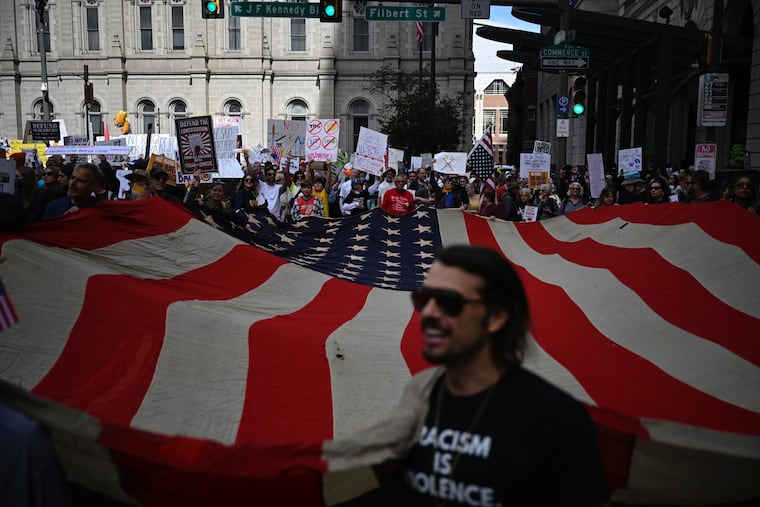
I would love to ask white people who were part of the “No Kings” rally recently the same question, but I am unsure of what tangible outcome was sought from it. It seemed like an occasion to voice their displeasure, so I am unsure what the next step is beyond planning another “protest” in the next few months.
The optics from the mass demonstration were indeed impressive: seven million people, predominantly older and white, took part in protests nationwide. That cannot be ignored. But the substance of these protests was lacking.
Not according to news media pundits, who declare that these acts are signs of the anger and emerging resistance to the Trump administration we’ve been waiting for.
But “No Kings” shouldn’t be confused with the Arab Spring.
Protesters made no demands. They caused no ruckus. In fact, this “protest” seemed more like a party than a desperate attempt to save humanity.
Joy is one of the fruits of our work, whether it comes from protest or other mass action, but a protest isn’t a party.
Don’t get me wrong.
Protesting one’s grievances in an attempt to acquire a remedy for them by way of public policy is a good thing. Black people are well acquainted with our history of protest and resistance to unjust laws.
Lessons from the civil rights era
But the lessons for all to learn from the history of Black resistance, particularly the civil rights movement, is 1) there is always a tangible demand for something or numerous things, 2) there’s a righteous anger that is harnessed into a tangible action (e.g., protest, boycott, divesting, etc.) to produce the demand, and 3) there is a desperation that yields a willingness to sacrifice in the name of their humanity.
The “No Kings” protest had none of these.
But it did have singing, dancing, and folks in costumes. Indeed, there is room for joy within any social movement (if you can call this a social movement yet, I am not sure), and there’s been that at protests before.
Joy is one of the fruits of our work, whether it comes from protest or other mass action, but a protest isn’t a party.
Organized protests should elicit a response that either brings the oppressor to their knees and forces them to concede the demand, or, at the very least, brings them to the negotiating table.
The “No Kings” rally produced only one response from Donald Trump: an AI video of a “King Trump” jet dumping what appeared to be liquid feces on the protesters. Clearly, demonstrators got a reaction from Trump, but not the kind that relieves any of the pressure they face at the kitchen table.
I previously commented that white people have a decision to make. That is, whether they intend to fight for their rights and the rights of nonwhite people, or only for their own rights. I’m not sure what these protests suggest is their answer to that question. But my advice is to learn from the civil rights movement.
Some sit it out
I highly doubt white Americans can “save” democracy in America by way of reconciling its relationship with white supremacy absent Black people. However, a lot of us have chosen to sit out these protests because many of the people protesting Trump are likely responsible for his return to power.
We’re tired of persevering through the hypocrisy in the name of survival, but I digress.
Learn from the civil rights movement to strengthen this effort on behalf of all Americans. Concretely define the “movement’s” demand(s) via policy change that can directly begin to upend systemic oppression.
Just as the civil rights movement improved the lives of all Americans, so should these coordinated mass demonstrations. Harness the real anger seen at town hall meetings, for example, to agitate and aggravate the power structure to show that these protests are a force to be reckoned with, as opposed to “a good time had by all.”
Lastly, continue direct action with a consistency that demonstrates your demands aren’t a wish list, but rather the oxygen necessary to breathe.
Taking it to the streets is definitely a start. But it’s nowhere near the finish.
To reach the finish line, y’all have more work to do. Some Democrats in Congress need to learn these lessons, as well.
Rann Miller is an educator and freelance writer based in southern New Jersey. His “Urban Education Mixtape” blog supports urban educators and parents of children attending urban schools. urbanedmixtape.com @UrbanEdDJ