My grandfather was part of ‘the Mighty Eighth’ being honored in Normandy this D-Day
Domenic Simonetti was a proud son of immigrants, a violinist and member of the symphony orchestra in Philly. He won a scholarship to study in Miami — where his draft notice came in 1943.
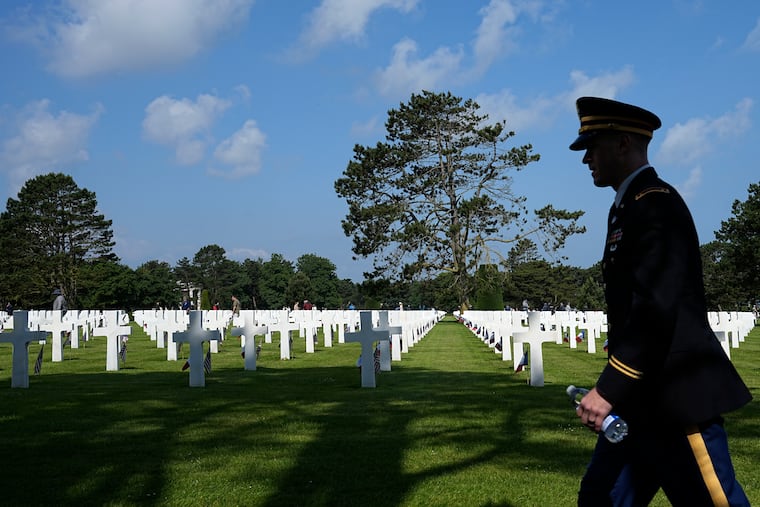
As I prepare to depart for Normandy, France, for the 81st anniversary of D-Day, I find myself deeply missing my grandfather and wishing he were alive to accompany me back to the continent where he risked so much.
Domenic Simonetti was a proud product of the Philadelphia melting pot and the great American dream. Born in 1923 to Italian immigrants on the city’s west side, he displayed incredible musical talent from his earliest days.
A classically trained violinist, he was a member of the symphony orchestra in Philadelphia and, later, in Miami. My grandfather excitedly enrolled at the University of Miami on a music scholarship, but his education was cut short when the draft notice arrived in 1943.
Once in Northern England, Domenic was assigned to the 8th Army Air Force to support European combat operations, including the D-Day landings. He participated in a mission over those iconic beaches and would forever describe the sight in one word: unbelievable.
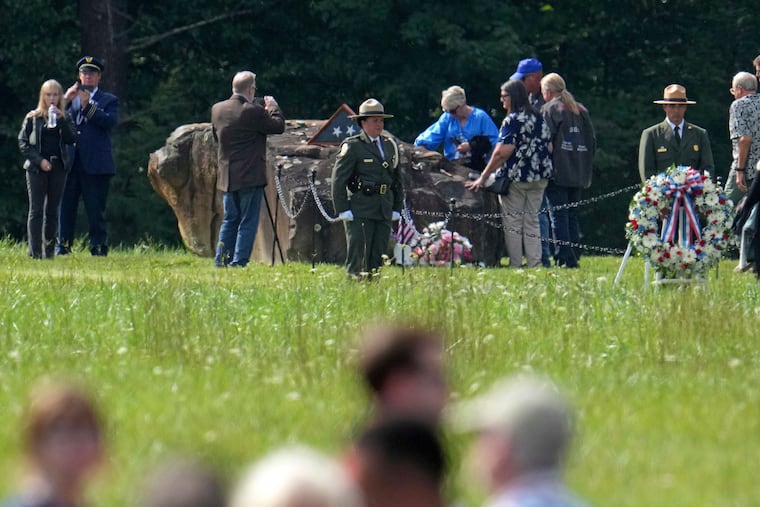
The people of Normandy have never forgotten heroes like my grandfather, and the region today is dotted with hundreds of memorials to American troops. This week, a new monument will be dedicated to the 8th Army Air Force, and I am honored to be invited to attend.
The “Mighty Eighth” played an outsize role both on D-Day and in the 11 long months of fighting that followed. The unit — which began as an Army asset and became Air Force after that branch was founded in 1947 — flew more than 2,300 sorties on D-Day and suffered more than 47,000 casualties, including some 26,000 deaths, during the war. Its airmen were awarded 17 Medals of Honor.
Three remarkable 8th Army Air Force World War II veterans will be returning to France for this year’s D-Day commemorations: Edward Berthold, 105, from Illinois; William Becker, 99, from California; and Harold Terens, 101, from New York.
Their stories are awe-inspiring.
Berthold’s service was marked by a series of close calls and emergency landings: On his first mission, the plane’s engine caught fire; on his second, the prop governor seized up. His third sortie was D-Day, and it ended in the successful bombing of a bridge in the strategic city of Saint-Lô.
Terens flew important and emotional missions: bringing home American and British POWs released from German captivity in the weeks following D-Day.
And Becker served on a B-24 bomber with a squadron of special operators code-named the “Carpetbaggers” — a precursor to the CIA. The squadron flew clandestine, night missions deep into enemy territory, dropping supplies to French, Norwegian, and Danish spies collaborating against the Nazis.
The “Mighty Eighth” played an outsized role both on D-Day and in the 11 long months of fighting that followed.
These three men are the living embodiment of our force’s long history. Just days after we wrap up the D-Day anniversary events in France, the Army will celebrate its 250th birthday, making it a year older than our nation. Berthold, Becker, Terens, and my grandfather are four unique threads of that rich tapestry.
I can’t wait to hear these warriors’ stories, and I find myself wondering: Could they possibly remember Domenic? Will they see him in me — as so many do when they look at our military service photos?
Like my grandfather, these men gave vital years of their lives in service to our nation. Then they went home and contributed to their communities and families. Berthold owned three businesses in suburban Chicago with his wife of more than 60 years. Becker spent decades organizing the much-loved reunion groups for the 8th Army Air Force. Terens was the vice president of a British corporation and was married for more than 70 years. After being widowed in 2018, he returned to Normandy last June to marry his 96-year-old sweetheart.
For his part, my grandfather remained in Europe a year after the war. He was promoted to first sergeant at just 23 years old, earning a personal commendation by the commanding general. While stationed in England, he met and married my grandmother — Ellen Finney of Rawtenstall, Lancashire.
The Finney family knew the sacrifice of World War II: Two sons, Joseph and Crowther, were both killed serving with the British Grenadier Guards in North Africa and Normandy.
After the war, Domenic brought his young wife to America aboard a “war bride ship,” and the couple raised three children in my hometown of Philadelphia. He never lost his love for music, but he spent 50 years supervising general construction projects in Philadelphia. I listened to every Army story he ever told, and I knew my future from my youngest days.
In the Army, we often say we stand on the shoulders of giants. On the 81st anniversay of D-Day, the giant I will carry in my heart is one of Philly’s own, 1st Sgt. Domenic Simonetti of the Mighty Eighth.
Vincent Simonetti is the command sergeant major of First Army’s Division West.