Streater: Why the school board isn’t putting off the hard conversation about our facilities any longer
The president of Philadelphia’s school board writes that a plan to close 18 public schools stems from the billions of dollars required to make needed repairs to aging buildings.
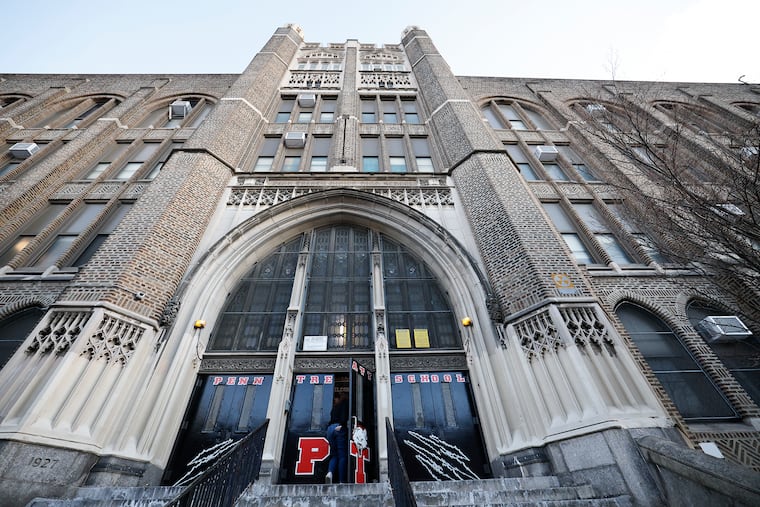
As the school board begins the process to consider the district’s “Accelerating Opportunity: The School District of Philadelphia Facilities Master Plan,” I thought it necessary to reflect on how we got here and why.
For five years — including four as president of the Philadelphia Board of Education — I have sat through meetings where I reviewed the same sobering facts: school buildings that average more than 73 years old, a looming operating deficit in the hundreds of millions, and the lasting lesson of what happens when Philadelphia loses control of its schools.
Nowhere are these challenges more visible than in our school buildings. According to the Parsons Environment and Infrastructure Group report, the district faces as much as $7.8 billion in deferred maintenance and building replacement needs if it tries to maintain or upgrade its current footprint. That figure reflects essential repairs — not cosmetic improvements — and includes the cost of restoring or replacing buildings where continued maintenance would cost more than rebuilding.
After years of advocacy by the board and the district for this level of investment, it became clear that our funders were not in a position to support the district at that scale. That reality sent us back to the drawing board.
Year after year, the board has sounded the alarm, making the case publicly that Philadelphia’s children are being asked to learn in buildings that require far more investment than current funding provides.
On top of that, the district faces a structural operating deficit that, without action, would force deep and destabilizing cuts. For five years, we have been clear: No urban school district can meet challenges of this magnitude without substantial public investment.
We have said it in budget hearings.
We have said it in Harrisburg.
We have said it in City Council chambers.
We have said it in Washington, D.C.
We have said it from every mountaintop available to us.
Federal COVID-19 relief funds provided temporary breathing room.
They allowed the district to invest in building repairs, stabilize staffing, support academic recovery, and avoid immediate austerity. But those dollars were never meant to be permanent funding.
They delayed the inevitable fiscal reckoning — they did not erase it.
The board has repeatedly warned about the district’s structural operating deficit and called for greater investment, both before and after the William Penn School District et al. v. Pennsylvania Department of Education ruling by the Commonwealth Court of Pennsylvania that found the state’s school funding system unconstitutional. Most importantly, a bipartisan commission later determined that our district alone is underfunded by $1.2 billion.
Philadelphia has been here before. Our structural deficit, which is now in the hundreds of millions, is not just numbers on a page. It reflects the real consequences of long-term fiscal instability and underfunding.
Under Pennsylvania law, the state can step in when a school district is financially distressed, and history shows what that can mean for our city. Ignoring structural deficits does not make them disappear. It only raises the risk that decisions will be made for us, under far less stable conditions and with far less community input — a scenario we are determined to avoid.
This context led the board to pass a resolution directing the district to begin a comprehensive facilities planning process.
That resolution did not authorize school closures. Instead, it called for a responsible, staged, and transparent process — one that includes budget alignment, policy review, public engagement, transition planning, and independent board votes before any school-specific action. The goal is to ensure resources are used more effectively to support the education of the whole child.
We also carry lessons from the past — lessons this board is determined not to repeat.
The 2012 school closure process disrupted students and communities. It contributed to enrollment instability, families leaving the district, and lasting effects on student outcomes and school climate. Any future action must include careful transition planning, academic safeguards, transportation planning, and clear strategies to reduce harm.
This moment is not about shrinking the district. It is about aligning buildings with students, strengthening elementary school experiences, investing in neighborhood high schools, expanding career pathways, and ensuring every facility supports full academic programming.
This moment is not about shrinking the district. It is about aligning buildings with students.
And let me be clear: Our children are worth the investment.
Public education is not a quarterly earnings report; it is a public good and a civil right. Our students’ value is not measured by test scores or graduation rates. But for those who want data before investment, the evidence is clear: graduation rates are rising, dropout rates are falling, and academic achievement is improving.
Despite chronic underfunding and aging buildings, our educators and students are making real progress. Imagine what they could achieve with fully modern classrooms and a well-aligned educational system.
I write as a proud product of the Philadelphia School District, a father of children currently enrolled in our schools, and a Black man whose life was shaped by the quality public education I received here. That education gave me the foundation to succeed first in the restaurant business and later as a plaintiff’s trial attorney. I know firsthand what strong public schools can unlock. When public education works, it strengthens neighborhoods, builds workforce skills, expands economic mobility, and supports civic life.
As Philadelphia prepares to commemorate the 250th anniversary of the American republic, Frederick Douglass’ words still resonate: “If there is no struggle, there is no progress.” His message is about the work required to achieve lasting change.
Public education demands that same dedication and effort. It is only sustainable if we protect it, fund it, and govern it responsibly. Imagine a world with no failing buildings, universal access to algebra and prekindergarten, robust extracurriculars, fewer school-to-school transitions, expanded criteria-based options, and high-quality programming that prepares students for success beyond the classroom.
I write as one of nine volunteer board members, none of whom gain financially from these decisions. Our goal is not to alarm — it is to govern responsibly. The only thing we stand to gain — or lose — is the same as every Philadelphian: a strong public school system that lifts our children and strengthens our city.
The facilities plan is not the end of the conversation. It is part of our ongoing responsibility to keep public education strong in Philadelphia.
That responsibility belongs to all of us.
Reginald L. Streater is president of the Philadelphia Board of Education.
The Board of Education will hold a town hall on Thursday, March 12, at 4 p.m. about the school district’s facilities master plan. The town hall will feature 90 registered speakers providing public testimony on facilities recommendations. Those interested in registering to speak can visit www.philasd.org/schoolboard/meetings.