Can Pittsburgh rally to save its newspaper?
After the Pittsburgh Post-Gazette announced plans to close, colleagues asked me what could be done to rescue the paper. Recent local news investments in Philadelphia and Baltimore may provide an answer.
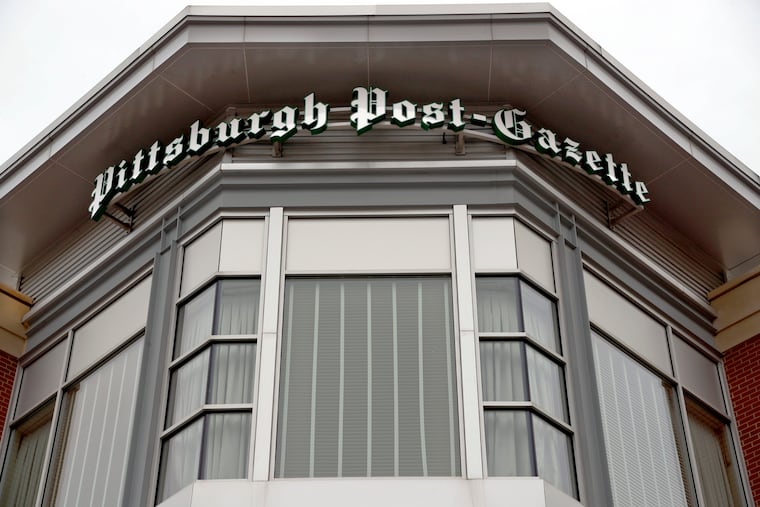
Pennsylvania’s two largest cities have more in common politically, demographically, and economically with one another than with the rest of the commonwealth. For decades, they also had in common the presence of great American newspapers serving their diverse and dynamic communities: The Inquirer and the Pittsburgh Post-Gazette. Sadly, that may no longer be the case.
On Tuesday, Block Communications, the owners of the Post-Gazette, announced that on May 3, it will shutter the newspaper, the roots of which date back 240 years. The loss of a once great newspaper in a major American city is itself a civic tragedy. The fact that this loss was entirely preventable is even more unfortunate.
It is no secret that the traditional print newspaper business is in sharp decline. Self-inflicted wounds — including a long history of labor strife, family disunity, and financial losses — have compounded these headwinds at the Post-Gazette. The Block family’s announcement cited cumulative losses of over $350 million over a 20-year period.
Disclosure of a decision to close the paper came the same day the U.S. Supreme Court denied the company’s appeal of a decision that required it to honor the terms of an earlier union contract, and after the resolution of a bitter three-year labor strike. Striking workers agreed to return to work on Nov. 24 and were told this week they would be severed.
The Lenfest Institute for Journalism, of which I am CEO, is in the business of helping sustain and support local news. I heard this week from more than half a dozen news industry colleagues about the potential to “save the Post-Gazette.” As a Philly-based journalism executive, I was unsure what was really left of the Post-Gazette to save. So I reached out to Pittsburgh newsroom sources, readers, and local foundations.
While the Post-Gazette has suffered multiple layoffs and a reduction in its print schedule to two days a week, there is unquestionably still a there, there. The current newsroom numbers 110 employees. And its journalists still produce great public service journalism, covering politics to sports. More importantly, with or without the Post-Gazette, there remains a need and an appetite among readers for independent local news in Pittsburgh. As of the end of 2025, more than 60,000 pay for the P-G in digital form, and 27,000 in print.
To save, reinvent, or perhaps replace the Post-Gazette, it is instructive to look at recent local news investment in Philadelphia and Baltimore:
Ten years ago this month, the late H.F. “Gerry” Lenfest, a philanthropist and cable television entrepreneur, donated his ownership of The Philadelphia Inquirer to the nonprofit Lenfest Institute for Journalism, allowing The Inquirer to invest long term in the transformation of its news and business operations.
The Inquirer’s 200-person newsroom is supported in large part by the loyalty of readers, the growth of its digital revenues, and supplemented by donations from readers, foundations, and the Lenfest Institute. The Inquirer, which remains a for-profit enterprise, is well-managed, both editorially and as a business. It has more than 120,000 paying digital subscribers, and philanthropy — a finite resource — is a single-digit percentage of total revenues, although mission-critical.
Emulating the Lenfest Institute model, Stewart W. Bainum Jr., a Maryland-based hotel and healthcare executive, sought to acquire the Baltimore Sun from its parent company and to convert it to nonprofit ownership. Unable to come to terms with a difficult seller, Bainum chose instead to launch the Baltimore Banner from scratch in 2022, an impressive, all-digital nonprofit news enterprise that won the Pulitzer Prize for local reporting last year for coverage of its city’s opioid crisis.
Pittsburgh’s journalistic, business, and philanthropic interests have several paths open to them:
The Post-Gazette could be acquired by a nonprofit organization similar to the Lenfest Institute. However, local leaders with whom I have spoken seem loath to take on its obligations and liabilities.
Let’s hope Pittsburgh finds the resolve to serve its residents with the local news they need and deserve. Certainly, we at the Lenfest Institute are here to help.
The Post-Gazette is by no means the sole source of independent journalism serving Southwest Pennsylvania. The region is covered by NPR station WESA, by Pittsburgh’s Public Source, a small but effective nonprofit, and by Harrisburg-based Spotlight PA, of which the Lenfest Institute was a founder. Each of these entities could help form the foundation of expanded Pittsburgh news.
Or the community could build from scratch, mirroring the approach of the Baltimore Banner.
Each path has its complications, but they all have one thing in common: the need for determined, deep-pocketed, and strategically aligned funders to create sustainable local news at scale for the city of Pittsburgh.
Maxwell E.P. King, a former editor of The Inquirer and past president of two of Pittsburgh’s leading philanthropies — Heinz Endowments and the Pittsburgh Foundation — has sounded the alarm.
“I am heartbroken, both as a reader and a contributor” to the Post-Gazette, King told me. “But the community, particularly the foundation community, must rally to this moment. Nonprofit journalism is succeeding around the country, most notably in Philadelphia with The Inquirer. We have to find a viable nonprofit way to continue daily journalism here. It is crucial for the region.”
Let’s hope Pittsburgh finds the resolve to serve its residents with the local news they need and deserve. Certainly, we at the Lenfest Institute are here to help.
Jim Friedlich is CEO and executive director of the Lenfest Institute for Journalism, the nonprofit, noncontrolling owner of The Inquirer. @jimfriedlich