As the NFL playoffs begin, remembering a Pa. pro football champion that wasn’t
For a century now, football historians and fans of the game alike have been urging the NFL to reverse a controversial decision that denied the 1925 championship to the Pottsville Maroons.
POTTSVILLE, Pa. — Because I love Pennsylvania and football (and not always in that order), I drove 90 miles recently to this coal-region city of 13,300 to take a peek at a bronzed football shoe, a trophy carved from coal, and a battered football, its laces askew.
On Dec. 12, 1925, 100 years ago last month, a 23-year-old kid named Charlie Berry — who also played baseball for the Philadelphia Athletics and later became an American League umpire — used that high-top shoe to kick that ball to lift the Pottsville Maroons to a huge victory.
The Maroons got that trophy, emblazoned with the words “TRUE WORLD CHAMPIONS,” after beating a squad of former Notre Dame players, 9-7, in an exhibition game at Shibe Park in Philadelphia. But the Maroons were true world champions only in sentiment. They did not even win their own league.
That would be the National Football League — the same NFL that now includes the Eagles and opens its annual playoffs this weekend, ending with Super Bowl LX. The NFL would deny the Maroons the league championship despite clearly having the best team, having disposed of the Chicago Cardinals a week earlier in icy Chicago, 21-7.
The exhibition game turned out to be a big problem. Long story short: Although the Maroons had requested (and, they said, been granted) permission to play the Notre Dame team, they were treading on the turf of the city’s NFL team, the Frankford Yellow Jackets. The Maroons were thrown out of the league.
You have probably heard of the Yellow Jackets, who folded in 1931 and whose remnants were purchased in 1933 by Bert Bell and Lud Wray for $2,500 and relaunched as the Eagles. The Maroons have faded, like a photograph in an album. That is a shame. The Maroons were a town team that climbed through a primitive organizational ladder to reign supreme over a sport.
“There are so many reasons why this thing still smells funny,” said Jeffery Payne, a historian who coauthored a 2025 book with Darin L. Hayes, Marooned: The Rise, the Fall, and the Redemption of the NFL’s Pottsville Maroons, which adds detail and perspective to the story.
Payne, who had not heard of the Maroons while growing up in Erie, acknowledged that the NFL is unlikely to declare the Maroons as 1925 champions, saying, “It would take a higher force for this to happen.” And it is old news: The last Maroons player died in 2003, at age 101.
The NFL has examined the controversy a few times, most recently in 2003, when Ed Rendell, the former Philadelphia mayor and Pennsylvania governor (not to mention a rather vociferous Eagles fan), wrote a letter petitioning the NFL to award the 1925 title to Pottsville.
Rendell wrote that he did not intend “to have any more communications with the cowardly barons that run the National Football League, including their extremely well paid leader, until they relent and grant the gallant Pottsville Maroons what is rightfully theirs.”
(He added that the vast majority of NFL owners lack “cojones.”)
But Rendell only had two NFL teams behind him: those from Pennsylvania, the Eagles and the Pittsburgh Steelers. So that Tush Push, of sorts, failed to reach the line to gain. The NFL still places the Cardinals atop its official 1925 standings, with the Maroons second.
Plus, the Cardinals padded their final winning percentage — used then to determine the champion — by beating teams with some high school kids. They refused to accept the trophy (the one not made of coal) until years later, after the team had been sold to Charley Bidwill.
The Maroons have faded, like a photograph in an album. That is a shame. The Maroons were a town team that climbed through a primitive organizational ladder to reign supreme over a sport.
The last name may ring a bell. The Cardinals, now in Arizona, are still owned by the Bidwill family. How interesting it is that the team has won only one NFL championship since — way back in 1946. They have played in just one Super Bowl, losing in 2009 to the Steelers.
Some “Skooks,” those from Pottsville and surrounding Schuylkill County, still enjoy claiming the Cardinals have been afflicted by the Curse of the Maroons. “And that 1925 championship was stolen. Never forget,” says a Skook friend of mine, still seeking retribution.
“It’s just so tragic and cruel. What should have been a watershed moment by winning such a big game ruined Pottsville and their football team,” David Fleming, who wrote an astonishing book in 2007 about the controversy, Breaker Boys: The NFL’s Greatest Team and the Stolen 1925 Championship, told me recently. “Pottsville put the NFL on the map.”
The NFL of 1925 was prehistoric compared with the NFL of 2025. Salaries were meager, from $100 to $300 a game, and players had to hold down second jobs to pay the bills. Moreover, college football was far more popular and considered to be a far better product.
Pottsville sort of ignored the Pennsylvania “Blue Laws,” so the Maroons often played at home on Sundays against opponents that played in Philadelphia the day before. The Maroons set trends that last to this day: For example, the coach insisted his players live in town.
Pottsville was among the smallest cities with an NFL team, but the city more than made up for it by adoring the Maroons — even during a contentious miners’ strike that nearly broke the town. For the exhibition at Shibe Park, as Fleming wrote, several Maroons fans playfully wore coal-miner garb to distinguish themselves from the overwhelming majority of Notre Dame fans.
Even after both teams had arrived at Shibe Park, the exhibition game was nearly canceled because only about 8,000 had paid to see the game, some 10,000 fewer than expected, leading Notre Dame star Harry Stuhldreher, one of the legendary “Four Horsemen,” to push for $25,000 upfront — which is worth about $450,000 today — for his team to play in the game.
(The gate was surely smaller than expected because the Yellow Jackets suddenly scheduled a game at the same time in Frankford, beating Cleveland, 3-0, before 7,000.)
At the same time, the Maroons were holding out for $10,000 upfront, or about $181,000 today (the pay disparity underscores the difference in perception then between the college and pro games), so the kickoff was delayed. Then Notre Dame took a 7-0 lead on an Elmer Layden touchdown. But the Maroons rallied — gallantly.
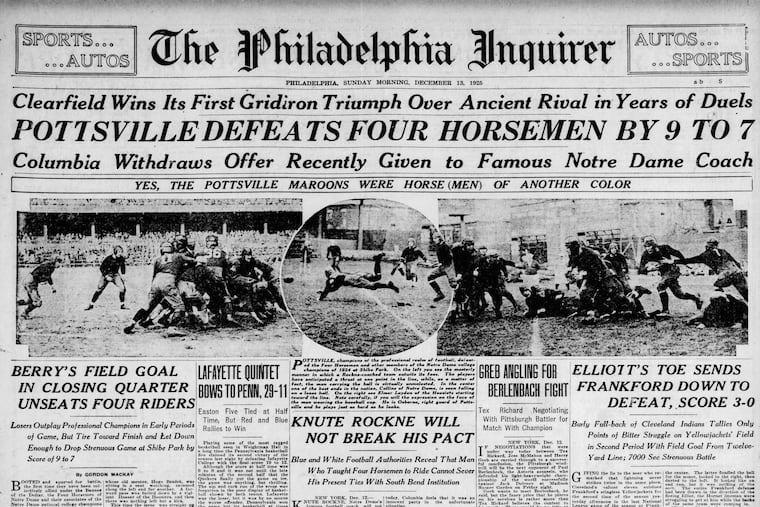
“YES, THE POTTSVILLE MAROONS WERE HORSE(MEN) OF A DIFFERENT COLOR,” The Inquirer gasped the next morning. Gordon Mackay, the reporter, labeled it “perhaps the greatest football battle that this Quaker City has known in years and years.”
The Maroons had put in 28-year-old Tony Latone, the “Human Howitzer,” after halftime. Latone’s story was mythic: He began working in nearby coal mines to support his family when he was 11, after his father died.
At first, he was a “breaker boy,” working 70-hour weeks picking slate and debris from the valuable anthracite coal. (After a week or two, the skin on the tops of a breaker boy’s fingers would peel off.) Later, he strengthened his legs by pushing loaded coal carts from the mines.
Berry, already a catcher for the A’s, hit the crossbar on an extra-point attempt after Latone scored a touchdown late in the third quarter, so Notre Dame still led, 7-6. But Latone, playing on a sore right heel, gained five first downs on another brutal, physical drive.
“He just ripped the Notre Dame team to shreds,” Payne told me of Latone, who ran for more yardage in the NFL in the 1920s than the legendary Harold “Red” Grange.
The drive stalled at the Notre Dame 18-yard line, so Berry tried a 30-yard field goal, which was hardly automatic back in those days. He’d made only three of nine attempts in the season to that point, none past 29 yards.
But, as Mackay so colorfully wrote in The Inquirer the next morning: “He swung that agile hoof. There was a crash of ball and foot, and the crowd, awed into silence, held their breaths as the sphere soared and soared and skipped straight through the crossbar.”
As Fleming wrote in 2007: “Most of the fans at Shibe Park, even the ones from Pottsville, had come out for a fun day of football and a glimpse at the famous Four Horsemen. Instead, they were witness to a watershed moment in the history of American sports: the very moment that professional football surpassed college ball.”
Books about the Maroons, including Fleming’s and the recent release by Payne and Hayes, are on sale at the museum’s gift shop (and online, as well), as are $18 maroon T-shirts with “The Real Champions.” A 100th anniversary celebration was held in August. Students at nearby Nativity BVM High School premiered a documentary, MaRooned.
Fleming, whose book, A Big Mess in Texas, about the antics of the ill-fated 1952 Dallas Texans, was published in October, had Breaker Boys reissued before the 100th anniversary, with a new cover: a photo of the trophy made of silver, not anthracite coal.
“I just wanted to give them the title that they were denied,” he said.
Well, more like, robbed of. Payne and Hayes make a six-premise thesis in their book for the NFL to award the 1925 NFL title to the Pottsville Maroons. They write, “Until the NFL corrects the situation, the Pottsville championship status remains, very simply, marooned.”
Until that day comes, and as a native Pennsylvanian and football fan, the matter should at least be considered; there is only memorabilia from a bygone age in a second-floor alcove at the Schuylkill County Historical Society, a cozy museum in a former school on Centre Street.
Joe Zacko, the late sporting goods store owner and die-hard fan who ordered the jerseys that gave the Maroons their name, had Berry’s shoe bronzed after a 1961 reunion. The goal was to present it to the Pro Football Hall of Fame, then under construction.
The shoe is still in Pottsville. I am not a Skook, but, as I said, I love Pennsylvania and football, and I say a real NFL trophy belongs right next to that shoe, coal trophy, and old ball.
Dave Caldwell, an Inquirer sports writer from 1986 to 1995, grew up in Lancaster County and lives in Manayunk.