The President’s House site overflows with dichotomies. Here’s how we can tell all of its sweeping and incongruous history.
The Trump administration has proposed removing mentions of slavery from exhibits at Independence Mall. If anything, we must enlarge the scope of the interpretation there.
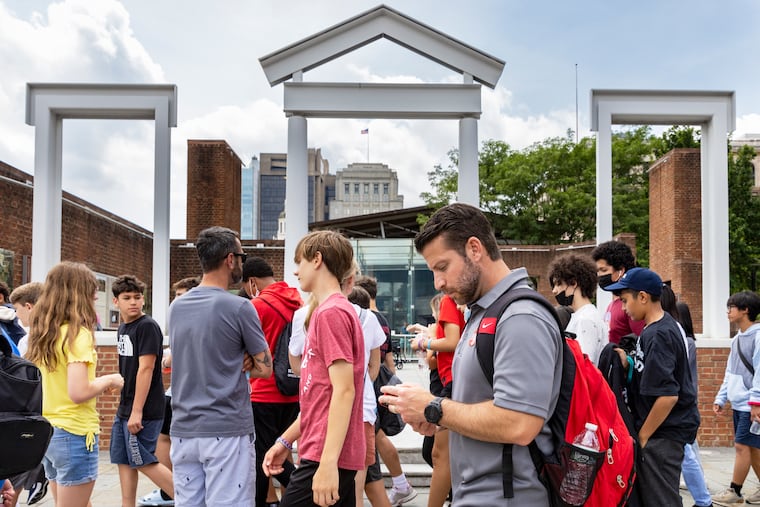
When it comes to the debate over removing mentions of slavery in an exhibit at Independence National Historical Park, I find myself wondering if the dozens of esteemed local historical groups who have signed onto a letter opposing the removals are missing a major opportunity.
A key aspect of the National Park Service’s mission is to protect our national resources and inspire future generations. To achieve this mission, we must ask ourselves, “What is inspirational about a specific resource?” Let’s look at what’s unique about the President’s House, where the exhibits mentioning slavery are displayed.
It was there that the executive branch of our government was formed. It was there that George Washington edited the draft of Article 2 of the Constitution, and it was there that he implemented the same.
That three-and-a-half-story residence, near the southeast corner of Sixth and Market Streets, was distinctive in the world at the time. Few other nations had elected leaders in the 18th century.
This was the place where Washington conducted the business of the presidency during his term and defined the office as a practical institution. This is the only place that happened, and the best place to tell that part of our national story. That is what is unique about that place, and that is an important element in the formation of the United States.
What is sadly not unique to this spot is the fact that several enslaved people lived there, as there were enslaved people throughout the colonies, and, unfortunately, around the world. Slavery was the basis of an economic system that was over 3,000 years old. To rid the country of slavery, a new economic model was needed. It just so happened that the replacement economic system was developed, in part, by a man who once owned that same house, one of my ancestors, Robert Morris.
Morris, an investor who came to be known as the “financier of the Revolution,” worked for the young government on creating a system based on free enterprise, not slavery.
For example, on July 29, 1782, as the nation’s superintendent of finance (similar to the Treasury secretary today), Morris issued his report, “On Public Credit,” to the president of Congress.
It featured an annual head tax on enslaved people and an import tax on the same. He promoted the creation of a national mint, a navy to protect commerce, the establishment of manufacturing, access to capital, free trade, and all sorts of laissez-faire policies. These measures would eventually make slavery obsolete.
Clearly, the Southern bloc in Congress was well aware of this and fought Morris throughout his tenure as superintendent of finance. During the debate over the Constitution, which both Morris and Washington signed, Patrick Henry, who twice served as Virginia’s governor, was concerned that Morris’ tax would “compel the Southern States to liberate their negroes,” a development Henry described as “a picture so horrid, so wretched, so dreadful, that I need no longer dwell upon it.”
The fact that the one-time owner of the President’s House — Morris — and its most famous occupant — Washington — each supported policies that would bring an end to slavery goes unnoticed, showing a remarkable missed connection among the members of the historical community.
I would like to recommend that they focus on the site as a key location that marks the transition from a brutal, backward, nasty economic system that relied on human bondage to a modern market-based system that rewards enterprise. Morris and Washington both exemplified this transition, in that both held enslaved people at some point in their careers, and both wished to see the end of slavery.
Some people believe it is most important that commemorations of history focus on problems, others on how challenges were overcome. The President’s House site — which, like so much of our nation’s history, overflows with dichotomies — offers a place where multiple perspectives can be amplified.
Some can rightly focus on the important information there about the horrors of an ancient wrong, while others can celebrate the source of our bounty and liberty. It is the perfect place to show that economic freedom is the basis for all our freedoms.
However, we must not exclude mention of the enslaved people who lived there. Instead, it is essential that we enlarge the scope of the interpretation at the site to provide the full context for the President’s House in a way that is consistent with the mission of the National Park Service, which is to inspire future generations.
Rob M. Morris, who is a great-great-great-great-grandson of Superintendent of Finance Robert Morris, is a former board member of the Independence Hall Association.