I was the first Princeton valedictorian to major in African American studies. Strangers ridiculed my selection.
African American studies, these commenters argued, lacks genuine intellectual rigor. It does not belong in the same sentence as academic excellence.
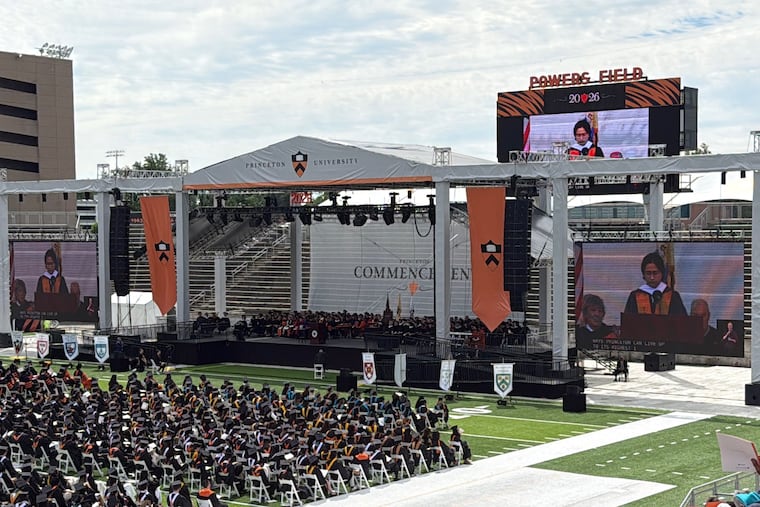
Several weeks ago, I took the stage at Princeton University’s 2026 commencement as this year’s valedictorian. My selection marked an institutional milestone: I am the university’s first valedictorian to major in African American studies since the department’s founding in 2015. In my remarks, I emphasized the importance of the critical humanities and celebrated my classmates’ achievements.
What I can share now, however, is that the occasion was not entirely celebratory.
The weeks leading up to my selection had been some of the most difficult of my life, as thousands of strangers across social media platforms wrote, liked, and reposted comments ridiculing my selection. Their anger centered on my choice of major. Recapitulating virulently racist tropes about both Asian and Black communities, they mocked my Asian appearance and heritage while deriding my Black colleagues and mentors.
Throughout my time at Princeton, I had observed similar — and sometimes much more aggressive — campaigns against my professors and peers across the field of African American studies.
The logic of these attacks is familiar to any student of ethnic studies, gender studies, or any of the critical disciplines deemed “radical indoctrination” by the Trump administration. African American studies, these commenters argued, lacks genuine intellectual rigor. It does not belong in the same sentence as academic excellence.
In recent years, university administrators and faculty have claimed that the contemporary university is suffering from a crisis of academic rigor, accelerated by the prevalence of grade inflation and generative AI.
Combined with shrinking university budgets, these claims have increased the burden on disciplines like African American studies — already maligned as unserious and unscientific — to prove their intellectual seriousness to administrators, funders, politicians, and the public.
This is the paradox of the backlash to African American studies: The field is villainized by the far-right as dangerous, radical indoctrination, while simultaneously, it is maligned for shallowness, insularity, and frivolousness.
Forget percentiles and curves — this vision of rigor requires sustained, critical engagement with power and inequality.
In rebuttal to the latter proposition, many have compellingly argued that Black studies has all the components of a rigorous academic field. Though correct, these defenses concede an assumption that deserves greater scrutiny — that rigor itself is the central criterion by which a field ought to justify its place in the university.
Difficult and valuable are not synonymous. A challenging task is not necessarily a worthwhile one. Consider, for instance, the large introductory engineering courses at many universities, including my own alma mater. These courses are considered to be difficult, and they demand excellent technical skills.
But technical skill is not the same as moral judgment, and such courses rarely ask students to reckon with how the skill they are developing will be used. What of the aerospace engineers who will deploy that skill in the service of defense contractors, whose problem sets will prepare them to destroy countries from afar?
Disciplines like African American studies expand “rigor” to include forms of intellectual excellence not reducible to grades. Forget percentiles and curves — this vision of rigor requires sustained, critical engagement with power and inequality, which forces the thinker to reconsider their most fundamental assumptions about culture and society. A definition of rigor that considers the former without the latter is incomplete; it may make skilled engineers/bankers/doctors/lawyers, but perhaps not ethical ones.
Both the rising supremacy of the quantitative disciplines in higher education and universities’ insistence on “institutional neutrality” have helped reinforce this restrictive notion of excellence, defined by technical expertise and grading distributions.
In the process, elite universities have lost sight of their ultimate obligation — to shape not just learners but citizens, people, and leaders. Student activists recognize what their administrations cannot: that the university cannot escape our most pressing political questions, and that intellectual inquiry and civic engagement are inseparable.
Thus, my final remark as Princeton’s 2026 valedictorian, to administrators, students, and all Americans alike: Take an African American studies class.
Amid threats to civil liberties and free expression, growing budgetary pressure from the federal government, and endowments that continue to profit from global injustice, elite universities cannot afford to indulge a narrow definition of academic excellence or intellectual challenge.
They must learn from the Black radical tradition that a truly rigorous education forces us not just to do but to question — and, always, to keep a more just world in our sights.
Daniel Yu is a recent graduate of Princeton University, where he was named the 2026 valedictorian — the first from the department of African American studies.