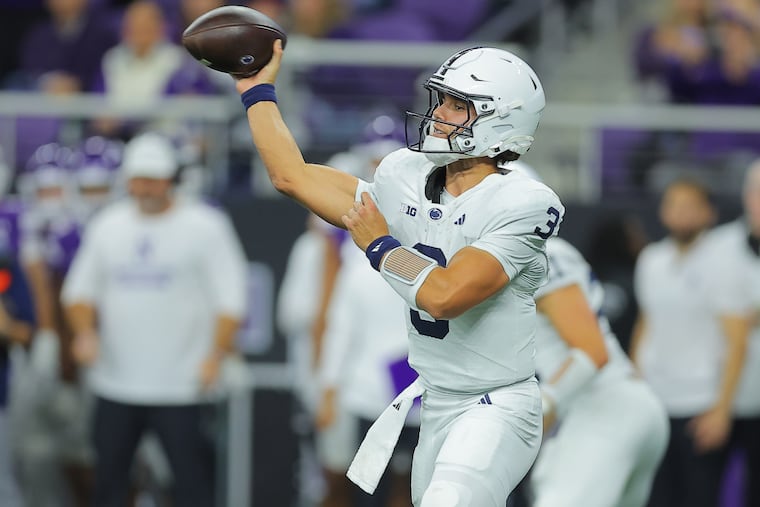
As the future of college athletics takes shape, Penn State doesn’t need permission to speak for itself
Universities should not surrender their voice as Congress rewrites the rules governing student-athlete compensation.
Universities should not need permission from sports conference administrators to engage with Congress on legislation that will shape their future. That statement should be obvious.
As what had been a slow-brewing crisis in college athletics comes to a boil, Washington is finally paying attention.
For years, universities have struggled to manage a system increasingly shaped by sweeping court rulings, a patchwork of often-contradictory state laws, and endlessly competing commercial interests rather than any coherent national policy. Athletes navigate a tangle of name, image, and likeness rules, which govern the compensation they can receive and which vary widely by state. Administrators make decisions without knowing what the rules will look like six months from now. And fans watch their favorite players transfer from campus to campus with few reliable guardrails in place.
Yet as Congress considers the Protect College Sports Act, the most significant attempt in years to establish a national framework for college athletics — many universities appear reluctant to engage publicly while conference administrators increasingly position themselves as the primary voice speaking on behalf of their members.
That should concern every university trustee, president, donor, alumnus, college athlete, and policymaker.
This is not a debate about whether the Protect College Sports Act is perfect. It isn’t. Nor is it a debate about whether conference commissioners are talented leaders. Many are.
This is a debate about who should speak for universities when the future of higher education and intercollegiate athletics is being decided.
The current system is broken — and there are only two realistic options for what comes next: a federal framework that restores stability and national standards, or the continuation of today’s chaos. There is no option three.
What troubles me most is not opposition to the Protect College Sports Act. Reasonable people can disagree. What troubles me is the notion that universities should remain silent while others speak for them.
As a Penn State graduate, two-time NCAA All-American wrestler, donor, parent of a future Penn State athlete, and someone who has spent four decades building businesses and advising organizations throughout college athletics, I have watched this moment unfold from nearly every angle.
My perspective comes from life as an athlete, entrepreneur, executive, adviser, and parent. From the wrestling mat to the boardroom, I have never seen college athletics facing greater uncertainty than it does today.
Congress is not asking the Big Ten what is best for Penn State. Congress is asking stakeholders what is best for college athletics.
In fact, one of the bill’s cosponsors, Sen. Maria Cantwell of Washington, recently challenged the growing influence of conference administrators in the legislative process, asking whether universities were really comfortable allowing conferences to drive the discussion.
It’s a fair question.
Penn State should answer that question itself.
Lawmakers are finally engaging. They are asking questions. They are seeking input from universities, athletic leaders, and stakeholders across the country. Penn State should be part of that conversation.
If conference administrators are prohibiting university leaders, trustees, athletic directors, donors, and other stakeholders from engaging directly with lawmakers or expressing support for legislation, then conference employees are attempting to silence the voices of the institutions that created them. That is not their role.
Universities created the conferences. Conferences exist to serve universities — not to control them.
If institutions with Penn State’s stature are unwilling to engage directly with lawmakers, then the future of college athletics will increasingly be shaped by others.
The stakes extend far beyond football. As a former student-athlete, I know firsthand that the value of college athletics goes well beyond the sports that generate the largest television audiences. Wrestling, volleyball, gymnastics, swimming, track and field, soccer, softball, lacrosse, and dozens of other sports depend on a healthy and sustainable collegiate model.
The opportunities those programs create changed my life, as they have changed the lives of countless others. They deserve to exist for future generations as well. That is what is at stake.
The decisions being made in Washington will affect every university in the nation. They will shape opportunities for college athletes for decades to come.
Pennsylvania’s universities deserve a voice in that discussion. Penn State certainly does — and it should take its seat at the table and speak with its own voice, as should other institutions that have recently voiced independent concerns, including Michigan, Ohio State, and USC.
Not because the legislation is perfect. Not because every stakeholder agrees. But because leadership requires engagement.
Penn State has never been a follower. It shouldn’t start now.
Chris Bevilacqua is a veteran of four decades in sports, media, and technology as an entrepreneur, operator, investor, and adviser, including founding the nation’s first 24-hour college sports television network. He is a 1986 graduate of Penn State where he was a two-time NCAA All-American on the wrestling team and also competed internationally for USA Wrestling.