An 18th-century battle flag sewn in Bethlehem, Pa., tells a little-known tale of the American Revolution
The Pulaski Banner stands out not only for its striking design but for the extraordinary story it shares about the international roots of America’s fight for freedom.
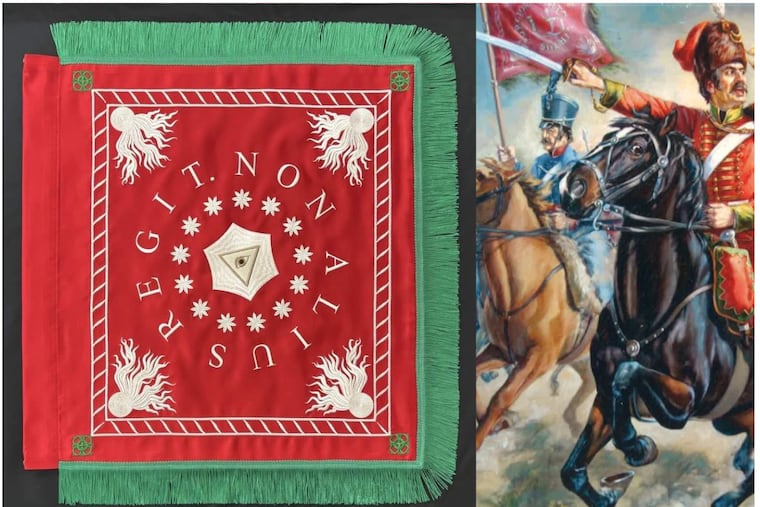
The story begins with Michael Kováts de Fabriczy, a Hungarian nobleman and battle-hardened hussar who had fought in many of Europe’s 18th-century wars.
Inspired by reports of the American colonies’ struggle for independence, Kováts wrote to a Philadelphian named Benjamin Franklin offering his services to the revolutionary cause. “Golden liberty cannot be purchased with yellow gold,” he wrote. In 1777, he arrived in Pennsylvania to join the fight.
Though he spoke little English, Kováts quickly found his place among Pennsylvania’s German-speaking communities, many of them Moravian Protestants who shared his religious convictions and passion for liberty.
Within months, he joined forces with Casimir Pulaski, the Polish nobleman and military commander, to establish the Pulaski Legion — America’s first professionally trained cavalry unit, formed with the tactics and discipline of European light cavalry.
But Kováts’ contributions extended beyond the battlefield. His influence reached into the design of a historic flag carried by Gen. Pulaski’s troops themselves.
This summer, visitors to Philadelphia’s Museum of the American Revolution will have the rare opportunity to view some of the most remarkable artifacts of the Revolutionary War: its original flags. Among them, the Pulaski Banner stands out — not only for its striking design, but for the extraordinary story it tells about the international roots of America’s fight for freedom.
Part of the museum’s “Banners of Liberty” exhibit, the Pulaski flag embodies a powerful but little-known connection between Poland, Hungary, and the United States — a shared yearning for liberty stitched into the fabric of an American symbol.
The Pulaski flag was sewn in 1778 by Moravian Sisters in Bethlehem, Pa. Bethlehem’s Moravian community was a quiet but vital hub of revolutionary support. Kováts had deep personal ties to it.
Years earlier, while serving in the Prussian army, he had befriended the family of Countess Susan von Gersdorff, a prominent figure in the Moravian Church in Bethlehem. Their connection helped forge a relationship between Kováts, Pulaski, and the Moravian community — one that played a role in the creation of the Pulaski flag.
The flag’s design was more than symbolic. Its crimson silk, green fringes, and yellow-white embroidery reflected the traditional colors of Hungary, used since the 17th century.
Its Latin motto, Unita Virtus Forcior — “United Valor is Stronger” — also echoes Hungarian political thought, closely resembling the national motto of Prince Báthori: Virtus Unita Valet.
The U.S. initials within the flag’s laurel wreath mark one of the earliest uses of such abbreviation for the fledgling nation. Together, these elements made the banner a distinctive emblem of transatlantic ideals.
Over time, romanticized stories about the flag’s presentation to Pulaski took hold, fueled by art and literature — most famously, Henry Wadsworth Longfellow’s poem, “The Hymn of the Moravian Nuns.”
A 1930s mural at Hotel Bethlehem’s ballroom captures this scene, even though historical evidence for such a ceremony remains elusive. Still, the legend itself speaks to how deeply the flag resonated.
The real history, however, is even more compelling. The fact that this extraordinary banner emerged from a small Pennsylvania town — through the unlikely collaboration of a Hungarian hussar, a Polish general, and devout American artisans — captures the spirit of the American Revolution in its most expansive sense.
It was not just a colonial uprising, but a global cause that attracted people willing to risk — and give — their lives for liberty. Kováts was one of them — he died in 1779 at the Battle of Charleston.
As the United States approaches its 250th anniversary, the “Banners of Liberty” exhibit offers a timely invitation to rediscover these forgotten threads of American history. Like many of the flags on display, the Pulaski Banner is more than a relic. It’s a testament to the enduring power of unity, cultural exchange, and the shared hope for freedom that helped birth a nation.
Anna Smith Lacey is the executive director of the Hungary Foundation. László Örlős is vice president for international affairs at the Mihály Kováts Friendship Society in Hungary. He is also the head of international and sustainability affairs at the Hungarian Export Promotion Agency.