Split decision: How the Art Museum missed an opportunity with its new ‘Rocky’ exhibition
The exhibit could have done more to honor and explore why, virtually every day for 50 years, the masses have come to run the museum’s steps, and for the last 20 years, to pose with the statue.
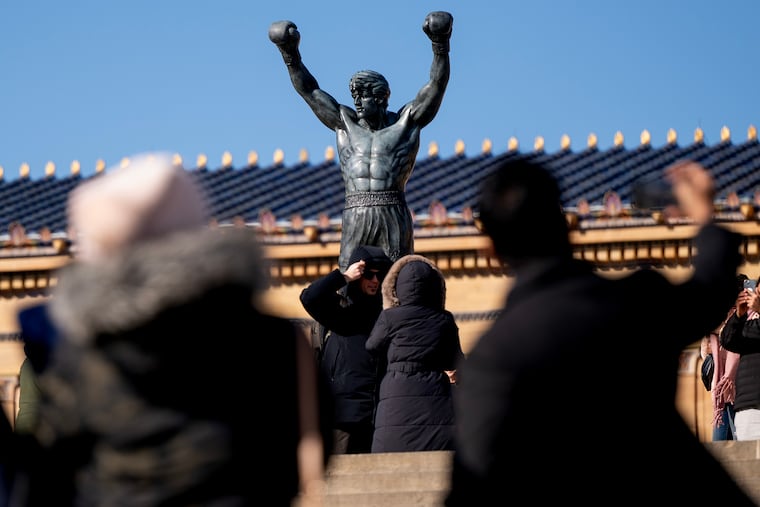
There are many elements to applaud in the new exhibit, “Rising Up: Rocky and the Making of Monuments,” at the Philadelphia Museum of Art.
It does succeed in important ways. Most of all, it gives its due to Joe Frazier, the Philadelphian and heavyweight world champion, whose epic fights with Muhammad Ali electrified the nation and the world. The exhibit highlights Philadelphia’s boxing history and other sensational fighters like Bernard Hopkins.
From my perspective, however, the exhibit missed a golden opportunity.
I am no art critic or museum curator. I am a street reporter who observed, year after year, people running the steps, so happy to celebrate at the top, and I decided to spend a year at the steps and write a book about the phenomenon. Along with Inquirer photographer Tom Gralish, I told the stories of people from all over the world who came to run the steps like their fictional hero.
Rocky celebrates its 50th anniversary this year, and the nation its 250th. It is right and appropriate for the museum to celebrate the film, which won the Academy Award for best picture and still resonates half a century later.
But in my view, rather than — or at least in addition to — focusing on the Rocky statue, and the role of monuments and the connection to boxing, the exhibit should have centered more on the movie itself and all it has meant to the city and the culture. The exhibit could have done more to honor and explore why, virtually every day for 50 years, the masses have come to run these steps, and for the last 20 years, to pose with the statue. Rocky is about inspiration and, most of all, transformation.
And the iconic expression of that transformation is the running of the steps.
Let me remind everyone about the scene that made those steps iconic. Rocky Balboa is a down-and-out boxer, no friends, no manager, no girlfriend. He’s making a living as a tenderhearted leg breaker for a loan shark. Then he gets his chance of a lifetime — to fight Apollo Creed, the heavyweight champ, in Philadelphia on the Bicentennial.
Early in the movie, and in his training, Rocky cannot make it to the top of the museum steps. He falters. But on the eve of the fight, at the end of a famous montage, he sprints up the steps and celebrates at the top, alone. He is not celebrating victory in the ring — he is celebrating his transformation.
Rocky has worked so hard and already achieved what’s most important — the love of Adrian, the friendship with Mick, his trainer, and his own self-respect. He has learned that without these things, success in the ring would have no meaning.
Soon after the movie premiered in November 1976, people started running the steps and celebrating like Rocky at the top. This ritual was organic, not some marketing invention. Running the steps allowed people to bring the message of the movie to life, to be the stars of their own life stories.
As Sylvester Stallone noted in the foreword to our book: “You know, you can’t borrow Superman’s cape. You can’t use the Jedi laser sword. But the steps are there. The steps are accessible. And standing up there, you kind of have a piece of the Rocky pie.”
Several key components contribute to making the scene iconic.
First is the story — that through hard work and dedication, an everyman can overcome long odds and achieve his dream.
Second is the architecture and the venue itself, the classical museum, and what it represents. Then the design and location of the steps, with the vista of the city below.
Fourth is the music, the ubiquitous Rocky theme, “Gonna Fly Now,” written by then-unknown Bill Conti, which so many runners sing, hear, or imagine as they run.
And finally, the camera, the Steadicam, created by Philadelphian Garrett Brown, tested on those very steps and essential to capturing the epic run. All these elements combined made the scene at the steps what it became.
To the museum’s credit, the exhibit begins with a giant video of those beautiful steps, 72 in all, with the dimensions of a grand staircase that begs to be run. And there is a mellow version of the Rocky theme song playing at the entrance, but so mellow I didn’t even notice it the first time through.
The exhibit does include the demo tape of Brown’s future wife running the steps. But so much more could have been done to explore all these elements, not to mention the stories of the runners themselves.
I found and believe it is still true today that people run for profound and deeply personal reasons: to celebrate overcoming odds and difficulties in their own lives, to come for motivation for challenges ahead, or to share their connection to the movie with their partners, children, and loved ones.
Stallone understood the power of the steps. And in Rocky II, he runs them again, this time followed by hundreds of schoolchildren.
In Rocky III, the fictional mayor dedicates the statue to Rocky at the top of the steps, saying, “This memorial will stand always as a celebration to the indomitable spirit of man.”
In every Rocky sequel, as well as in Creed and Creed II, there is a scene at the Rocky steps or (in Rocky IV, which takes place in Russia) a flashback to it.
I am so glad the museum and the movie have made their peace — another element of the Rocky story that could have been more deeply explored. I thought the Rocky statue at the bottom of the steps, where it was placed 20 years ago, was the perfect venue.
I am fine with it now at the top. People love it. It has become a symbol of the movie and the city. But let’s be clear. It draws its power and appeal from its proximity to the steps. When it was down at the Spectrum for 25 years, it did not have nearly the power or magnetism it has at the steps. And even inside the museum, as a work of art, it struck me as out of place.
And I quibble with one fact: The exhibit claims the statue attracts “approximately 4 million visitors a year.” The estimate comes from the Philadelphia Visitor Center, which used cell phone data to count foot traffic and included anyone who walked by the statue. I think that’s a very generous way to count, and misleading. The statue is beloved, but to reach four million visitors, the statue must average 456 visitors every hour of every day. Even now, at the top of the steps, on a beautiful spring day, I do not believe it averages close to that.
I believe that the people themselves, the Rocky runners, are the greatest tribute to the movie and its meaning. And as long as they keep running, they are living proof of the lasting power of Rocky and the indomitable spirit of man.
Michael Vitez, a former Inquirer staff writer and winner of the Pulitzer Prize, is the author, along with Inquirer photographer Tom Gralish, of “Rocky Stories: Tales of Love, Hope and Happiness at America’s Most Famous Steps.”