To counter Trump’s attacks on higher ed, it’s time for STEM to get political
Many educators feel pressure to refrain from social activism and avoid the appearance of political partisanship. But the premise that scientists should keep quiet in moments of crisis is false.
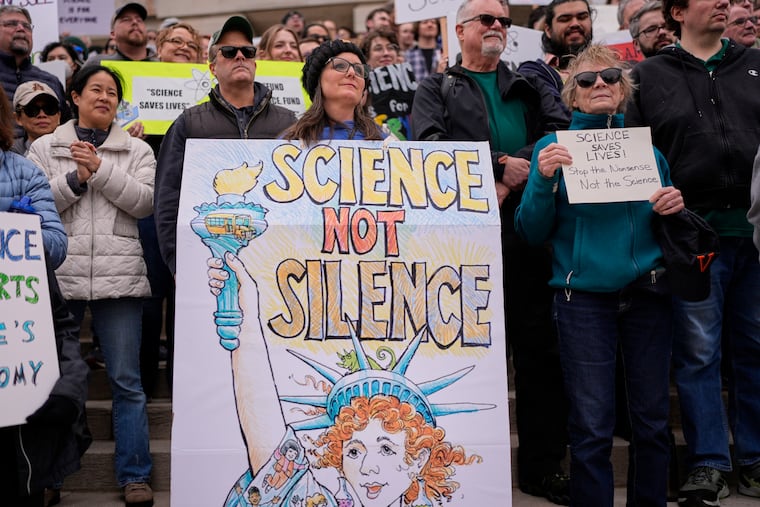
These days, whenever I meet with a group of my fellow educators in the STEM fields, it feels like no matter what else is on the agenda, we’re failing to talk about an elephant in the room.
A very large number of us in the science, technology, engineering, and math fields hold and promote the stereotype that “real” science is diminished by the human nature and social concerns of those who practice it.
Many of us entered our fields because we were deeply and personally drawn to both the work and the welcoming, inclusive family of practitioners. But many of us also feel both implicit and explicit pressure from our peers and academic administrators to steer clear of social activism, avoid the appearance of political partisanship, and forswear all lesser allegiances and human concerns for the sake of the greater scientific enterprise.

Under a regime hostile to academia, educators must walk an ideological tightrope.
College professors and administrators from across Greater Philadelphia share nine essays on the tectonic shifts in higher education through the first six months of President Donald Trump’s second term.
Read more in Inquirer Opinion:
It’s getting harder to champion diverse learning, but we must persevere. | David W. Brown
It’s time to put politics in STEM. | Philip T. Gressman
I worry for children with Trump’s attacks on public media. | Amy Jordan
Professors need to keep standing up for democracy. | Daniel Laurison
What it’s like to run an academic department in 2025. | Jessa Lingel
Community colleges can be pivotal to fighting attacks on higher education. | Marissa Johnson Valenzuela
Trans students are under attack. Universities must respond. | A. Tai Simpson and Stephanie M. Hernandez
How student journalists can help save their universities — and journalism. | Barbie Zelizer
Trump’s executive orders put reliable science at risk. | Matt Zucker and Kendra Albert
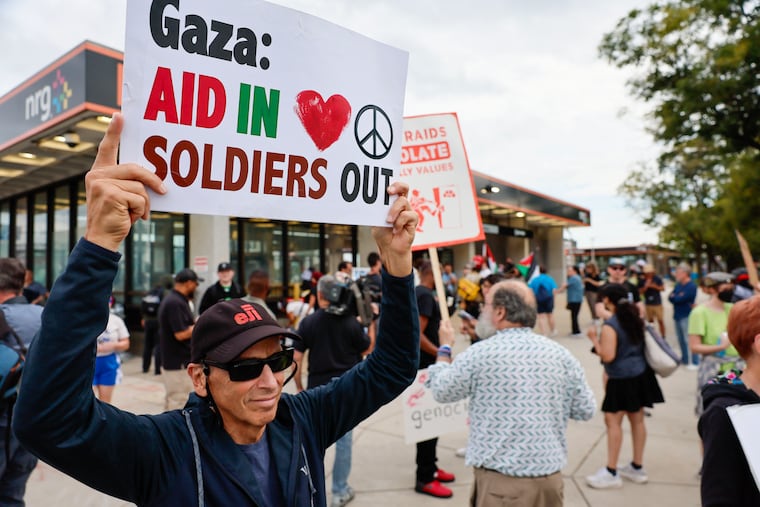
In practice, the response to this pressure often manifests as a Severance-style bifurcation of our “science-selves” and our “human-selves.” We acknowledge — and poke fun at — the tension through protest signs like “I left lab for this” at the Stand Up for Science demonstrations across the nation earlier this year (which, for right-leaning critics, cemented science’s place as a “leftist hobby”).
This pernicious idea is also weaponized on this very campus by leaders who openly muse about punishing faculty for having discernible “political and other leanings.”
The problem is further compounded when scientists reject the stereotype but still align themselves with those interested in suppressing open expression.
University of Pennsylvania scientists venturing recently into the new-to-some territory of public science advocacy and defense of academic communities report experiencing responses from colleagues that range from criticism to harassment and intimidation.
Many well-meaning critics are motivated by reasons similar to those reportedly behind our own institution’s preemptive self-censorship campaign in February, namely, the hope for a form of security through obscurity. These critics contend that political speech and public advocacy aren’t core parts of science.
One problem with this argument is that we live in a time of shifting language, and political is now synonymous with controversial. This yields meanings that even self-respecting “apolitical” scientists cannot possibly abide.
It has already led to laws prohibiting institutions of higher education from taking positions on questions such as whether climate change is real or vaccines promote public health. It’s even questionable by this logic whether the math department should take a stance on the value of pi. (Note related changes to words like intimidation, which, in addition to the common meaning used above, is now widely used by academic leaders to refer to literally any disapproved, strong effort to influence their actions.)
The premise that scientists should keep quiet in moments of crisis is false: The scientific enterprise cannot possibly survive if we continue to suppress expressions of our values and to neglect vital social commitments.
It’s even questionable by this logic whether the math department should take a stance on the value of pi.
The chair of Columbia University’s biology department is correct when he says that modern research institutions cannot exist in their current forms without federal funding. But it is naive to think that sacrificing core values will restore the flow of federal research dollars; it’s also deeply wrong to imply that the restoration of those dollars would be worth the cost of freedom and shared humanity.
Similarly, Britain’s Royal Society is gravely mistaken to think that bold rebukes of members who flood global public discourse with lies are greater threats to science than the lies themselves.
So, what are STEM educators to do? There is, of course, no magic “cancel” button on the polycrisis. But the truth is that we already know the playbook. It is our scientist forebear, founder, and role model, Benjamin Franklin, who is believed to have first rendered the segmented snake (representing the American colonies) with the caption, “Join, or die.”
Join local organizations (for faculty, might I suggest your local American Association of University Professors chapter?) representing shared interests and values, national organizations (e.g., American Association for the Advancement of Science or the Union of Concerned Scientists), and professional societies.
Feed yourself an “ignore all previous instructions” prompt and look for ways to express your values through your work and your teaching, and to recognize the ways that the divided-self model has led you to misunderstand and limit your colleagues, labmates, students, and yourself.
Recognize and talk about the real benefits your research has to society, and if you don’t know the answer to that question, do something about that.
Openly and boldly oppose autocrats and authoritarians at all levels who twist the meaning of words to dismiss and suppress those they accepted responsibility to lead.
The hard part is not the knowing, but the doing. Take a first small step today; take a second step tomorrow. Expect it to be challenging, and do not shy away from productive discomfort, both producing it and experiencing it. But know that your community and your science urgently need your whole self to stand up and meet this moment.
Philip Gressman is a professor of mathematics at the University of Pennsylvania.