Justices Sotomayor and Jackson: Cassandras for our time
Like the Trojan princess whose accurate prophesies were doomed to be disbelieved, dire warnings of the justices about American democracy are going unheeded.
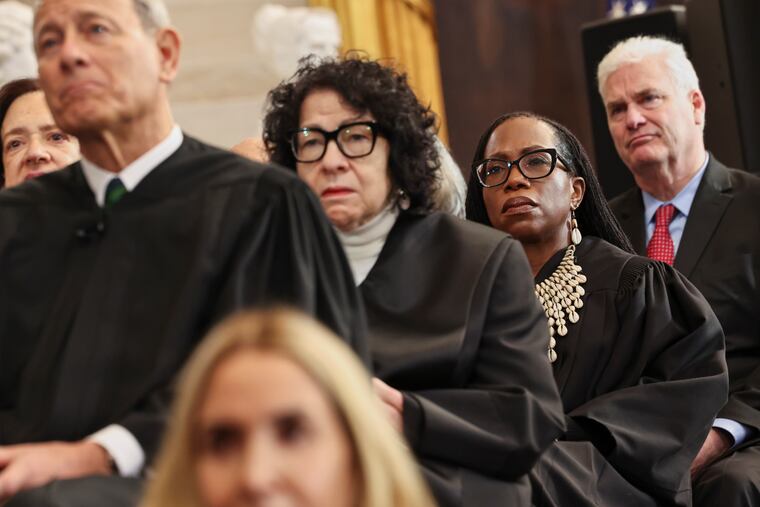
Through their frequent and increasingly forceful dissenting opinions, Justices Sonia Sotomayor and Ketanji Brown Jackson are sounding an alarm: Our democracy is in danger as never before in American history.
But will their warnings be heeded?
The Greek myth of Apollo and Cassandra seems to be playing out in 2025 America. Cassandra was a Trojan princess given the gift of prophecy, but cursed by an angry Apollo so that no one would believe her. She warned her brother, Paris, not to go to Greece, that his journey would lead to war.
As the war progressed, Cassandra tried to tell her father that Troy would fall. She warned against bringing a wooden horse into the city, saying it was a trick being played by the Greeks. No one took her seriously, though every prophecy came true, and the Greeks destroyed the city. Forty thousand people died.
Are Sotomayor and Jackson the Cassandras of our time? Their opinions repeatedly are sounding warnings.
“No right is safe in the new legal regime the Court creates. ... I will not be complicit in so grave an attack on our system of law.”
In June, each penned a dissent from the U.S. Supreme Court’s decisions preventing federal courts from issuing nationwide injunctions. Each expressed grave concerns that, at the very time a president was ignoring constitutional and legal limits, the court was greatly restricting the power of the judiciary to check him.
Sotomayor wrote: “No right is safe in the new legal regime the Court creates. … I will not be complicit in so grave an attack on our system of law.”
Jackson declared: “The Court’s decision to permit the Executive to violate the Constitution with respect to anyone who has not yet sued is an existential threat to the rule of law.”
Repeatedly, over the summer, as the emergency docket swelled, each wrote dissents to Supreme Court rulings that overruled lower court cases and upheld the actions of President Donald Trump.
In early July, the Supreme Court, without a word of explanation, overturned a lower court order that would have prevented people from Venezuela and Cuba from being sent to South Sudan, where they faced torture and even death. Sotomayor, in an opinion joined only by Jackson, strongly objected: “The Court’s continued refusal to justify its extraordinary decisions in this case, even as it faults lower courts for failing properly to divine their import, is indefensible … Other litigants must follow the rules, but the administration has the Supreme Court on speed dial.”
A court that favors Trump
The decisions in favor of the president kept coming, and so did Sotomayor’s and Jackson’s dissents. In August, Jackson wrote a powerful opinion objecting to the Supreme Court’s reversal of a lower court injunction requiring that the National Institutes of Health restore funding that had been illegally terminated.
She declared: “[R]ight when the Judiciary should be hunkering down to do all it can to preserve the law’s constraints, the Court opts instead to make vindicating the rule of law and preventing manifestly injurious Government action as difficult as possible. This is Calvinball jurisprudence with a twist. Calvinball has only one rule: There are no fixed rules. We seem to have two: that one, and this Administration always wins.”
As in Greek mythology, we are again dealing with a powerful man who is acting out of anger and revenge, with women who are powerless to be heard and acknowledged, refusing to be quiet.
Some criticize Sotomayor and Jackson for not looking for compromises, for speaking too much, for being too shrill. But shouldn’t we be asking why, at a time when Sotomayor and Jackson are warning that our democracy is in danger, others are being so timid and conciliatory?
“The Court’s decision to permit the Executive to violate the Constitution with respect to anyone who has not yet sued is an existential threat to the rule of law.”
Powerful dissenting opinions matter. They remind the country of its values and point the way to a better future.
Tradition of great dissenters
Justice Louis Brandeis famously dissented, writing not long before much of the world fell to fascism: “Experience should teach us to be most on our guard to protect liberty when the government’s purposes are beneficent. Men born to freedom are naturally alert to repel invasion of their liberty by evil-minded rulers. The greatest dangers to liberty lurk in insidious encroachment by men of zeal, well-meaning but without understanding.”
At other times when our country has been at its angriest, dissents have urged respect for powerless minorities.
Powerful dissenting opinions matter. They remind the country of its values and point the way for a better future.
When the Supreme Court tragically upheld the evacuation of Japanese Americans from the West Coast during World War II, Justice Robert H. Jackson prophetically warned: “The Court for all time has validated the principle of racial discrimination in criminal procedure and of transplanting American citizens. The principle then lies about like a loaded weapon ready for the hand of any authority that can bring forward a plausible claim of an urgent need.”
Far from calling for politeness and deference, in times like these, we should applaud this court’s Cassandras who follow in the tradition of the great dissenters before them.
The first nine months of this Trump presidency have been unlike anything this country has seen: the repeated ignoring of the Constitution and laws, the efforts to enormously increase presidential authority, the use of power for the sake of retribution.
But will the warnings, especially by these two women, be heard and heeded? Just as it did in Troy, that question may determine the future of our democracy.
Erwin Chemerinsky is dean of the University of California, Berkeley School of Law. Lisa Tucker is a professor of law at Drexel University’s Thomas R. Kline School of Law. Together, they are the cofounders of We Hold These Truths, a nonprofit that seeks to educate Americans about the rule of law in a constitutional democracy.