‘Conversion therapy’ is antithetical to responsible psychological counseling
The Supreme Court seems poised to validate a debunked practice that aims to reinforce a mandated definition of sexual orientation and gender identity.
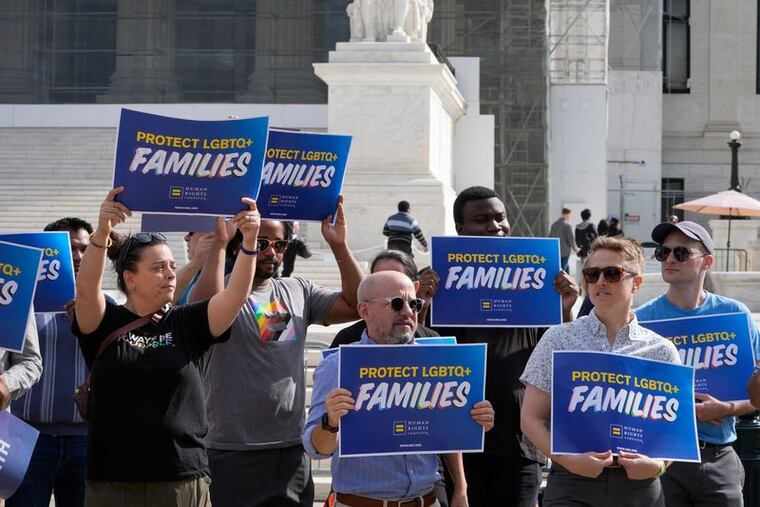
As I listened to the recent oral arguments before the U.S. Supreme Court challenging Colorado’s ban on conversion therapy for minors — a pseudoscientific practice that attempts to change or suppress a person’s sexual or gender identity — as a mental health professional, I was confronted with a difficult truth: The Supreme Court debate itself revealed major gaps in the general understanding of what ethical therapy is, and how it differs from malpractice.
While the decisive action taken in 2024 by the Shapiro administration and five state licensing boards to officially declare conversion therapy professional misconduct and harmful is a major victory affirming our ethical standards here in Pennsylvania, the questions raised by the justices underscore a critical and urgent need. Mental health professionals must clearly communicate to the public, especially to the youth in our commonwealth, what constitutes sound, ethical, and effective treatment.
To an outside observer, or even a justice who sits on the highest court in the land, psychotherapy might seem like a conversation with someone who is supportive and compassionate.
But the psychological science confirms that this impression is patently inaccurate. Evidence-based psychotherapy is built on the premise that validation, acceptance, and understanding are the keys to alleviating distress, strengthening relationships, and enabling healthier life choices.
Becoming a competent and ethical psychotherapist takes years of specialized training, study, and supervision.
Importance of validation
Just looking at one of these skills, validation, we can see how complex this is. Validation is the focused act of striving to understand a person’s feelings, thoughts, and behaviors, reflecting the ways their reactions make sense in the context of their lived experience.
Crucially, and something I stress to my own patients, validation is not agreement or approval. True validation allows for curiosity, paving the way for the self-acceptance that is essential for learning and growth. And, importantly, validation requires the therapist to put aside their own wishes, hopes, and beliefs, also not easy or natural.
The entire premise of conversion therapy stands in direct opposition to what comprises ethical practice by therapists.
Conversion therapy asserts that one’s inherent sexuality, a quality that lacks any evidence of malleability, is pathological and must be altered. This lie is deeply shaming and stigmatizing.
Shame and stigma do not persevere without active promotion from those in power.
A therapist’s position is not that of a mere “conversation partner,” but a person in an official capacity with specialized training.
The entire premise of conversion therapy stands in direct opposition to what comprises ethical practice by therapists.
Any professional who promises a client they can alter their core sexual identity is exploiting that power and acting in the face of the overwhelming evidence that their own training is built upon.
To illustrate, consider a licensed dermatologist consulting with a patient whose natural skin tone is subject to deep societal prejudice. The patient wishes to permanently change their skin color to escape this stigma, and the dermatologist, perhaps due to a shared personal or religious belief, sincerely wishes they could grant this escape.
Despite this shared wish and personal conviction, if the dermatologist were to accept payment and declare, “I will prescribe a treatment that will permanently and fundamentally rewrite your DNA to give you an entirely different skin color,” that doctor would be committing profound malpractice and fraud.
Unethical and immoral
More than just unethical, it is immoral, because it validates and profits from the harmful, prejudiced notion that the patient’s natural, nonpathological trait is a curable defect. Their oath demands they communicate the truth: that such a fundamental alteration is impossible.
The therapist’s scenario is the direct professional equivalent.
They might share a client’s faith-based desire to alter their sexual orientation. But this desire does not supersede the scientific consensus of every major national psychological, psychiatric, and medical organization, all of which agree that sexual orientation is not a disease to be cured or a choice to be changed.
A therapist can ethically help a client manage their feelings or behaviors related to their orientation; they cannot ethically promise to remove the orientation itself.
To promise this impossible, discredited service is professionally unethical and morally corrosive, as it actively reinforces the lie that a natural variation of human existence is a defect needing a “cure.”
The distinction is clear: Ethical therapy offers acceptance; malpractice promises an impossible cure.
The debate before the Supreme Court is not about a professional’s freedom of speech; it is about protecting the public — especially vulnerable minors — from emotional violence perpetrated under the guise of professional care.
Keren Sofer is a Philadelphia-based clinical psychologist.