Trump is making it harder for us to champion diversity, but we absolutely cannot give up
Despite proclamations against so-called wokeness and executive orders seeking to whitewash history, instructors like me still have the ability to shape our students into empowered critical thinkers.

I’ve been a champion of diversity in education before I even knew diversity was something I had to fight for.
I’m a proud product of Philly’s public schools. Born and raised in West Philly, I gladly took a bus and two trains every day to get to Central High School back in the early ‘80s. There, I was exposed to some of the most transformative learning environments of my educational journey.
My classmates came from every corner, every ethnicity, and every socioeconomic background of the city. Academic achievement was the common denominator, and when I was ready to go to college, I felt prepared to take on whatever challenge was put before me. I wrote for our high school paper, won awards for my writing, and was determined to major in journalism as my way of shaping the world into a better place.

Under a regime hostile to academia, educators must walk an ideological tightrope.
College professors and administrators from across Greater Philadelphia share nine essays on the tectonic shifts in higher education through the first six months of President Donald Trump’s second term.
Read more in Inquirer Opinion:
It’s getting harder to champion diverse learning, but we must persevere. | David W. Brown
It’s time to put politics in STEM. | Philip T. Gressman
I worry for children with Trump’s attacks on public media. | Amy Jordan
Professors need to keep standing up for democracy. | Daniel Laurison
What it’s like to run an academic department in 2025. | Jessa Lingel
Community colleges can be pivotal to fighting attacks on higher education. | Marissa Johnson Valenzuela
Trans students are under attack. Universities must respond. | A. Tai Simpson and Stephanie M. Hernandez
How student journalists can help save their universities — and journalism. | Barbie Zelizer
Trump’s executive orders put reliable science at risk. | Matt Zucker and Kendra Albert
It was in college that I discovered there would be barriers to overcome that had more to do with the complexion of my skin than the competence of my writing.
In my very first assignment in my freshman English class, the professor tried to embarrass me by physically parading my paper around the class — full of red ink — as an example of what bad writing looked like.
I was the only Black person in the class, and, as a professor myself, I know there are a myriad of ways to provide students with constructive criticism. Singling out your only Black student in such a public fashion was cruel, lazy, and racist.
But it motivated me to turn my anger into action.
» READ MORE: At UPenn, the silence of allies poses the greatest challenge in the battle to uplift all | Opinion
I was convinced I was a better writer than this professor made me out to be, and I was determined to prove it. Not only did I outperform my classmates, I also eventually became the news editor for our college newspaper and made the dean’s list six out of eight semesters (despite my dean doubting my ability by advising me to explore “less creative fields like accounting,” which would be a “more realistic” career path for “someone like me”).
Before becoming a professor, I enjoyed a fairly successful career in advertising and public relations. I’ve been inducted into both of Philly’s separate PR and advertising halls of fame. I’ve owned or managed five agencies in the city, and have even been to the White House to share my expertise. But that shaming experience in college had a profound effect on me, and continues to motivate my work in higher education.
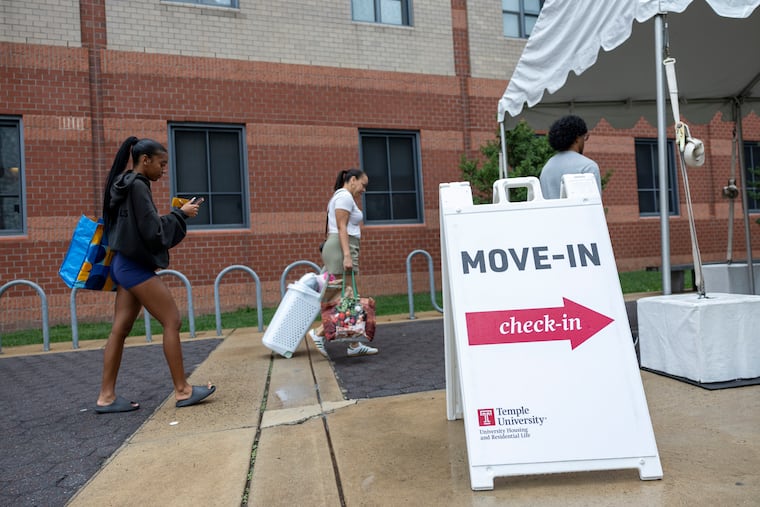
At Temple, I’ve developed and taught classes on diversity in PR. I’ve helped other faculty learn how to teach on tough topics like race, religion, and politics from the standpoint of embracing diverse views. My students call me tough but fair, and I see the promise in them that I wish had been seen in me.
In this era when concepts of diversity, equity, and inclusion are under attack, we instructors are the ones who continue to hold power in the classroom. Despite proclamations against so-called wokeness and executive orders seeking to whitewash history, instructors like me still have the ability to shape our students into the kind of informed and empowered people who can fight on when the battle demands it.
When I entered my first college classroom as a student more than 40 years ago, I didn’t see many professors who looked like me, and concepts of diversity, equity, and inclusion weren’t principles that were prominently embraced by many institutions of higher learning. Over the years, that has changed, and I have felt we had reached a tipping point in which DEI was being embraced in a more broad-based fashion.
But I have come to realize that achieving diversity, equity, and inclusion in higher education (or in any field) is more of a pendulum swing than a tipping point. And while it seems the balance is moving further in the other direction, I’ve been around long enough to know that, in the words of many who have preceded me, the arc of the moral universe is long and bends toward justice. It simply requires a commitment to stand your ground when others try to shake the earth from under your feet.
David W. Brown is an associate professor and serves as assistant dean for community and communication at the Klein College of Media and Communication at Temple University.