Cuba uses U.S. sanctions to deflect blame for prioritizing regime survival over citizens’ needs
The tragedy of the “blockade-only” narrative is that it transforms international observers into accomplices.
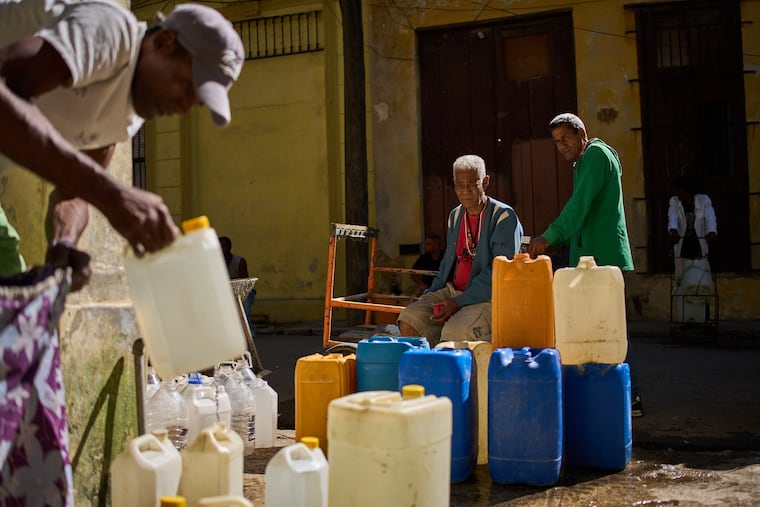
In one store in Cuba, the shelves are empty. The line stretches out the door as people wait for their monthly rations, maybe a pound of rice for the month.
Just one block away, there is another store. This one is air-conditioned, a rare luxury. Its aisles are stocked with imported products, and the line is short, not because Cubans don’t want to shop there, but because most cannot. These stores operate in MLC (moneda libremente convertible), a digital currency pegged to the dollar and accessible only to those with family abroad or connections to the regime.
That contradiction captures the reality of life in Cuba today: scarcity exists, but so does supply. The deeper problem is not simply what is available, but who has access, and why.
Yet, recent international discourse surrounding Cuba’s collapse has largely ignored this internal architecture of inequality. Instead, the conversation has retreated into a familiar geopolitical binary: blaming U.S. policy as the sole driver of the island’s suffering.
Democratic lawmakers have described the recent oil blockade as a form of “economic bombing” or “cruel collective punishment.” While this framing fits domestic debates, it distorts a more complex reality.
By casting the crisis as purely external, the media shields the Cuban state from scrutiny and responsibility for policies prioritizing regime survival over citizens’ needs.
The weight of the sanctions narrative
The U.S. embargo is not without faults.
Proponents of the “sanctions-first” narrative argue that the designation of Cuba as a state sponsor of terrorism (SSOT) and tightened maritime insurance have created a “compliance chill.” These measures restrict credit access and raise import costs. In this view, the Cuban government is a handicapped actor, forced to manage its economy with one hand tied.
However, the narrative of a “total blockade,” still propagated by the Cuban government and parts of U.S. media, is undermined by the existence of MLC stores. These establishments show that the barrier to goods in Cuba is not a physical naval wall, but a financial gate maintained by the state.
Much of this retail infrastructure is managed by GAESA (Grupo de Administración Empresarial SA), a military-run conglomerate with near-total opacity. By forcing purchases in external currency it collects, the regime has created an internal extraction system. The state captures hard currency from remittances while most Cubans survive on a devalued national peso with no power in well-stocked aisles.
The crisis is not just about shortages, but deliberate distribution. The state uses the “common enemy” of U.S. sanctions to achieve narrative immunity, masking a domestic economic model that incorporates elites while the informal sector starves.
The ‘embargo-only’ fallacy
The same distortion extends to the energy crisis.
In 2026, the collapse of the Cuban grid was widely blamed on an “oil blockade.”
However, this ignores decades of delayed maintenance and refusal to modernize. For years, the government relied on subsidized Venezuelan oil to avoid investing in aging Soviet-era plants. When those subsidies faltered, the state chose to protect regime liquidity over maintaining the grid, prioritizing luxury hotels and military-run tourism even as domestic supply collapsed.
The crisis is not “economic bombing,” but the end point of policies treating infrastructure as secondary to military profit.
“Engagement” is not neutral. Because the Cuban economy is structured around military conglomerates like GAESA, trade often flows into systems that manage scarcity rather than alleviate it. Scholarship on authoritarian survival suggests that regimes under pressure do not necessarily reform; they refine extraction.
Any policy shift only makes sense if it accounts for this. Without addressing the state’s monopoly on currency and distribution, external changes are more likely to stabilize power than alter daily reality.
Beyond the shield
The tragedy of the “blockade-only” narrative is that it transforms international observers into accomplices. When foreign media repeat Havana’s talking points, they validate a system holding its population hostage.
As long as the world believes shortages are solely the fault of Washington, the generals running GAESA are never asked why their hotels remain lit while the rest of the island sits in darkness.
The truth about Cuba is uncomfortable: The state has mastered the art of using external pressure as a mask for internal failure.
Scarcity is not accidental or purely external; it is structural for a regime that fears an independent, well-fed citizenry. Until the narrative shifts to hold Havana accountable for its own choices, the lines will grow longer, the streets will deteriorate, and the country will sink further into darkness.
Laura Morejon Rodriguez is a student at the University of Pennsylvania, studying political science and international relations with a special interest in Latin America. She was born and grew up in Cuba.