The regime does not make mistakes
The language used by the Trump administration to justify occupation and arrests chillingly echoes that of Latin American dictators like Augusto Pinochet.
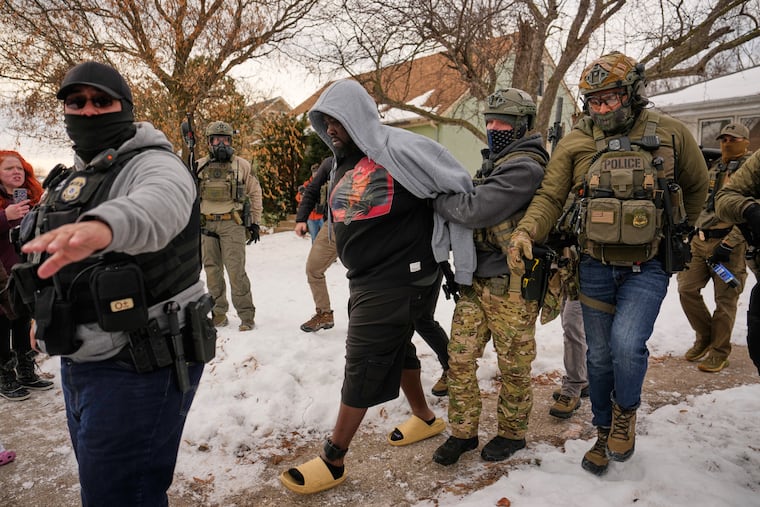
Manuel Contreras, the head of the secret police during Chile’s dictatorship, which reigned from 1973 to 1989, once explained why so many seeming innocents — students, union leaders, local activists — were murdered by the state: “The guerrilla tries to act like a normal citizen, honest and good, and lies even to his family. When discovered, he will always deny the facts.”
The regime does not make mistakes.
“The lack of specific information … demonstrates that they are terrorists with regard to whom we lack a complete profile.”
That last bit wasn’t the head of Chile’s secret police, though. It was a U.S. Immigration and Customs Enforcement field director, Robert Cerna, explaining last March why 75% of Venezuelan deportees to El Salvador’s mega-prisons had no criminal background.
I am a scholar of authoritarian politics at the University of Pennsylvania. I research and teach about repression and censorship. The Trump administration is engaged in state terror. And, in a page ripped from the autocrat’s playbook, they are trying to convince us that the victims deserve it.
On Jan. 7, Secretary of Homeland Security Kristi Noem claimed Renee Good — shot in the head by an ICE agent while observing a raid — engaged in an “act of domestic terrorism.” Noem said that Good “weaponized” her car (the same car with a glove compartment overflowing with her child’s stuffed animals and a friendly dog in the back).
The very next day, federal agents shot two people in Portland, Ore., during a traffic stop. DHS claims the driver “is believed to be a member of the vicious Venezuelan gang Tren de Aragua,” who again “weaponized his vehicle.” The same claim appears again and again: to justify why federal agents killed Silverio Villegas Gonzalez in Chicago, and why they shot Marimar Martinez five times (the U.S. Department of Justice brought, and then dropped, charges against her). After Alex Pretti, a Veterans Affairs nurse, was executed by federal agents in Minneapolis on Jan. 24, White House Deputy Chief of Staff Stephen Miller called him a “would-be-assassin.”
The Trump administration wants you to believe that the people they are terrorizing and killing deserve it.
These are the same lies Augusto Pinochet told in Chile, where the regime frequently falsified reports that blamed the victims for their own deaths. Rather than executions, victims died in “shootouts.” The official government account of the death of one 28-year-old activist was that he was a “subversive” killed while attacking a barracks. But witnesses saw him being arrested two days earlier. A miner with no known political affiliation, the press claimed, “tried to seize a policeman’s weapon … and so he was shot.” Two victims executed by army troops were accused of “criminal or subversive activities.”
Like Pinochet, the Trump administration wants you to believe the people they are terrorizing and killing deserve it. They want us to accept, or even celebrate, their crimes. Because if a victim deserves what happened to them, if there is a reason for it, then perhaps it can be stomached, or excused away, or ignored.
During Argentina’s brutal 1970s dictatorship, civilians often justified repression using the phrase “Por algo será” — roughly, “There must be a reason for it.”
Victimization implied that the victims were guilty of something. People are thrown out of planes while drugged. Por algo será. They are taken from their families in the middle of the night. Por algo será. Bodies are dumped in mass graves. Por algo será.
And if there is a reason for it, then anyone can avoid being a victim by staying home. By not fighting. By letting the administration do whatever it wants, with no pushback.
Good was a 37-year-old white mother from Colorado, her death filmed at multiple angles, all of which make the government’s lies harder to swallow for an American audience. But who the victim is should not matter: The government is violating fundamental human rights.
It is our responsibility to refuse to accept these lies. To demand — and to pressure our representatives to demand — accountability for these crimes.
Jane Esberg is an assistant professor of political science focused on authoritarian repression and censorship, particularly in Latin America, at the University of Pennsylvania.

Inquirer Opinion Newsletter