In capturing and prosecuting Maduro, Trump is modeling ‘might makes right’
We cannot defend democracy by obliterating its foundations.
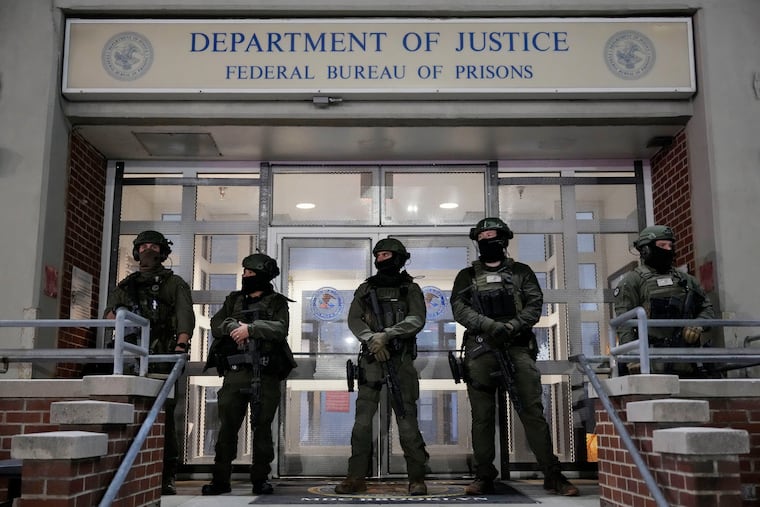
The images are historic and alarming: Nicolás Maduro, the president of Venezuela, captured and transported by a U.S. warship to stand trial in a New York federal court. President Donald Trump hails this as justice, promising Maduro will face the “full might of American justice.”
But this is not justice. It is its opposite.
Maduro is an autocrat. I do not support his rule. Yet, the spectacle of President Trump — a man who has pardoned convicted insurrectionists, who relentlessly attacks U.S. courts as corrupt, and whose lawyers’ arguments, in the words of a federal judge, sought to grant Trump “the divine right of kings” to avoid criminal prosecution — now acting as a global sheriff is the height of hypocrisy.
It reveals a belief that law is not a universal principle, but a weapon the powerful use against others while exempting themselves.
» READ MORE: Trump’s attack on Venezuela further flouts the Constitution he swore to uphold | Editorial
This double standard extends to the world stage. The United States fiercely rejects the jurisdiction of respected judicial bodies like the International Criminal Court, even restricting its prosecutors in order to protect Americans. Yet, it now unilaterally extends its own domestic courts to sit in judgment over a foreign leader, echoing the 1989 capture of Panama’s Manuel Noriega.
The charges of “narco-terrorism” may be serious, but the process is purely an assertion of power through legal theater.
This action shatters global order; it does not uphold it.
What principle will stop China from arresting a Taiwanese leader for “secessionist terrorism” to face a court in Beijing? What stops Russia from charging a Ukrainian president with “Nazi conspiracy” in Moscow? By normalizing this model — where powerful nations kidnap and try the leaders of weaker states — the U.S. is inviting a world of legalized vendettas.
It replaces a fragile system of rules with raw power.
For Americans, this is a direct threat to our security. It makes every U.S. official, diplomat, and service member abroad a potential target for retaliatory arrests by rival powers who will cite this case as their precedent.
We have just handed our adversaries a blueprint for political kidnappings disguised as “law enforcement.”
This action shatters global order; it does not uphold it.
The acting president of Venezuela, Delcy Rodríguez, is right to call this a mortal threat to sovereignty. True democrats in Venezuela, who seek a future free from Maduro, now face an impossible dilemma: Their cause has been co-opted by a foreign power’s invasion of their nation’s self-determination.
This act will not foster democracy; it will fuel nationalism and anti-American resentment for a generation, making a genuine, Venezuelan-led transition harder.
We cannot defend democracy by obliterating its foundations.
If we believe in any kind of justice, it must be a justice that respects the equality of nations before the law, not a justice delivered at gunpoint by the world’s most powerful navy to a courtroom in Manhattan.
The capture of Maduro and his wife by Trump may seem like victory for the U.S. administration today, but its legacy will be a more lawless, dangerous, and unstable world for all of us tomorrow.
He is not enforcing the law; he is proving that, in his view, only might is right.
Januarius Asongu is a scholar and the author of more than 20 books on political philosophy and international conflict. A resident of Townsend, Del., he is the founder and chancellor of Saint Monica University in Cameroon and of the American Institute of Technology in Sierra Leone.