Celebrating Adrienne de Lafayette and the other half of the American Revolution
The women of the Revolutionary era were far more than footnotes or symbols. They had a profound impact on history.
As we celebrate the 250th anniversary of the signing of the Declaration of Independence, we are already looking forward to stories that are equal parts familiar and extraordinary. Most of the focus will be on our Founding Fathers, whose legacies stand as giants among men, with the occasional nod to women like Betsy Ross, who are often reduced to a single symbolic act.
But the women of the Revolutionary era were far more than footnotes or symbols. Their experiences varied, but their impact was profound. Some sustained households and communities through war. Others helped shape and advance the very ideals of liberty, not as bystanders, but as equal partners in the cause.
In my 34 years at Lafayette College, I had the privilege of curating the manuscripts, books, artworks, and artifacts that make up the college’s distinguished Marquis de Lafayette collections. Our campus bears his name, and his likeness is everywhere.
‘Deeply fused’
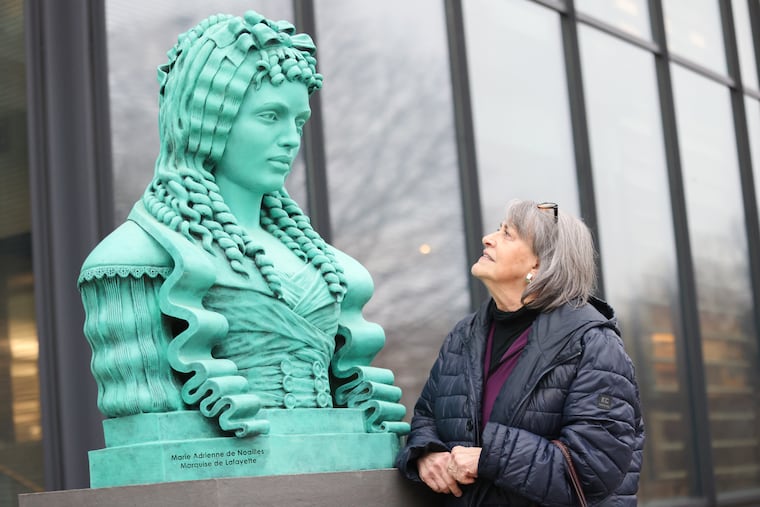
This spring, those many representations were joined by the person most “deeply fused” into his life: Marie Adrienne Françoise de Noailles, the Marquise de Lafayette.
The addition is not ornamental. Statues anchor conversations. They prompt questions. We hope this bust created by the late sculptor Audrey Flack will inspire students to ask not only who Lafayette was, but who stood beside him.
Married in 1774 at 14 to a 16-year-old Lafayette, Adrienne entered an arranged union that transformed into a love match. Three years later, her husband set sail for America, determined to join a revolution in a language he did not speak, for a country he had never seen.
We often reflect on that decision with our students, many of whom are the same age as Lafayette. At 19, Lafayette’s audacity feels almost incomprehensible to them. They measure his risk against their own lives and ambitions.
What receives less attention is Adrienne’s position.
She was 17, pregnant with their second child, when she wrote that she had been “cruelly abandoned.” The phrase is stark. It disrupts the romance of revolutionary heroism. Yet, what followed was not estrangement, but shared resolve.
Lafayette became the romantic foreign hero of the American Revolution. Adrienne became the steady force that allowed him to be one.
While he fought, she managed their estates, navigated family politics, and cared for their children. They wrote constantly. His letters from America often downplayed his dangers, even joking about the leg wound he suffered at the Battle of Brandywine. But beneath the levity was reliance. Adrienne’s words were sanctuary. She provided emotional shelter from an ocean away.
And when the fighting stopped and Lafayette returned home, her work only deepened.
Returning to a restive Paris, Lafayette, affectionately known as “father-provider,” oversaw the police and military, while Adrienne, called “universal mother,” organized collections for the poor and mourned those who perished in the storming of the Bastille.
Their collaboration extended beyond France and America. The Lafayettes purchased a plantation in French Guiana in an imperfect effort to undermine slavery from within the French colonial system. As revolutionary politics consumed her husband, Adrienne corresponded with plantation managers and arranged for the religious care of the enslaved people there. She also supported Lafayette’s advocacy for the civil rights of French Protestants.
These were not his causes alone. They were theirs.
The French Revolution would test that partnership, as Lafayette’s support for a constitutional monarchy made him radical enemies. In 1792, he fled France, only to be captured by Austrian forces and imprisoned for nearly five years.
Adrienne’s ordeal was perhaps more harrowing. Arrested in 1793, she endured the loss of her grandmother, mother, and sister, who were executed by the guillotine, just days before the end of the Reign of Terror. She was spared the same fate only through the intervention of Gouverneur Morris, the American minister to France, and the efforts of James and Elizabeth Monroe.
After her release, she did not retreat into obscurity. She petitioned relentlessly for her husband’s freedom. When that failed, she voluntarily joined him in the fortress prison of Olmütz until their release in 1797, negotiated with the assistance of Napoleon Bonaparte.
Her health never fully recovered, and she died in 1807. Her final words were for her husband: “I am yours alone.”
Lafayette became the romantic foreign hero of the American Revolution. His wife, Adrienne, became the steady force that allowed him to be one.
Her words were a testament to a love forged through shared conviction. She belonged to him in marriage and devotion.
But in her courage and commitment to human rights, she belongs to all of us.
The new bust on our campus will not tell her entire story. No single piece of art can. But it will prompt questions. And if this anniversary is to mean anything beyond spectacle, it should compel us to ask — again and again:
Who were the women who made revolution possible?
And how might our understanding of liberty deepen when we finally tell the stories of all people, not at the expense of key figures and familiar narratives, but alongside the men and their stories that we already know so well?
Diane Shaw is director emerita of Special Collections and College Archives at Lafayette College, where she oversaw the college’s Marquis de Lafayette collections.

Inquirer Opinion Newsletter