Philly hosting the World Cup is just the latest chapter in soccer’s American immigrant story
In 1930, the United States men’s soccer team, composed mostly of immigrants and working-class amateurs from Northeastern migrant communities, reached the semifinals of the World Cup in Uruguay.
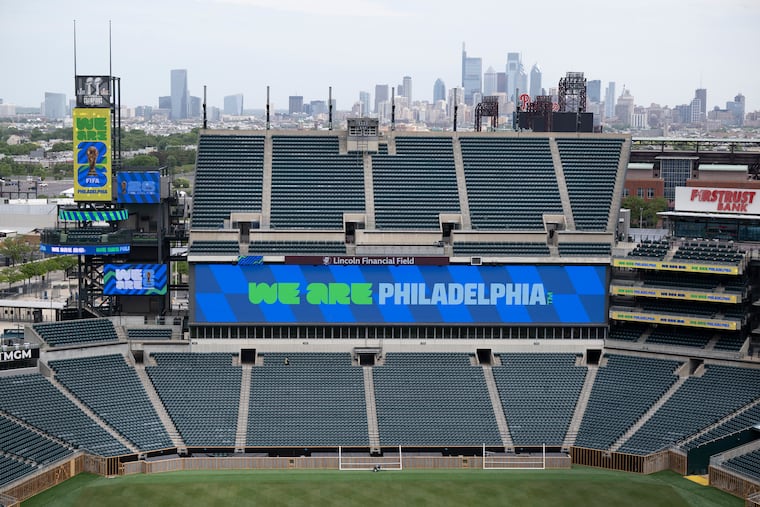
On July 4, tens of thousands of fans will gather at Lincoln Financial Field for a World Cup knockout match in the most global sporting event on earth. Philadelphia’s role as a hosting city for the World Cup coincides with its centrality to the nation’s Semiquincentennial birthday events. Soccer, the city hopes, will have the power to bring people together, to enjoy the city’s sites, and to boost the economy amid this year’s 250th hullabaloo.
The history of soccer in the United States has the potential to offer a sharper account of American life than the bombastic rhetoric surrounding America 250. That’s because the history of soccer is, in large part, a history of immigration.
Soccer’s roots in the United States were never separate from the movement of people across borders. In the late 19th century, the game took hold most firmly among British, Irish, Scottish, and other European immigrant communities, especially in industrial towns where factories, textile mills, and ethnic associations helped sustain local clubs and leagues.
The history of soccer is, in large part, a history of immigration.
The West Hudson region of Northern New Jersey became one of the country’s early soccer hotbeds, and that’s because immigrant workers made it one. British and Irish migrants, many drawn by textile work, built teams and institutions around the game. In places like Kearny, Harrison, and Newark, soccer was played on factory floors, ethnic clubs, and neighborhood fields. The game became a way for migrants to preserve ties to old worlds while making claims on a new one.
In the same decades that soccer persisted in these communities, mainstream American sporting culture increasingly elevated baseball as the “national pastime,” while college football emerged as a spectacle of institutional loyalty, physical toughness, and masculine discipline. That history helps explain why soccer has so often appeared peripheral to dominant narratives of American sport.
It was not because soccer lacked roots in the United States. It was because those roots distinctly ran through immigrant neighborhoods and working-class communities.
The first World Cup revealed the strength of that older soccer world. In 1930, the United States men’s soccer team, composed of mostly immigrants and working-class amateurs plying their trade in Northeastern migrant communities, reached the semifinals in Uruguay — still the men’s national team’s best finish ever.
The achievement remains oddly forgotten, perhaps because the 1930 team reflected a transnational soccer culture that had already taken root in the U.S. In later accounts, the United States’ success was often dismissed as the work of “imported” British professionals, but the label was misleading: players from abroad had built their careers in this country, where immigrant communities had already made soccer part of American life.
That pattern continued into the second half of the 20th century, and especially after Congress passed the Hart-Celler Act in 1965. The law dismantled the national origins quota system that had structured U.S. immigration policy since the 1920s, and helped create new patterns of migration from Asia, Latin America, Africa, and the Caribbean. In the decades that followed, the United States became more visibly connected to the rest of the world through families, labor markets, universities, media, and culture.
American soccer entered a new global phase. The North American Soccer League (NASL), founded in 1968, tried to turn the U.S. into a destination within the international soccer economy. The league is often remembered through its excesses: ambitious owners, uneven attendance, unstable franchises, and the spectacular rise and fall of the New York Cosmos.
Short-lived teams, like the Philadelphia Atoms (1973-1978), experienced success and collapse in equal measure, with the Atoms winning the league in 1973 and dissolving only five years later. While that story is not wrong, it is incomplete.
When Pelé joined the Cosmos in 1975, and Franz Beckenbauer followed later in the decade, they did more than lend glamour to a fragile sports venture. They arrived as migrants of a kind: workers, celebrities, and cultural ambassadors whose movement reflected the increasingly global circulation of labor, capital, media, and sport. Their presence revealed how global American soccer had long been, while recasting that history for a new era of television, corporate ambition, and post-1965 migration patterns.
The NASL was overhyped and commercially unstable. But it also revealed a desire that had never fully disappeared: the ambition to imagine American sport as part of a wider world. In the post-1965 United States, that was not merely a soccer story. It was an immigration story, too.
The modern U.S. national team reflects the same history in a new form. For decades, American soccer officials have searched across borders for players who could claim ties to the U.S. through birth, parentage, citizenship, or family history. United States men’s national soccer team coach Jürgen Klinsmann’s recruitment of German American players before the 2014 World Cup made that strategy especially visible, but it was not an aberration. It was a modern version of an older truth: American soccer has always depended on multiple forms of belonging.
Recent U.S. teams have included players whose lives and family histories cross national borders. Sergiño Dest was born in the Netherlands to a Dutch mother and Surinamese American father. Yunus Musah was born in New York and raised in Italy and England. Tim Weah is the son of Liberian president and soccer legend George Weah. Antonee “Jedi” Robinson was born in England to an American father. Folarin Balogun was born in New York, raised in England, and eligible for multiple national teams before eventually choosing the United States. The Philadelphia Union’s Cavan Sullivan, the most highly rated youngster playing in the United States right now, is of German Bangladeshi descent through his mother.
These players are sometimes described through the language of recruitment, eligibility, or strategy, as if they are exceptions to a more natural national order. But they are not loopholes in American identity; they are expressions of it. Their careers reveal what immigration history has always shown: national belonging is made through family histories, legal categories, labor markets, cultural attachments, and choices shaped across borders.
Even the word for the sport itself, soccer, so often mocked as proof of American provincialism, carries that history. It began as British slang for association football before becoming, in the United States, a marker of American difference. The word itself is borrowed, transformed, and made local.
That is the democratic promise of soccer. The game does not dissolve racism, class inequality, or nationalism. It has often even reproduced all three. It has been commercialized, segregated by access and cost, and governed by institutions more interested in revenue than justice.
The World Cup is governed by FIFA, an institution that has repeatedly turned the language of global unity into a vehicle for corporate profit, political accommodation to authoritarian nations, and state spectacle. It speaks in the language of inclusion, but its history offers little reason to trust it as a defender of the migrants, workers, fans, and communities who give soccer its meaning.
A tournament built on movement and plural attachment will unfold in a country whose government has made immigrant exclusion central to its political identity.
But in the United States, soccer has also offered immigrants, workers, racial minorities, and diasporic communities a way to claim public space. It has made visible forms of American belonging that official narratives have often pushed aside.
The 2026 World Cup will make that America visible. Fans will gather in Philadelphia carrying flags from around the world. Many will lay claim to more than one national story at once. That layered belonging should not be treated as a threat to American identity. It is one of American history’s most persistent facts.
E. Kyle Romero is an assistant professor at the University of North Florida. He studies the history of American foreign policy, immigration politics, and global consumer economics.
Made By History takes readers beyond the headlines with articles written and edited by professional historians. Opinions expressed do not necessarily reflect the views of The Inquirer.