From bike lanes to zoning codes, the needs of the few sometimes outweigh the common good | Shackamaxon
Plus: Councilmember Curtis Jones Jr. says the quiet part out loud as he faces an election challenge.
This week’s Shackamaxon looks at the many ways the interests of the few so often trump the common good.
Keeping up with the Joneses
Pay any attention to City Hall for a considerable length of time, and you’ll end up witnessing what one commenter once called the City Council Awards — the segment of public meetings when the work of consequential legislating sometimes takes a back seat to handing out honors and preening. If nothing else, it offers a window into how the various Council members are thinking. It also supplies frequent fodder for social media chatter, since — despite the cameras — our local officials just can’t help but embarrass themselves and the city when they have the floor.
This week, it was 4th District Councilmember Curtis Jones Jr.’s turn.
To be fair to Jones, he is capable of being productive. He was a major proponent of creating the “100 Shooting Review,” an effort to document the toll of gun violence in the city, which ended up shedding light on the terrifying surge in violent crime that occurred during the height of the pandemic. Unfortunately, that achievement exists alongside what appears to be Jones’ growing curmudgeonly attitude toward the job, especially since his colleagues passed him over for Kenyatta Johnson for the position of Council president.
Perhaps that’s why on Tuesday, Jones said in public what many usually say behind closed doors. He asked city officials why they had to close two major bridges in his district — the Falls Bridge and the 59th Street Bridge — while he was up for reelection. He then urged them to delay the project until 2028, after the votes were counted.
While residents often suspect that politics plays a role in when city projects happen, rarely does a politician admit to it in public. The statement is all the more shocking given how rarely district councilmembers, Jones included, face challengers. Since his election all the way back in 2007, Jones has essentially gone unopposed.
I gave Jones an opportunity to explain if the comments were meant as a joke. He did not take it.
This episode is another example of why district member control of land use and executive functions — known as councilmanic prerogative — must be curtailed. No matter how often they insist that all they do is represent community voices, the record shows there’s a lot of self-interest.
Much ado about ADUs
The fairly dry proceedings at the Zoning Board of Adjustment are also worth paying attention to if you want to know how the city is and isn’t working. One case from November 2021 has stayed with me.
Padideh Moghaddam and Ramtin Saneekhatam were bringing Moghaddam’s parents over from Iran to live with them. To accommodate the move, they sought to turn their 2,700-square-foot East Kensington rowhouse into a triplex. Like many families, they wanted their parents close by, but also a bit of their own distinct space. The project would not have involved any new construction, just the remodeling of their interior. They would not be adding a car that would compete with neighbors for street parking.
The couple hired an attorney and an architect. After a local neighborhood association surprised them by voting 6-7 against the project, they knocked on doors to gather more support. Eleven neighbors signed their petition. The area is also zoned for mixed-use structures and hosts other, similar multifamily buildings. At the zoning board hearing, their lawyer described it as an easy case. It wasn’t.
One near neighbor called in to oppose the project, dismissing their desire for a small amount of distance and personal space, saying that “they should be able to figure out how to get along and share a kitchen.” Frankly, speculation about the internal dynamics of another household should never be a neighbor’s business, let alone aired at a public hearing. Still, the proposal was voted down unanimously.
What happened shows why the city should embrace the nationwide movement to legalize accessory dwelling units, or ADUs. It comes a few years too late for the Saneekhatam-Moghaddam family, but 3rd District Councilmember Jamie Gauthier’s ADU proposal could make life easier for people in similar situations.
While in much of the country, the word ADU evokes a backyard cottage, that is not a valid option for most Philadelphians. After all, you can’t build a cottage on a rowhouse’s four-foot deep “backyard.” What the legislation will do, however, is allow modifications within the current footprint of the house, like what was planned in East Kensington.
Sadly, this legislation is unlikely to be implemented citywide because of councilmanic prerogative. Even when City Council has good ideas, the tradition of giving Council members control over their fiefdom holds Philadelphia back.
Bike lane battle
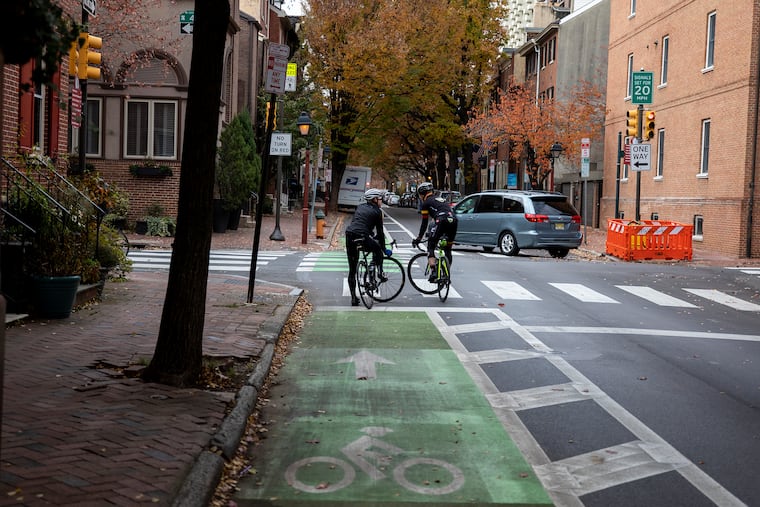
After Barbara Friedes, the pediatric chief resident at Children’s Hospital of Philadelphia, was killed by motorist Michael Vahey while riding her bike in July 2024, Philadelphia did something unexpected: It acted. Mayor Cherelle L. Parker and Council President Johnson vowed to protect cyclists. Places of worship agreed to surrender parking privileges they held for decades. City Council passed a law preventing stopping in the bike lanes along Spruce and Pine Streets, and new concrete barriers were approved to bolster protection for those riding their bikes. For motorists who need access to their homes, new spots for loading and unloading were proposed.
Then a group named Friends of Pine and Spruce sued to stop the democratically approved plan, and the Society Hill Community Association (SHCA) spent $25,000 to support the case. The plan is now stuck in limbo.
Given the association’s intervention, you might think the idea is wildly unpopular in Society Hill. The results of a community survey anonymously sent to me suggest that this is not the case.
According to the survey, most people were in favor of stronger protections. More than 50% wanted the city’s current plan to proceed. Another 16.3% wanted the plan to proceed, with occasional breaks in the concrete for loading zones. Just 30.6% of respondents opposed the plan entirely.
The current leadership of SHCA decried the survey as not “legitimate,” but past SHCA president Susan Burt Collins told me the results match her own perception of the neighborhood’s sentiment.
This is a common problem in Philadelphia: While district councilmembers and community groups often present themselves as speaking for everyone, they pick and choose which perspectives count. Those who agree with them are treated as the vox populi, while voices that don’t are labeled as unrepresentative outsiders. Hard data on how people feel are rarely part of the debate.
Making matters worse is that, unlike most registered community organizations, the Society Hill Civic Association charges dues in order for residents to secure voting rights. They also receive funding from something called the Interstate Land Management Corporation, which operates parking lots created by the construction of I-95. That means a board elected by an undemocratic poll tax is using resources derived from public assets to push an agenda that’s unpopular in the neighborhood, and counter to Council-passed and mayor-signed legislation.
Neighborhood civic associations absolutely enlighten the city when they take on planning community events, cleaning and greening, and other functions that foster togetherness. They simply aren’t the right venue to make important policy decisions that affect the lives and safety of people from across the city.