SEPTA’s decision to focus on housing, not parking, is a win for Southeastern Pennsylvania | Editorial
Encouraging new housing, retail, and job opportunities close to existing stations and routes offers a much larger community benefit than building yet another parking garage.
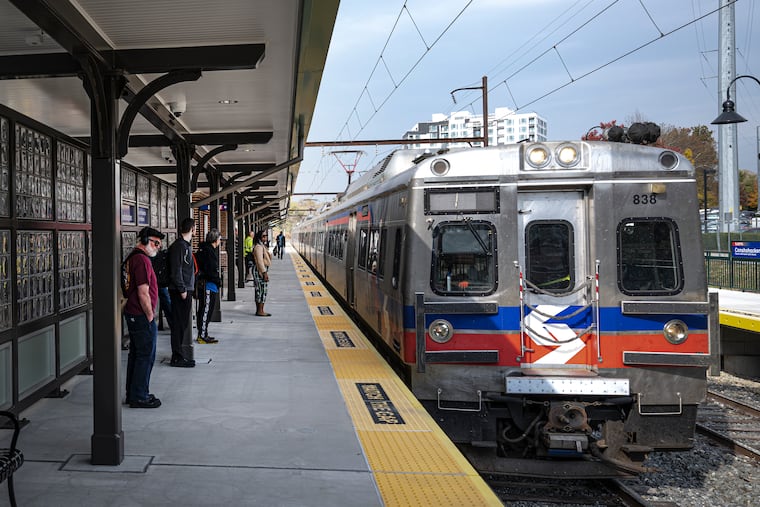
Which development project would more likely increase public transportation ridership: creating 528 parking spaces or constructing 300 apartment buildings? It’s not a trick question.
For decades, SEPTA and other U.S. transit agencies prioritized adding parking spaces for commuters, even as evidence mounted that the lots lost money and were a poor use of the land.
The recent decision to change course on a parking garage project in Conshohocken shows that local transit executives may have finally learned their lesson.
In the past, SEPTA insisted that facilitating residential development around its stations was outside of its purview. In a 2008 interview with PlanPhilly, SEPTA’s then-director of long-range planning stated plainly, “We’re not a redevelopment authority.” Instead, it built and planned hundreds of millions of dollars’ worth of parking garages, including at well-served hubs like the Frankford Transportation Center, despite a clear need for investment and maintenance in core services.
This approach exemplified the way mass transit was treated in regional planning decisions at the time — as an afterthought.
» READ MORE: After a third attempt on his life, Trump could work to make America safer again | Editorial
While much of Southeastern Pennsylvania was initially built around railroads and trolley lines, new development from the 1960s onward prioritized cars. This sprawl development promised a future of abundant parking just as the increased lot sizes and distances between homes made walking a chore. The result was an increase in car ownership, the loss of local farmland and wilderness, and the slow erosion of transit ridership.
Transit agencies believed the way to capture customers from these new, transit-less outlying areas was to build park-and-ride facilities. This was part of the idea behind the planned Conshohocken garage. Planners claimed signs on I-76 would encourage motorists to pull off the highway, park in the garage, and hop on a train.
But as experts point out, public transit works best when riders can walk both to their departure point and to their destination once they disembark.
SEPTA’s turnaround on the $48 million garage project is a welcome sign. With the support of the Delaware Valley Regional Planning Commission, county commissioners, and even some municipal officials, the agency is now embracing something called transit-oriented communities. This means encouraging new housing, retail, and job opportunities close to existing stations and routes. Research shows that households with proximity to transit are more likely to use it, across all income levels.
While this may be a new approach for SEPTA, it is a return to tradition for the region.
» READ MORE: Trump chose to go to war with Iran. Now he has no idea what to do. | Editorial
As a series of maps created by the Delaware Valley Regional Planning Commission shows, development in Greater Philadelphia was once defined by access to rail. In 1930, the 3.3 million people who lived in the nine-county area took up just 222,000 acres of land. Despite adding just 2.3 million residents over the next 80 years, the region built on an additional 661,000 acres of land. The totals from 1970 are even more stark. Just 500,000 additional residents led to the development of 342,000 acres. Without returning to traditional development patterns, we risk transforming our slice of Penn’s Woods into a giant slab of concrete.
Of course, SEPTA’s plan for transit-oriented communities could be more ambitious.
Specifically, the agency could use the program to help accelerate its Reimagining Regional Rail program, which is currently scheduled to take decades. If private developers were asked to contribute toward renovating stations to provide the high boarding platforms the plan demands in exchange for concessions on building height and density requirements, the timeline could be considerably shortened.
This would necessitate further collaboration with county and local officials, but work on the Conshohocken garage project shows that cooperation is possible.
By restoring the link between public transit and real estate development, Southeastern Pennsylvania can shore up SEPTA, add much-needed housing, and do so while minimizing the impact on traffic and the environment. That’s a win for all.