Dick Allen’s talent was undeniable. So was the racism he faced. The media denied both. | Editorial
While much has been written about his run-ins with the Phillies and the fans, it was his shabby treatment by the media in the '60s and '70s that delayed Allen's Hall of Fame bid.
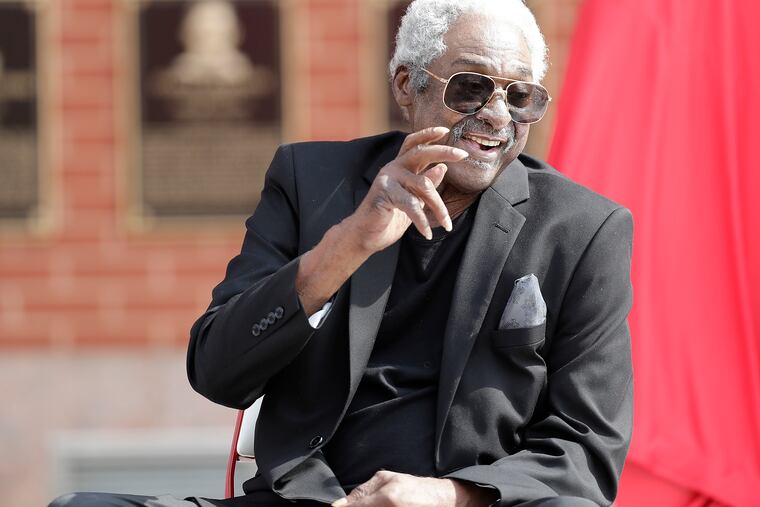
Dick Allen finally received the well-deserved honor of being inducted into the Baseball Hall of Fame — nearly 50 years after he retired.
Sadly, Allen died in 2020 and didn’t get to enjoy his moment in the sun.
While much has been written about Allen’s run-ins with the Phillies and the fans, most of the blame for the delay in getting into Cooperstown rests with the media. In particular, the print media that dominated sports coverage when Allen played in the 1960s and ‘70s.
Long before ESPN or social media, newspapers shaped the public perception of many athletes. In Philadelphia, the sports coverage, like the blue-collar town it covered, could be notoriously tough.
Mike Schmidt, arguably the greatest Phillies player ever, famously said, “Philadelphia is the only city where you can experience the thrill of victory and the agony of reading about it the next day.”
Schmidt spoke from experience. The 12-time All-Star won 10 Gold Glove Awards, three National League Most Valuable Player awards and hit 548 home runs. Yet, throughout his career, Schmidt was booed.
In Philly, much of the critical reporting and commentary during Schmidt’s and Allen’s days appeared in The Inquirer, Daily News, and the now defunct Philadelphia Bulletin.
Bill Conlin, the late dean of Philadelphia baseball writers, who spent five years at the Bulletin and another 46 at the Daily News, called Allen “baseball’s No. 1 Rebel,” and the “Sultan of Sulk.” (Conlin’s own Hall of Fame writing career ended in 2011 amid allegations of sexual abuse.)
Allen Lewis, who covered the Phillies during most of his time at The Inquirer from 1946 to 1979, wrote that Allen was “a con man with muscles.” Lewis inferred that Allen exaggerated the racism he faced while playing in the Phillies’ farm system.
The truth is Allen encountered brutal discrimination and bigotry when he played in Little Rock, Ark., as The Inquirer detailed in a recent report. The racial slurs and taunts continued when he played in Philadelphia. Allen wore a helmet in the field because fans threw coins and bottles at him.
The media demeaned Allen as well. When he first played for the Phillies from 1963 to 1969, reporters referred to him as “Richie,” even though he went by “Dick.”
Even after Allen asked to be called by his preferred name, sportswriters would derisively refer to him as “Dick, ‘Don’t call me Richie,’ Allen.”
Allen didn’t help his cause with the mostly white press corps. He often avoided or ignored them, which likely fueled the unfriendly coverage. Allen famously used his spikes to scrawl a one-word note in the infield dirt to fans during a game: “Boo.”
Bill James, the influential baseball statistician and writer, made a lengthy case against Allen’s induction into the Hall of Fame. “(Dick) Allen never did anything to help his teams win,” James wrote.
Schmidt, who played with Allen when he returned to the Phillies in 1975, saw a different side of him.
“Dick was a sensitive Black man who refused to be treated as a second-class citizen,” Schmidt said. “He played in front of home fans that were products of that racist era” and alongside “racist teammates” at a time when there were “different rules for whites and Blacks.”
As it so happens, it’s the Baseball Writers’ Association of America that votes on who gets into Cooperstown. And Allen’s detractors had their say.
In 14 tries on the Hall of Fame ballot, Allen never got more than 18.9% of the vote from the baseball writers.
Even though, from 1964-74, Allen had the highest adjusted on-base plus slugging percentage, or OPS+, of anyone in Major League Baseball. Incidentally, OPS is one of those sabermetric stats that guys like James obsess about.
Allen put up plenty of other numbers to support his case. But the argument is over.
Dick Allen is now in the Hall of Fame forever.
While he didn’t live to see it, Allen got the final word.