Supreme Court must check Trump’s presidential power grab | Editorial
There is still hope that the high court will display the same respect for precedent and commitment to the Constitution that the lower courts have shown in standing up to Trump.
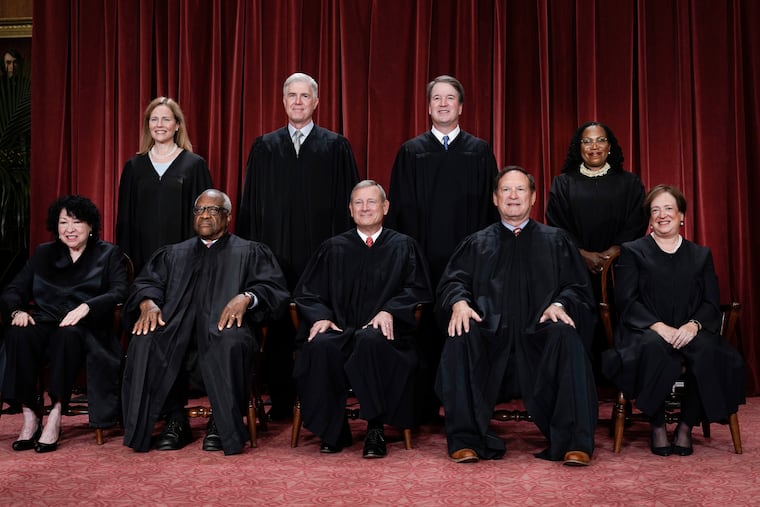
The U.S. Supreme Court began its new term on Monday, with the biggest question to be decided — on a docket that also includes critical voting rights and culture war issues — being whether the conservative majority will continue to lend its dwindling legitimacy to entrenching an imperial presidency.
On that account, perhaps the biggest damage has already been done.
The justices, in a 6-3 decision along ideological lines, determined last year that presidents have “absolute immunity from criminal prosecution” for official acts in office. This deeply misguided ruling would be an invitation for abuse even under the best of circumstances, but it is a blank check for malfeasance given the proven disdain for the law by the man in the Oval Office.
However slim, perhaps there is still hope the high court will display the same respect for precedent and commitment to the Constitution that the lower courts — made up of judges appointed by Republicans and Democrats — have shown in standing up to the Trump administration’s blatant power grab.
But even that limited optimism is tempered by the court’s deference to an unchecked executive through the so-called shadow docket, which the administration has used to petition the justices to stay lower courts’ preliminary injunctions against Trump’s executive actions.
» READ MORE: Trump’s actions belie his Nobel dreams | Editorial
In almost all cases, the court, with little or no explanation, has allowed the president to follow through on his efforts to dismantle federal departments and fire officials, to deport immigrants to third-party countries, and withhold billions in funding authorized by Congress.
While these decisions are temporary and meant to allow the administration’s actions to go forward as legal challenges play out, in practice, the justices ensure that any future judicial victory will ring hollow for those immediately affected. People have already lost their jobs, agencies have been gutted, immigrants have been sent to foreign gulags, and congressional spending timelines have expired.
Still, whatever its prior determinations, the court will have a chance to explain its position on presidential power in a series of cases.
In Trump v. Slaughter, justices will review Trump’s firing of a member of the Federal Trade Commission. The administration’s argument is that the president can fire anyone within the executive branch of government. If the justices rule in Trump’s favor, they will overturn the 1935 Humphrey’s Executor v. United States decision, which upheld a law that prevented the president from firing FTC commissioners. In Trump v. Cook, the court will determine whether the president can remove a governor on the Federal Reserve Board on a whim.
While certainly past presidents have removed appointees, Trump’s wholesale attack on government agencies is an effort to undermine independence and the kind of institutional guardrails that mostly kept him in check during his first term in office.
Trump’s ability to unilaterally impose tariffs under the International Emergency Economic Powers Act will be reviewed in Learning Resources Inc. v. Trump and Trump v. V.O.S. Selections. The conservative majority’s intellectual consistency will be put to the test as it considers an issue that clearly runs afoul of the major questions doctrine, which posits that in cases of major economic and political significance, there must be clear congressional authorization.
» READ MORE: Federal funding is not worth Penn’s independence | Editorial
The court used this rationale to invalidate several policies proposed by the Biden administration, including the regulation of greenhouse gas emissions and relief for student loan debt.
Showing that justices are consistently interpreting the law and not bending it to preferred ideological outcomes is crucial if the court wants to stop the decline in how Americans perceive it and its decisions.
The court’s favorable rating has dropped 22 percentage points since August 2020, coinciding with the period when the conservative majority has not only ruled against popular Democratic proposals but also against settled law, as in its 2022 Dobbs v. Jackson Women’s Health Organization decision that eliminated the constitutional right to abortion access.
Along with the cases dealing with presidential power currently scheduled, the court is likely to hear challenges this term to Trump’s assault on birthright citizenship and use of the Alien Enemies Act to send immigrants to a Salvadoran prison.
Justices must follow the Constitution and serve as a check on the executive’s power. The president is not a monarch. The Supreme Court should stop polishing Trump’s crown.