While some pay for police, others are getting a free ride | Shackamaxon
When it comes to paying for public safety, City Council members, favored community groups, and some of Pennsylvania’s towns and villages are getting an absolute bargain.
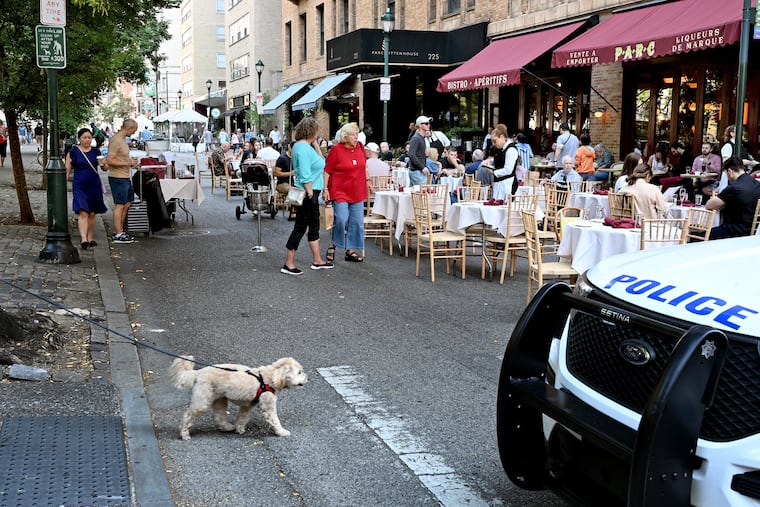
This week’s Shackamaxon asks: Who should pay for public safety, and why didn’t Philadelphia’s big employers do more to save SEPTA?
Bills for thee, unlimited OT for me
My intrepid newsroom colleagues Ryan W. Briggs and Max Marin have shed light on another frustrating phenomenon in local government: the city’s haphazard and uneven policy on security for events.
While some independent community and cultural groups have been hit with bills as high as $40,000 for their festivals, others haven’t been asked to contribute a dime. This includes events hosted by local politicians, who get their costs added to the city’s $150 million police overtime bill.
Instead of forcing communities to end or curtail long-standing and successful events over security costs, the city should focus on finding ways to lower the cost. This should start by taking away the decision-making process from individual police captains and making these calls at the Managing Director’s Office.
The city should also invest in security options that don’t require personnel, like the portable vehicle barricades used by the Center City District for its Open Streets events. This would eliminate or reduce the need for police presence. Lowering the overall amount the city pays for events will make it easier to take on the cost for all of them and eliminate the need for the current, inequitable status quo.
More blue for less green
City Council members and some favored community groups aren’t the only ones benefiting from an uneven cost structure for public safety.
While Philadelphia spends almost $900 million per year on policing, at a cost of over $550 per resident, some of Pennsylvania’s towns and villages are getting an absolute bargain — they don’t pay for police at all.
It’s a growing phenomenon in which rural and exurban communities, most of them Republican-led, are essentially defunding the police — it isn’t just hamlets in Forest County that are benefiting from the dollar savings either. Sizable towns like Lower Macungie, the second-largest population center in Lehigh County, rely solely on the Pennsylvania State Police to keep order.
State Rep. Justin Fleming has proposed a solution. His bill would create a fee structure for towns that forgo local police coverage, with the aim of growing and strengthening the state police. Fleming, who represents a small town outside Harrisburg that pays for its own police force, presents his plan as a fair way to cover the cost of public safety across the commonwealth. It is long overdue.
The truth about the PPA
No one likes getting a ticket, but many Philadelphia motorists harbor a special resentment for the Philadelphia Parking Authority. The recent implementation of (PPA-administered) speed cameras on Broad Street has led to an outbreak of often-conspiratorial claims about the agency.
Some critics have gone so far as to claim the PPA is a “private company,” or that “all the money goes to Harrisburg.” Even City Council President Kenyatta Johnson claimed ignorance when asked about some aspects of the PPA on a local podcast, saying he needed to look into it.
In reality, the PPA is a state agency, governed by a board that’s appointed by the governor and legislative leaders. In a typical year, it directs more than $50 million to local needs, and Executive Director Rich Lazer has moved away from the opaque and patronage-heavy policies the agency was once known for.
The speed cameras, far from being a way to raise revenue, are aimed at changing behavior. When implemented on Roosevelt Boulevard, speeding decreased — as did fines. You can’t make money from speedsters if they stop speeding.
Of course, there’s an easy way to avoid ever getting a ticket: park legally and don’t speed. If anything, the city would be better off if its other enforcement agencies were as effective as the dreaded PPA.
Transit failure
It is no secret that Gov. Josh Shapiro and Harrisburg Democrats folded on mass transit funding this year. Despite claiming a sustainable solution was their “top priority,” they agreed to subject riders to two more years of uncertainty, with no guarantee of a future solution.
But there’s another set of regional power brokers who failed to adequately address the public transportation system’s needs: our biggest employers.
Thomas Jefferson University, Comcast, Children’s Hospital of Pennsylvania, the University of Pennsylvania, and the Chamber of Commerce will gladly say they support transit funding. Just don’t ask them to spend a dime on it.
While the lobbies for casinos, sports gambling, so-called skill games, and marijuana all have plenty of cash to splash, transit has next to nothing. That lack of money made it hard to win over Senate Republicans, who mostly represent districts without many mass transit riders, leaving them immune to grassroots pressure to fund the system. This meant that a last-minute effort to fund transportation off taxing sports betting failed, with gambling companies and their social media influencer allies scaring legislators off.
According to local transit advocate Jon Geeting, Philadelphia’s major institutions have contributed next to nothing to the yearslong effort to forge a sustainable solution in Harrisburg. Geeting told me, “It’s really disappointing and sad that for three years in a row, it fell to out-of-state philanthropy to support the entirety of state transit funding advocacy.”
Despite the collective billions at their disposal, efforts by local industry and institutions to support mass transit funding have mostly consisted of sending in op-eds and occasionally speaking at rallies. If we are to save public transit in Philadelphia, Comcast and Penn should not be content to have the same reach as determined high school students.