He helped defeat a plan to sell the sewer utility in his South Jersey town last year. Now, he’s running for mayor.
Keith Gibbons, an independent candidate in Gloucester Township, was an unlikely David to a for-profit water company’s Goliath. There are signs his campaign his making the establishment nervous.
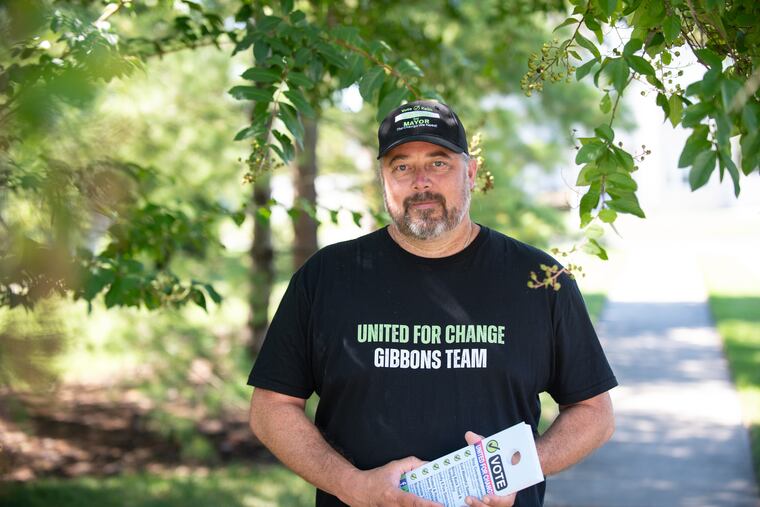
Keith Gibbons entered politics by accident.
A few years ago, he was driving with his then-11-year-old daughter when she asked where roads came from.
“The government,” Gibbons responded.
“What’s the government?” his daughter asked.
That led to a longer explanation and eventual father-daughter trip to a Gloucester Township meeting so she could see the government in, ah, action. Having covered many local government meetings and school boards long ago, I can attest that Gibbons went beyond any parental or civic duty.
Gibbons continued to attend the meetings when a proposal to dissolve the Municipal Utilities Authority (MUA) caught his attention. He feared the township was planning to sell the water and sewer system.
But during sworn oral testimony in a May 2023 teleconference, an attorney representing the township said there was no expectation the utilities would be sold within the next five years. Mayor David Mayer agreed.
Yet, a year later, the township council voted to sell the sewer system to the highest bidder.
“They lied to us,” Gibbons said.
The township received two bids from large for-profit water companies: Aqua offered $52 million, and New Jersey American Water bid a whopping $143 million, plus a promise to make an additional $90 million in capital improvements to a system that only needed an estimated $25 million in repairs.
Something didn’t smell right. Even for a sewer system.
Coincidentally, Mayor Mayer worked for American Water. In addition to his job as director of government affairs at the water company, his mayoral salary is $52,000.
To guard against any conflict of interest, Mayer recused himself from any discussion regarding the sewer sale.
Even still, American Water’s lucrative offer raised eyebrows. But generous bids are part of the for-profit playbook. Aqua offered Bucks County $1.1 billion for its sewer system, but the commissioners backed away after fierce public opposition.
For-profit water companies have been throwing big money at small towns in New Jersey, Pennsylvania, and beyond in an effort to scale up. The utility systems may not seem sexy, but they are mini monopolies that generate steady cash flow.
In Pennsylvania, a 2016 change in the law essentially opened the door for local utilities to be sold at higher prices. Local politicians are often happy to get the utility systems off the books and use the windfall to fund other projects or avoid tax increases.
But often left out of the negotiations are the ratepayers.
After the sales go through, the for-profit companies often jack up the rates. In some towns, after a brief rate freeze, the water bills have increased by 100%.
Rates have also increased at government-owned utility companies, but not by nearly as much. For example, Philadelphia recently increased water rates by 9%.
As utility bills grow, residents have nowhere to turn. Aging infrastructure, climate change, and increased demand, including to cool computer data centers, are expected to further drive up water prices in the years to come.
For-profit companies say they offer professional management and resources to make long-deferred upgrades, as well as the ability to purchase materials in bulk and spread the risk across systems as they grow.
Mayer said in an interview that the sewer sale would have enabled Gloucester to reduce property taxes, eliminate its debt, and make other improvements.
But critics argue that handing control to for-profit companies seeking quick returns on investments is shortsighted and results in higher costs to consumers. After all, water and sewer utilities are supposed to be a long-term public good, not a profit center.
To its credit, Gloucester Township scheduled a referendum last November to let residents vote on whether to sell the sewer system or not. A public vote should be a requirement, but most towns avoid referendums because the last thing they want is for taxpayers to have a say in the utility system they own.
The referendum gave Gibbons time to mount a grassroots campaign against the sale. He knocked on doors, handed out yard signs, and used a podcast to raise awareness.
But Gibbons seemed overmatched. His group spent roughly $3,000 opposing the sale, while New Jersey American Water spent about $1 million.
Yet, David beat Goliath in a landslide. More than 80% voted against the sale.
Gibbons, 48, a Cinnaminson High grad, who ran a Christmas tree farm and worked for Live Nation but is now self-employed and serves on the school board, became somewhat of a local hero in a town of 66,000 residents.
Residents soon urged him to run for mayor.
Gibbons, a former Republican, is running as an independent against Mayer, who has spent his life in South Jersey politics, working for former U.S. Rep. Rob Andrews in the 1990s before becoming chief of staff in the Camden County Clerk’s Office.
He also served as a New Jersey assemblyman before getting elected mayor in 2010. Mayer’s wife is a Camden County freeholder.
Mayer is part of the Democratic machine that has controlled South Jersey for decades, but has recently shown signs of losing its grip on power. In Gloucester Township, there are still twice as many registered Democrats as Republicans.
The election has turned nasty. There are allegations that the Democrats tried to recruit a “phantom candidate” to run as a Republican to siphon votes away from Gibbons.
Mayer said Gibbons has been on the school board for three years, and “I don’t know what he’s touting as his accomplishments.”
Other attempts to muddy Gibbons indicate that the Democratic establishment may be nervous.
Is it because Gibbons has a sophisticated field operation?
“I don’t even have a campaign manager,” he said.
Does Gibbons have deep-pocketed donors?
“I’ve spent about $5,000 on the election,” he said.
What’s his campaign message?
“I’m not a political person,” Gibbons said. “I just want to fix local problems.”
Can an outsider with no political experience win?
Gibbons believes voters are fed up with South Jersey’s entrenched political machine, in which jobs and contracts often go to cronies. He argues no one is looking out for taxpayers who are often too busy to get involved, or believe they can’t do anything to change the system.
Gibbons believes voters are fed up with South Jersey’s entrenched political machine.
But his efforts to block the sewer sale show that one person — and a motivated electorate — can make a difference.
Mayer counters that he is proud to be a Democrat, and that the party’s strength has benefited South Jersey. He pointed to a list of accomplishments as mayor, from creating community policing to adding open space, attracting new businesses, and opening an office for veterans, adding that no party boss tells him what to do.
For his part, Gibbons said he supports term limits and smart development. He plans to focus on fiscal responsibility and government transparency. If elected, he promised the water and sewer system would not get sold to a for-profit company whose main mission is to maximize shareholder value.
“I don’t claim to know everything, but I do know enough,” Gibbons said.
Now there’s a campaign slogan for an accidental candidate.