As Pa. and other states go all-in on sports betting, expect wagers — and cheating scandals — to keep coming
A series of recent indictments suggests legalized gambling on sports has become so pervasive that the integrity of the games can no longer be trusted.
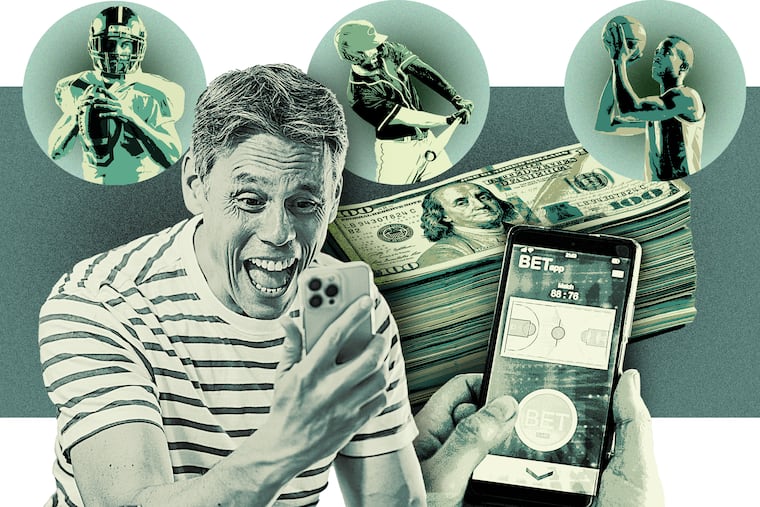
News item: The NBA asked several teams to hand over cellphones, documents and other property as part of its investigation into illegal sports gambling.
— The Athletic, Nov. 15
The latest investigation into sports gambling is not the first and won’t be the last. Nor is it a shock since the heedless race into legalized sports gambling is ruining the games — and some lives — all in the name of money.
Betting on sports has become so pervasive that the integrity of the games can no longer be trusted.
Just last month, 34 people — including an NBA Hall of Famer, a current star, and a former player — were indicted as part of an elaborate betting scheme that included one player who pleaded guilty in July to faking injuries to leave games early so gamblers could win prop bets on his performances.
The same gambling ring was also tied to suspicious wagers on college basketball, including games played by Temple University. A gambling watchdog flagged suspicious betting activity in a game last year between Temple and the University of Alabama at Birmingham, where UAB went from a two-point favorite to an eight-point favorite in a matter of hours. UAB ended up winning 100-72.
Separately, three college basketball players from Fresno State were banned last month for betting on their own games and “manipulating” their performances to alter outcomes, according to the NCAA.
Gambling is not just undermining basketball games.
The NFL suspended 10 players in 2023 for violating its league gambling policy. The same year, the NHL suspended Ottawa Senators forward Shane Pinto for 41 games, making him the first modern-day hockey player banned for sports gambling.
Two Cleveland Guardians pitchers, Emmanuel Clase and Luis Ortiz, were indicted last week for rigging pitches in certain situations to benefit tipped-off bettors.
For the uninitiated, bettors can wager on just about anything during games, including whether the batter will make an out or hit a home run, or whether the next shot in a basketball game will be for two points or three. These micro-bets create opportunities for players to do what is called “spot fixing.” The in-game betting also explains why sports announcers give updated odds during games.
The Guardians pitchers are not the first to raise concerns about betting on baseball. Last year, San Diego Padres infielder Tucupita Marcano was banned for life, and four others received one-year suspensions for gambling, including Phillies minor league infielder José Rodríguez.
Baseball has battled past betting scandals, from the 1919 World Series to Pete Rose betting on games he managed. Last week, a Senate committee sent a letter to Major League Baseball commissioner Rob Manfred raising concern over a “new integrity crisis” in American sports.
Fans are losing trust. Six in 10 now worry about games being fixed.
Even for those who don’t bet, the barrage of TV commercials and promotion of sports gambling inside the arenas is ruining the fan experience.
Many celebrities and former athletes, including former Sixers greats Allen Iverson and Charles Barkley, appear in commercials that make gambling seem cool. All the incessant advertising helps normalize something that is addictive. One study found that during broadcasts of the Stanley Cup finals, hockey fans were exposed to gambling logos and ads an average of 3.5 times per minute.
The upshot: Many young men and boys are getting addicted to sports gambling, upending their lives and their families.
At a Phillies game last year, my son and I listened to three young guys behind us talk nonstop about in-game bets while they tried to complete a challenge of drinking nine beers in nine innings.
For some, the addiction comes quickly. Rob Minnick started betting on Philadelphia sports teams at age 18. Within days, he was placing bets on the West Coast games using a pair of online sports betting sites, FanDuel and DraftKings.
Then Minnick got hooked on playing slots on his phone. Eventually, the South Jersey native told me he was gambling for up to eight hours a day, running up credit card debt and borrowing money from friends and family to maintain his habit.
Minnick went in and out of debt over six years. After a gambling binge that ended at a casino, he decided to seek treatment. He now helps others recover from gambling addiction.
“It was all fueled by seeing the commercials for FanDuel and other sports betting apps,” Minnick said.
Minnick is not alone. There has been a surge in people seeking help for gambling addiction, especially in states like New Jersey and Pennsylvania, where sports betting is legal.
Gambling results in other social ills. Gambling addiction has long been associated with increased risk of depression and suicide. Some early research has found an increase in debt and bankruptcy in states with legalized sports betting.
Blame the explosion in sports gambling — and the subsequent problems — on elected officials and the gambling lobby.
Illegal sports gambling has long operated in the shadows. Yes, it was unregulated and untaxed, but it was not ubiquitous.
Then, former New Jersey Gov. Chris Christie challenged the federal ban on sports betting in most states in an effort to help the still-struggling casinos in Atlantic City. In 2018, the U.S. Supreme Court struck down the ban, opening the floodgates to betting on sports.
States rushed to open sportsbooks, including Pennsylvania and Delaware. Online gambling apps made it easy for anyone with a mobile phone to gamble anytime and anywhere.
Last year, Americans bet nearly $150 billion on sports, according to the American Gaming Association.
Illegal sports gambling has long operated in the shadows. Yes, it was unregulated and untaxed, but it was not ubiquitous.
Today, more than one in five Americans bet on sports. More alarmingly, nearly half of men between the ages of 18 and 49 have an active online sports betting account.
More gambling has translated into more debt. One quarter of sports gamblers said they have been unable to pay a bill — including their rent — because of debts from wagers. And 15% said they have taken out a loan to fund their sports gambling habit.
Most elected officials ignore the social costs of problem gambling because of the easy tax revenues that roll in.
Harrisburg lawmakers may be the worst gambling addicts.
Since 2004, Pennsylvania has legalized slots, table games, sports gambling, and online betting, while adding pricier lottery games with little concern for the economic harm and increased addiction. The influential gambling lobby successfully blocked efforts in Harrisburg this year to increase the tax on sports betting.
The sports leagues once opposed legalized gambling. But now, the leagues are partners with the major online betting sites.
Not long ago, NFL commissioner Roger Goodell opposed legalized gambling before going all in. In 2017, he said, “The integrity of our game is No. 1.”
Don’t bet on it.