Letters to the Editor | June 16, 2025
Inquirer readers on Philadelphia business taxes and media coverage of Sen. Alex Padilla's expulsion from a news conference.
Front page news
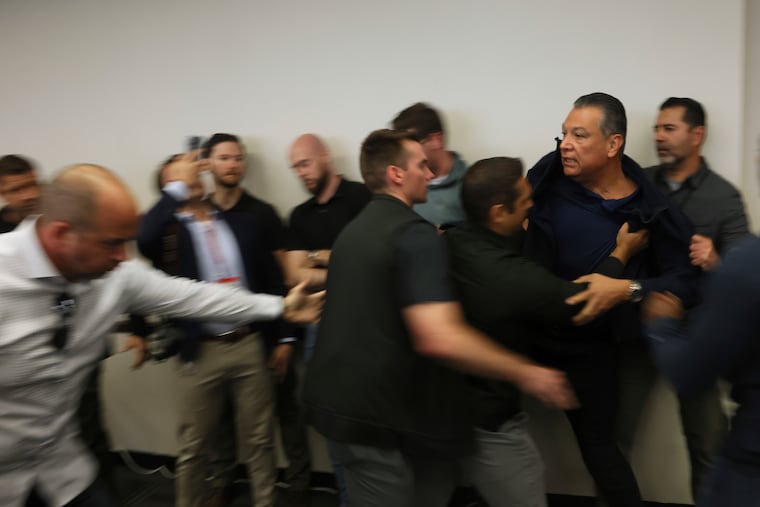
I find it hard to understand The Inquirer’s decision to place the story of U.S. Sen. Alex Padilla being pushed out of a news conference being held by Homeland Security Secretary Kristi Noem on Page A9 of Friday’s newspaper.
The senator was removed from the room by three security people while announcing who he was and that he had questions for the secretary. He was then grabbed by three other men, one wearing an FBI jacket, and wrestled to the floor, where he was handcuffed behind his back.
Following this incident Noem went on Fox News where she stated that he had failed to identify himself.
This was clearly a lie as he can be heard on video saying “I am Sen. Padilla” in a loud and clear voice. At no time did the senator offer any real resistance as they pushed him around and eventually forced him to his knees.
The incident and the misdirection that followed deserved Page One coverage.
Larry Stroup, Warwick Township
...
The shameful treatment of Sen. Alex Padilla Thursday was further compounded by ABC’s reporting (via the news ticker) Friday on Good Morning America. The ticker referenced the forcible removal of Sen. Padilla Thursday and followed up with, “Critics say Sen. Padilla charged at Secretary Noem and did not immediately identify himself.”
This is demonstrably untrue as there is a tape of what happened which includes the senator identifying himself — and which ran on ABC News Thursday night. So how is the inclusion of that falsehood anything other than pandering? And how do we get major news outlets to fulfill their obligation to report the truth and leave the rumors and falsehoods to the current administration? I get that they’re afraid of backlash but standing up for what’s right is part of their mission and obligation. Isn’t it?
Paula Boffa-Taylor, Philadelphia
Demanding decency
For more than a year, parents across Philadelphia have been organizing and working in good faith with School District officials to finalize a policy that would ensure that students are not denied food, water, movement, and even the right to use the bathroom. We’ve offered real solutions, shaped policy, secured a City Council hearing, and built a campaign with joy and dignity at its center. And yet, two weeks before a final school board vote, the District released a wellness policy that still fails to guarantee students access to bathrooms and water.
That’s not just a policy failure. It’s a moral one.
And it’s not about money. This is a no-cost fix. There is no fiscal reason our children — especially in under-resourced, majority-Black schools — should be told to hold their pee, wait for lunch, or sit still for six hours straight. Some parents have had to send our girls to school in adult diapers out of fear they won’t be allowed to change their menstrual pads.
This is the daily reality of many Philadelphia students. And it’s unacceptable.
When people ask why parents aren’t more involved, this is why. Because even after months of organizing, hundreds of hours spent in meetings, outreach shifts, and testimony — after convincing other parents to try again, to believe in hope and possibility — we find ourselves begging for bathroom breaks.
We didn’t create this crisis. The current board didn’t either. But they have the power to fix it.
We are calling on the school board to adopt the full Joy Campaign wellness policy at its meeting on June 25. At minimum, that means immediate implementation of at least 30 minutes of guaranteed daily recess; regular access to clean, stocked bathrooms; and dedicated food and water breaks throughout the day.
No child should be deprived of alleviating basic bodily needs. No child should associate school with punishment, shame, or scarcity.
We are not asking for extravagance — we’re demanding decency.
Susan McLeod and Julie Krug, members, Lift Every Voice Philly
Safety first
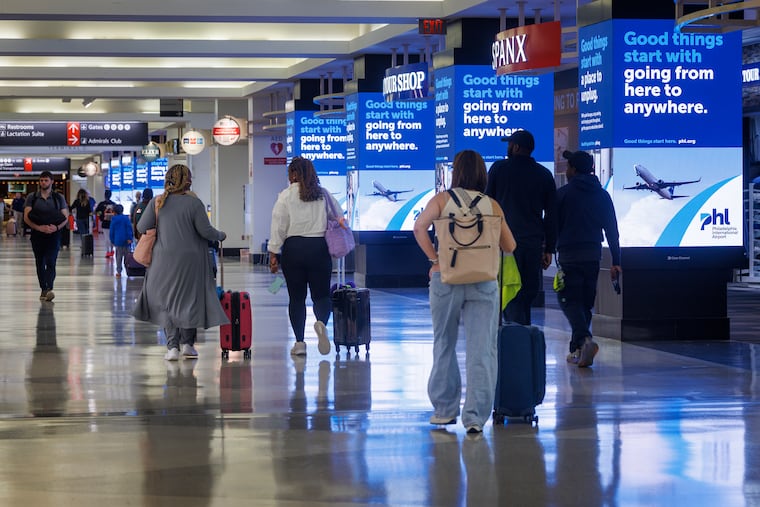
While a recent Inquirer article accurately points out an uptick in travel jitters, readers should not mistake outdated systems for unsafe skies.
Commercial aviation in the U.S. remains safe. According to federal government data, nearly 99% of transportation incidents — from minor fender benders to major train derailments — involve cars and trucks. The risk of getting into an aviation accident, meanwhile, is less than .001%.
That means U.S. travelers are more likely to get into an accident on the way to the airport rather than on the aircraft. And according to researchers at MIT, air travel has grown roughly twice as safe every decade since the late 1960s.
The strong track record is a product of rigorous training, layered safety systems, skilled pilots, and experienced air traffic controllers who remain calm under pressure. And this process will only improve as Transportation Secretary Sean Duffy works with Congress to modernize aviation infrastructure and boost air traffic control hiring.
Jackson Shedelbower, executive director, the Center for Transportation Policy, Arlington, Va.
Talking taxes, noting falsehoods
The Inquirer’s editorial endorsement of cuts to city business and wage taxes repeats three widely held but false ideas.
First, Philadelphia’s taxes do not encourage businesses to locate outside the city. Philadelphia business taxes are not based on location but on activity. Businesses that earn income and receipts in the city pay the BIRT whether they are based inside or outside Philadelphia. And businesses located inside the city do not pay the BIRT on income and receipts they earn outside it.
The one exception is for businesses that sell intangible services such as law or investment firms. The city has already enacted a law to fix this problem. It needs approval by the state General Assembly, and diverse interests in Harrisburg are ready to support it. Second, it is not true that the city is generating jobs or businesses more slowly than comparable cities. Philadelphia is growing as fast as comparable cities in the Northeast and Midwest, faster than those regions as a whole, and slightly faster than our collar counties. Third, there are no sound studies that show that business and wage taxes are major deterrents to economic growth in Philadelphia. In fact, research shows the exact opposite.
Marc Stier, executive director, Pennsylvania Policy Center, Pennsylvanians Together in Action
...
Your recent editorial regarding changes to the Business Income and Receipts Tax suggests that it is an issue only for “small firms.” Small firms will indeed be hurt badly. But in fact, the city treats every individual paid on a 1099 contractor basis as a small firm for purposes of levying the BIRT, whether they are actual businesses or just ordinary people working a job on a contract basis. If you are paid on a 1099 basis, your effective rate of income tax on the first $100,000 of your 1099 income will rise massively from the current 3.75% of net profits for city residents and 3.44% of net profits for nonresidents (the amount owed under the Net Profits Tax, which is equivalent to the wage tax and will remain in place) to more than 9% with the addition of the BIRT levy. The tax on people working contract jobs (and on actual small firms) was effectively increased on a dramatic scale. That exorbitant tax hike will drive hardworking people out of the city and discourage talented people from working here.
Chris Bordelon, Philadelphia, chrisbordelon@gmail.com
Join the conversation: Send letters to letters@inquirer.com. Limit length to 150 words and include home address and day and evening phone number. Letters run in The Inquirer six days a week on the editorial pages and online.