Letters to the Editor | Dec. 1, 2025
Inquirer readers on the fate of the Endangered Species Act and a contentious proposal by City Councilmember Jeffery Young to move the Cecil B. Moore Library in North Philadelphia.
Read the room
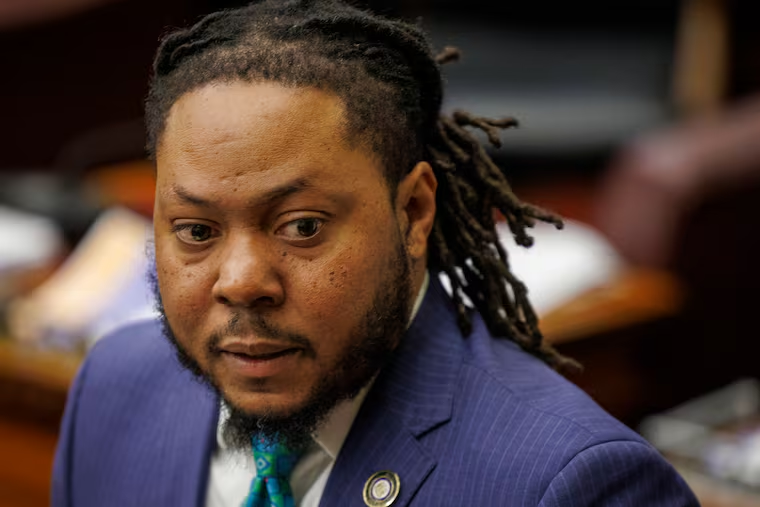
It would appear that neophyte City Councilmember Jeffery Young didn’t pay attention during Council’s orientation classes. The first and primary duty of a district leader is to placate constituents.
Young seems determined to replace a popular public library branch in his North Philly district with a “new and improved” facility some six blocks away.
His initial plan was to have housing units atop the new library — a complete nonstarter for the community. The people of his district overwhelmingly want the existing facility to remain where it is and be refurbished. Still, Young seems unwilling or incapable of understanding that the existing library has been a cornerstone of that often-troubled neighborhood for more than 60 years; it needs to stay.
Unlike Young, neighborhood residents know about the pitfalls of new construction: time delays, incompetent contractors, cost overruns, and administrative changes that leave projects languishing in limbo for years. Not to mention that a six or seven-block move can be a dramatic and even traumatic upheaval for a close-knit community.
Young proffers that, at 61 years old, the building has outlived its usefulness. Once again, some tutelage seems in order: Philly thrives on its mix of old and new, and — in a city that’s 343 years old — many would not view a 60-year-old structure as a liability. Most buildings here have passed that milestone and continue to serve our needs.
There’s an important lesson here: newer isn’t always better — even when it comes to politicians.
J. Savage, Philadelphia
Assigning blame
In a column earlier this year, Solomon Jones argued that because 56% of white voters cast ballots for Donald Trump, white people need to take the lead in fighting him now, not Black people. I think he’s partially right — white voters were indeed a strong base of support for Trump. But framing it solely as a “white people’s fight” oversimplifies what actually happened in 2024.
According to exit poll data, about 55% of white voters did cast ballots for Trump. But Trump’s coalition was more racially diverse than many realize: He gained inroads among Black voters (about 15%) and made notable progress with Hispanic and Asian voters, too.
Plus, within white voters, there’s a lot of variation — education level, class, region, gender — that any “white vs. Black” framing risks glossing over. For example, white working-class voters were particularly strong for Trump. If the fight is framed as only a racial one, we might miss the opportunity to build broader coalitions and address structural factors like economic inequality, education, and turnout. It seems cavalier to treat white voters as a monolith when 45% did not vote for Trump.
I’d argue that all of us — Black, white, and others — have a stake in what went wrong and how to fix it. There’s power in building a cross-racial political movement that doesn’t just blame but dismantles the root causes.
Mr. Jones raises a provocative point: It’s a tough conversation, but one worth having.
Maria Duca, Philadelphia
Lack of coverage
As a Black male leader in the Philadelphia School District and a loyal digital subscriber to The Inquirer and the Daily News, I am writing to express my profound dissatisfaction with the lack of coverage surrounding the Black Male Educators Convening (BMEC) 2025, which was held in Philadelphia recently.
This critical gathering of more than 1,400 participants from across the country — including policymakers, superintendents, higher education and K-12 educators from states as far away as California and Texas — was sponsored by the Center for Black Educator Development, an organization headquartered right here in Philadelphia.
This was not just a national conference held in Philadelphia; it was a movement driven by a local organization and attended by hundreds of dedicated Philadelphia educators.
For decades, well-documented research has depicted the crucial importance and urgent need for teachers of color, particularly in urban school districts across the country.
While the majority of K-12 students in the U.S. are students of color, only about 20% of educators are people of color.
As a career educator, I can speak firsthand to the importance of a diverse educator workforce and, more specifically, the transformative impact that Black male teachers have on students, especially young boys of color in our city.
The omission of coverage for this significant event is a missed opportunity to highlight an organization actively building and celebrating key solutions to the city’s most pressing educational and social issues.
Reuben Mills, Philadelphia
Act of sedition
It wasn’t long ago that President Donald Trump and his underlings axed many of the lawyers in the U.S. Department of Defense. One of the duties of the DOD lawyers is to examine the orders being issued by commanders to determine their legality. Given that orders to have Venezuelan boats blown out of the water over alleged narcotics being aboard without any actual boarding and searching is most likely illegal, it’s not difficult to see that the lawyers who could have ruled against these actions are no longer around to countermand Trump’s orders, and that he and Pete Hegseth know very well that what they’re doing is most likely illegal. Rather than accusing members of Congress of sedition, these two should be the ones being accused of it, as well as of homicide, based on the fact that more than 89 Venezuelans have lost their lives.
Richard Watson, Philadelphia
Learn to coexist
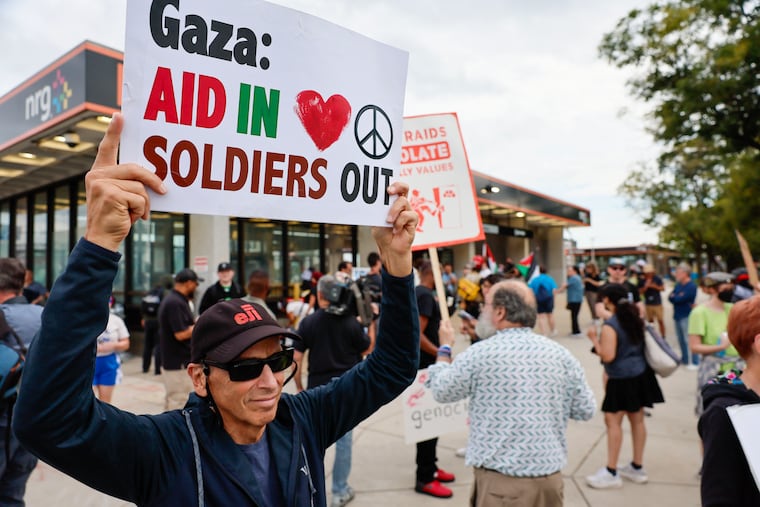
In a recent letter, Sam Kuttab argued that Trudy Rubin ignored the importance of Palestinian political aspirations in her column on Donald Trump’s Gaza plan. He goes on to say that Palestinians have the right to live free from military occupation, just as Israel has a right to security. All of this is true.
However, there are some clarifications:
The Palestinians have been offered a state, free from military occupation, on at least four occasions — and they rejected all of them: the Peel Partition Plan of 1936, the United Nations Partition Plan of 1948, Bill Clinton’s Camp David land-for-peace deal in 2000 and 2001, and Ehud Olmert’s land-for-peace deal in 2007 and 2008.
As for Israel’s right to security, when Israel left Gaza in 2005, Palestinians didn’t return the favor by granting Israel security. Instead, Hamas used its aid money to build a national fortress — firing thousands of rockets from Gaza into Israel, building terror tunnels, and starting wars in 2012, 2014, and 2023.
There is room in the Middle East for both a Jewish state and a Palestinian state. But this time, if the Palestinians truly want a state without military occupation, then they have some work to do. This time, they need to be willing to compromise on a two-state solution, they need to prove they can provide Israel the security it deserves, and most importantly, they need to demonstrate, at long last, that they are willing to live as good neighbors, side-by-side, next to a Jewish state.
Katherine Kaplan, Mount Laurel
Endangered Species Act
As Congress returns to regular legislating after the recent budget impasse, one thing that still shouldn’t be up for debate is protecting wildlife. The Endangered Species Act (ESA) has prevented 99% of listed species from going extinct over the last 50 years and is supported by the vast majority of Americans.
Here in Pennsylvania, the ESA has helped bring back the bald eagle and the peregrine falcon, and it continues to help ensure the survival of Pennsylvania species like the wood turtle and the Indiana bat. Yet, despite this program’s effectiveness — and popularity — some politicians continue to push proposals that would weaken core protections and strip species of federal safeguards.
Our senators, John Fetterman and Dave McCormick, should oppose any attempt to undermine the Endangered Species Act. Pennsylvania’s wildlife and natural heritage depend on it.
Eli Booth, Philadelphia
Join the conversation: Send letters to letters@inquirer.com. Limit length to 150 words and include home address and day and evening phone number. Letters run in The Inquirer six days a week on the editorial pages and online.