Letters to the Editor | Dec. 14, 2025
Inquirer readers on Mayor Parker's housing plan and President Trump's new fees for visas.
Divisive language
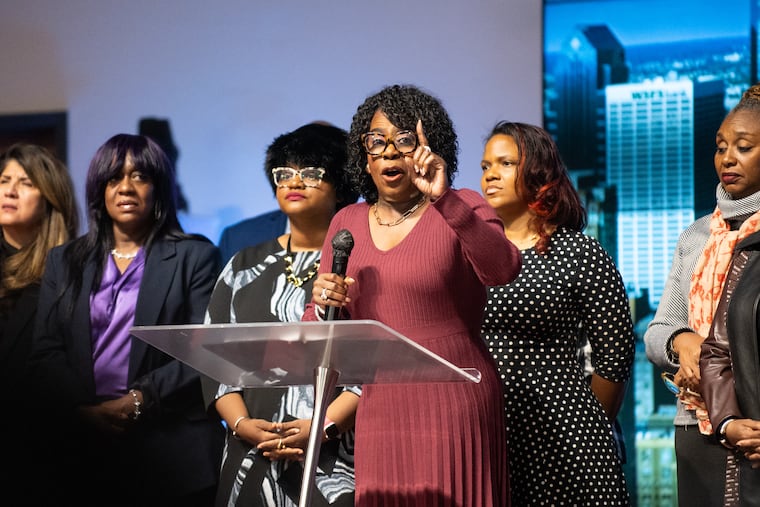
Mayor Cherelle L. Parker spent last weekend arguing that amendments to her H.O.M.E. initiative are “trying to pit the ‘have-nots’ against those who have just a little bit.” But what is divisive about making sure those who are the least well off are prioritized? According to the National Low-Income Housing Coalition and National Alliance to End Homelessness, extremely low-income households (households making 30% of the region’s annual median income or less) are facing the brunt of the housing crisis. City Council’s amendments propose reallocating 90% of the funding for certain programs to residents making 60% of the annual median income or less, as opposed to going to residents who make up to 100% of the annual median income. So her argument that this is a “subtraction” carries no weight. What is being subtracted? Moreover, if she really wanted to address the housing crisis, why would she not allocate assistance to those who, according to experts, need it the most? The amendments simply call for a reallocation of funds to those who need it the most. Nothing about that should be divisive; it is simply good policy, but Mayor Parker’s language about it certainly is. Mayor Parker is dividing Philadelphians, not progressives in City Council.
Jeff Wasch, Philadelphia
$100K visas
There’s no question that many American-born medical professionals would rather work in urban areas where they and their families can enjoy the amenities that large cities offer and their children can choose from a wide range of schools to attend. For years, foreign-born medical professionals have been filling positions in undesirable locales across rural America. President Donald Trump just levied a $100,000 H-1B visa application fee on foreign-born medical professionals, among others. If Nephrology Associates of the Carolinas closes because it cannot hire enough doctors, its dialysis patients will need to travel one hour each way to Charlotte, N.C., three times a week. I wonder if these dialysis patients in a city where residents overwhelmingly voted for President Trump now regret their 2024 vote.
Paul L. Newman, Merion Station
Balance of powers
According to analysts, the oral arguments heard recently by the U.S. Supreme Court in Trump v. Slaughter give clear indication that the majority intends to gut/overturn the governing precedent (the Humphrey’s Executor v. United States decision) that restrains executive authority over independent agency heads. This will solidify the “unitary executive.” The reins will be removed, and Donald Trump will consider there to be no remaining limits. He will remove any Fed governor, Securities and Exchange Commission commissioner, or, for that matter, even common civil servants as he sees fit, without repercussions. Historians should note Dec. 8, 2025, as the date that marks the end of our system of government as we have till this point understood it. Justice Samuel Alito acknowledged as much in a sarcastically phrased question. The salient question for America’s future is whether his sarcasm was because he does not believe there will be harm, even given the breadth of this decision, or was the sarcasm because he simply doesn’t care? Political ideology currently seems to trump considerations of justice or tradition. The court clearly seemed to indicate it is going to eliminate the balance of powers insofar as it restrains the executive. I suppose it is somewhat understandable that the Founding Fathers did not explicitly spell everything out in detail. There seemed to be some presumption that honor and gentlemanly decorum would prevent outcomes such as we see today. And as quaint and naive as that may have been even then, how could the intervening generations have been so naive as not to have foreseen this downside potential, and responded appropriately with more explicit legislative restrictions? Even in my lifetime, since Kent State, Richard Nixon, and Iran-Contra, how could we have continued forward with such naivete, having never explicitly delineated the constitutional limits of executive power? How could we have been so stupid?
W.B. Yeats certainly saw this coming: “Things fall apart; the centre cannot hold … The best lack all conviction, while the worst are full of passionate intensity.”
Michael Cahill, Phoenixville
Grand old flag
So the city’s Department of Public Property “aims to replace each flag twice a year,” and “shift crews perform a weekly check”? I must be driving the wrong Parkway. The flags I’m seeing look like they were the originals hung during the Bicentennial in 1976. Some look like they fail to reflect decades-old regime changes. The folks at public property need to check their maps, adjust their GPS systems, and reverse their binoculars. Some of the Parkway flags are looking mighty sad.
Mike Egan, Plymouth Meeting
Join the conversation: Send letters to letters@inquirer.com. Limit length to 150 words and include home address and day and evening phone number. Letters run in The Inquirer six days a week on the editorial pages and online.