Letters to the Editor | Jan. 1, 2023
Inquirer readers on Trump's dictator dreams, questioning the Roosevelt Boulevard subway proposal, and donor influence at Penn.

Dictator for a day
World War II cost our country more than a million casualties — more than 400,000 killed and more than 600,000 injured. These Americans gave so much to their country to keep us free and secure by destroying the dictatorships of Hitler’s Germany, Mussolini’s Italy, and Imperial Japan. About 16 million Americans served their country during the war. Currently, approximately 200,000 are living. One has to wonder what those survivors are feeling when they know how much they and their comrades sacrificed just to hear Donald Trump proudly promising that if elected he will be a “dictator for a day.” During my 83 years of life, I have heard politicians from every party make many promises; however, I’ve never heard one, until this December, promise to be a dictator. That one word, and what it represents, is repugnant to most Americans.
Paul S. Bunkin, Turnersville
Face reality
I see absolutely no reason for a new subway line on Roosevelt Boulevard. It’s a struggle right now to get ridership on existing SEPTA routes, and with the traditional “commute to Center City from surrounding areas for your office job” having faded even more since the pandemic, it seems almost silly to add this line (and to tote this as a reason). Have the proponents not gotten the memo? As a huge fan of public transportation (I ride the El and subway frequently), I shudder on almost every trip I take observing all the open seats giving evidence of low ridership.
Changing commuter habits (which predate the pandemic), the increased popularity of car use, and the use of ride-share apps have only contributed further to less public transportation participation, and these trends are not going away. Personally, I’d like it if the opposite were true, but I’m not going to bury my head in the sand and pretend it’s not. And as for the study suggesting robust ridership on this line that constantly gets cited, it was done in 2003. I would like nothing more than increased public transportation use, but this proposal would be a massive waste of public money.
James Kenkelen, Philadelphia, jaykayrho@gmail.com
Front row
The recent Parade article on George Clooney’s new movie, The Boys in the Boat, failed to mention the original girls in the boat movie, Backwards. Filmed entirely in Philadelphia, with the considerable support of our rowing community, cultural institutions, and the Greater Philadelphia Film Office, the 2012 film portrays the emotional conflicts of a female Olympic hopeful who coaches high school girl rowers, and the tensions between her aspirations and those of her young crew. Hollywood Today called it, “Heartfelt ... this film makes you care.” It stars James Van Der Beek and (my daughter) Sarah Megan Thomas and is viewable on Peacock and Amazon Prime Video.
Frank Thomas, Philadelphia
Basic principles
As a federal criminal lawyer and University of Pennsylvania alum who has spent a lifetime defending constitutional rights, I found the testimony by the presidents of Harvard, MIT, and Penn shocking because they erroneously stated the law. (Now former) Penn president Liz Magill, a “legal scholar,” and the others hid behind the veil of lofty free speech principles, failing to recognize well-established constitutional law that imposes limitations on free speech. Neither gender nor wealthy donors, who were appropriately appalled, are to blame for their ignorance.
Last year, the U.S. Supreme Court, in Counterman v. Colorado, stated that “From 1791 to the present, the First Amendment has permitted restrictions upon the content of speech in a few limited areas.” They are true threats, obscenity, defamation, and incitement. The existence of a threat depends not on “the mental state of the author,” but on “what the statement conveys” to the person on the receiving end. The perpetrators of hate speech need only act “recklessly” for their speech to constitute a crime. Undoubtedly, calls for the genocide of Jews and intifada are reckless and put Jewish people in fear of violence.
The presidents failed to accept these basic principles of constitutional law. Why? The reasons lie not only in their personal failures of leadership but in the moral bankruptcy of the institutions they lead. These institutions have punished microaggressions, improper use of pronouns, and expressions antithetical to a woke agenda, yet tolerate and support virulent antisemitism. This is indefensible, and the presidents simply could not pull a rabbit out of the hat for an excuse this time; they have been exposed.
Hope Lefeber, Philadelphia
Past is prologue
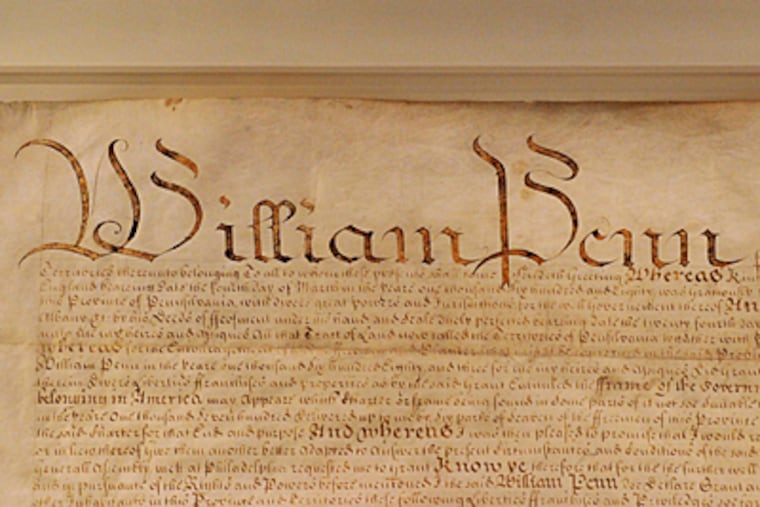
When my father, Gaylord P. Harnwell, was the president of the University of Pennsylvania, he angered powerful, wealthy donor Walter H. Annenberg, publisher of The Inquirer, for reasons obscure. Perhaps Annenberg wanted to influence staffing at the Annenberg School of Communications, or he wanted provost David Goddard fired for some offensive remark. Some even thought that Harnwell’s reference in a speech to biblical Moses was taken as a slight against patriarch Moses Annenberg, who had been indicted for tax evasion. In retaliation, Walter Annenberg blacklisted my father’s name in Inquirer publications. Much later, as my father lay dying, in 1982, Annenberg telephoned to apologize for his behavior (per Marion Pond, secretary to my father).
Harnwell confronted another free speech issue in April 1959, when he joined three other local college presidents (Bryn Mawr’s Katharine McBride, Haverford’s Hugh Borton, and Swarthmore’s Courtney Smith) to testify before a Senate subcommittee to rescind the “loyalty oath provisions” of the National Defense Education Act, which tied government funds to an oath and represented a danger to free thought. The oath was retracted three years later.
My father opposed the undue influence of wealthy Penn donors and national politicians. As he wrote: “Curtailments on freedom … are never desirable, particularly in the community of a great university where matters of controversy ought to be argued openly and candidly, in a free search for ideas and truth, without fear of reprisal or stigma.” Does this all sound familiar to what is happening today?
Ann Harnwell Ashmead, Haverford
Business benefits
A recent letter claimed that the Regional Greenhouse Gas Initiative is not good for small businesses and that small businesses do not support RGGI. The writer’s argument is hard to accept for the following reasons: First, RGGI has not increased consumer electricity bills in any of the 11 participating states, but rather has prevented these costs from rising — and provides some evidence of this. Second, surveys and polls are notorious for leading people to the conclusion the creator wants. Given that small-business owners are also members of the community and will benefit from RGGI in so many ways, it is hard to believe they would be against the positive results of RGGI. Third, since there are 11 other states actively benefiting from RGGI, why aren’t we hearing complaints from small businesses there?
Don Campbell, Glenside
Radical solution
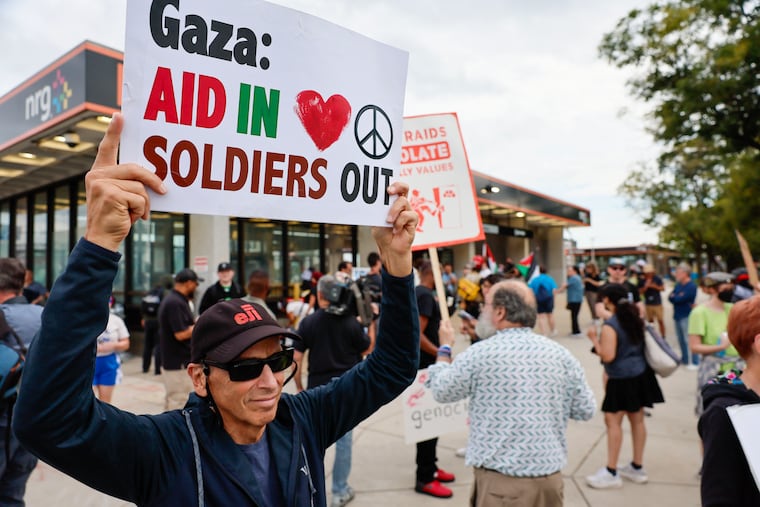
Israel continues to ignore U.S. pleas to end the deaths of Palestinian civilians as Israeli Prime Minister Benjamin Netanyahu pushes his attacks in Gaza to the point of committing war crimes. Is there any way Israel can be deterred at this point? Yes, there is, but only if we act quickly. The U.S., with the consent of Egypt, could send several thousand military personnel, from medical and engineering only, stage them in Egypt, and then deploy them to Gaza. Our medical personnel would provide aid, food, and water to the civilians in Gaza, and the engineering units would start to build houses, schools, and other vital infrastructures such as hospitals. Once we are in Gaza, I don’t think Israel would continue its bombardment for fear of killing U.S. military personnel. Then the political process of finding a permanent solution could begin. Right now, the U.S. is an enabler of Israel’s war. This has to end.
John McCann, Doylestown, pard1.mccann@gmail.com
Join the conversation: Send letters to letters@inquirer.com. Limit length to 150 words and include home address and day and evening phone number. Letters run in The Inquirer six days a week on the editorial pages and online.