Letters to the Editor | June 15, 2026
Inquirer readers weigh in on the growth of Catholicism and evaluating Philadelphia’s public schools.
Lincoln’s legacy
Just across from Boathouse Row, at the intersection of Kelly and Sedgley Drives, there is a statue of President Abraham Lincoln. At the base of the statue is a famous quote from his second presidential inauguration speech: “With malice toward none with charity for all … Let us finish the work we are in.”
On the opposite side: “I do order and declare that all persons held as slaves within the states in rebellion are and henceforth shall be free.”
As the center of America’s stage during this Semiquincentennial year, and a center of the world stage during this month of FIFA World Cup matches, we Philadelphians call on our national government to live up to our democratic principles and apply fair treatment to immigrants and descendants of immigrants, just as Lincoln called for bold actions on behalf of those who were once enslaved.
Ina Asher, Merion Station
Blame game
Opinions critical of Philly schools’ “success” when 33% of students are proficient in reading, and 25% in math, are misguided. When I was codirector of the Laboratory for Student Success at Temple University, I was actually surprised to find that years of research in student success shows that school-related factors like teacher quality, curriculum, leadership, climate, and resources account for as much as 40% of student achievement. Factors beyond the schools have a much greater impact on individual student success. These include family income, stability, parent education, access to healthcare, neighborhood safety, exposure to stress, and trauma. What we are witnessing is simply a result of living in a country with the greatest economic inequality of any developed nation on the planet. The answers are there — but those in power seem to prefer to blame the victims.
John Kovach, Wallingford
Catholicism is growing
Recently, I read about what sociologists call homophily: the tendency to develop friendships with those from similar backgrounds, identities, or socioeconomic classes. For young professionals in the city like myself, we’re often pulled into circles with peers from similar places of work or study.
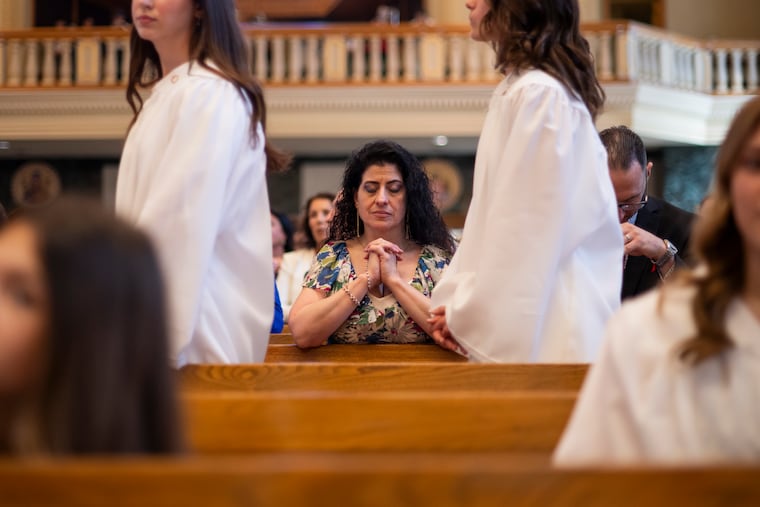
Perhaps one reason people are returning to the pews is that it shakes up these circles, bringing us hand-in-hand with those from places we’re unfamiliar with — and maybe there’s something exciting about that. Where else besides church might you find an older North Philly couple breaking bread with young Thomas Jefferson University students coming from a Center City high-rise?
A recent article in The Inquirer raised the question of why people are turning to Catholicism. We may never know all of the reasons why, but I hope it comes with a community built across diversity.
Maxwell Marshall, Philadelphia
Join the conversation: Send letters to letters@inquirer.com. Limit length to 150 words and include home address and day and evening phone number. Letters run in The Inquirer six days a week on the editorial pages and online.