Letters to the Editor | June 30, 2025
Inquirer readers on the U.S. bombing of Iran, press freedom, and challenges at transit stations.
U.S. folly
I was just putting together a letter to the editor about the misguided and immoral bombing of Iran, and was happy to find the editorial discussing the recklessness of Donald Trump’s decision. The Editorial Board also covered our less-than-illustrious history regarding decisions to wage unnecessary wars in South America, Vietnam, Iraq, and Afghanistan. All have resulted in thousands of deaths, instability, and chaos, and were based on untruths. I am in my 80s, and once again am witnessing the gaslighting, fearmongering, and lying by my government, this time by Donald Trump as he glibly vacillates among all his unthought-out, shoot-from-the-hip moves regarding Iran. He has no empathy, so it’s a war game.
This was an unprovoked attack. It was also executed without the consent of Congress and to the dismay of most Americans, who do not support war against Iran and believe it will make us less safe. There is just a bit of hypocrisy in my view, that Israel can build nuclear weapons, which it lied about doing until it was uncovered in the ‘50s, and the U.S. can stockpile them, but feels it has the right to strike countries who also have the capacity but have not proven they intend to use them. Barbara Tuchman, the Pulitzer Prize-winning historian, wrote, “Awful momentum makes carrying through easier than calling off folly.” We must do all we can to stop this folly.
Judy Rubin, Philadelphia
Positive outcome
There are many of us who opposed the U.S. decision to bomb Iran. Of note is the fact that some reports show that at minimum, Iran’s nuclear capability has been set back many years. In addition, Israel now appears to own the airspace over Iran, having neutralized much of Iran’s capacity to launch missiles. Moreover, the missiles Iran launched at U.S. bases in Qatar and Iraq — attacks which were telegraphed and appear to be a “measured response” to the U.S. — were immediately intercepted.
Having said this, it is possible that the “strategy,” if we can call it that, of the Trump administration to get Iran back to the negotiating table may be successful, notwithstanding the president’s bombastic, often incoherent, and frequently factually baseless discourse. I make these observations, not as a partisan but as a scholar who studied political rhetoric for more than 40 years. I am and have been vehemently opposed to Donald Trump since he came down the escalator and became president in 2016. Nevertheless, as a rhetorician, I know that sometimes bad people can be successful — and even do good things. I will not be surprised, therefore, if what’s happening in the Middle East becomes a political plus for the president.
Richard A. Cherwitz, Camas, Wash.
Nuclear option
I commend Father Paul Morrissey on his insightful and logical letter to the editor. He is right to question what the motives of a country are to develop nuclear weapons. And his answer is correct in stating that the primary motivation is to act as a deterrent to other countries who consider acts of aggression toward them … just as the U.S. and Israel are doing now to Iran. Offensive use of nuclear weapons remains unthinkable. Their use would just lead to mutual annihilation. He also raises the concept of Israel’s own nuclear weapon capability, which never seems to be mentioned. Who allowed Israel to develop nuclear weapons? I don’t feel safer knowing Prime Minister Benjamin Netanyahu can pull the same awesome nuclear trigger and bring on a nuclear holocaust, especially witnessing his actions of late. Both sides giving up their nuclear programs is a pipe dream, I know, but would represent a huge step in the direction of Morrissey’s “lasting peace.”
PM Procacci, West Palm Beach, Fla.
Reputational hit
The last volley of Iranian missiles before the recent ceasefire hit Microsoft’s office in Beersheva, Israel. Israel’s tech sector forms the backbone of its economy, sustaining its upper middle class and generating valuable start-ups. Its tech sector depends on foreign direct investment tied to a supposedly impenetrable air defense system. Yet, even before it initiated war with Iran, Israel’s foreign direct investment levels were at their lowest point since 2023, and the country was facing yet another credit downgrade. As Israel lifts the official veil of censorship on the destruction it withstood from Iranian strikes, these trends are likely to accelerate. The worst damage Israel has suffered, however, more than that due to Iranian missiles, has been to its image inside the United States, where a large segment of the population holds it responsible for committing genocide in Gaza. And only about 18% of the U.S. public supported threatening Iran with an airstrike, yet Donald Trump went ahead with it anyway.
Andrew Mills, Lower Gwynedd
Press freedom
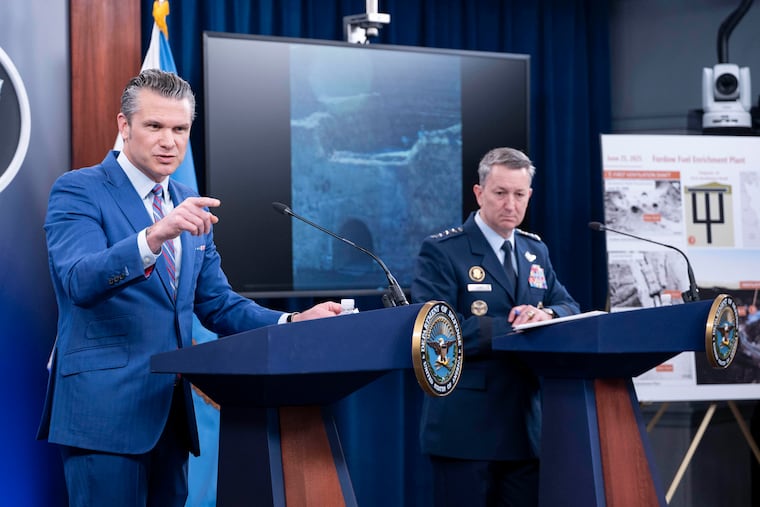
John Peter Zenger was born in Germany in 1697, emigrated to New York, and published a weekly newspaper. He was found not guilty of libel for his articles about governmental corruption in 1735. Freedom of the press is derived from this case. President Donald Trump and Defense Secretary Pete Hegseth brought this case to mind as the two men attacked the media for questioning the results of the Iran bombing. It is the job of the media to question the government. The government may not like a light being shined on it, but freedom of the press has been a cornerstone of our democracy and is enshrined in the Constitution.
Sheryl Kalick, Philadelphia
Disgraceful conditions
In the 45 years I worked in Philly, I took SEPTA buses and trains every day. I was never concerned for my safety on a system that was relatively clean and well policed by transit cops. We moved to New Jersey after retirement. Last week, we decided to take the PATCO train, for the first time, from Lindenwold to 12th and Locust to see a show at the Wilma Theater. The PATCO trains are very clean, comfortable, and fast. As we left the train, my wife and I commented on how convenient the transit system was. And then we found ourselves forced to walk through the gauntlet of unfortunate homeless and drug-addicted human beings holding on to life by a string.
In the absence of public bathrooms, the surrounding hallways, elevator lifts, and staircases to the street were littered with excrement and little drug baggies. We never saw a transit cop anywhere in the system, which added to our discomfort and concern for our safety. Philadelphia is a mecca for visitors from all corners of the states and the world. These appalling human conditions in a major transit system should never exist, just from the humanity of the situation, let alone as an introduction to our world-class city. When I called the offices of our Camden County elected representatives to discuss the need to address this disgraceful situation, I was told someone would call me back. Silence. Philadelphia and New Jersey officials need to establish a procedure to help these people and keep our public transit systems safe and clean.
Gerald Soslau, Voorhees
Join the conversation: Send letters to letters@inquirer.com. Limit length to 200 words and include home address and day and evening phone number. Letters run in The Inquirer six days a week on the editorial pages and online.