Letters to the Editor | June 9, 2025
Inquirer readers on protected bike lanes, Job Corps centers shutdown, and police contract negotiations.
Prioritize safety
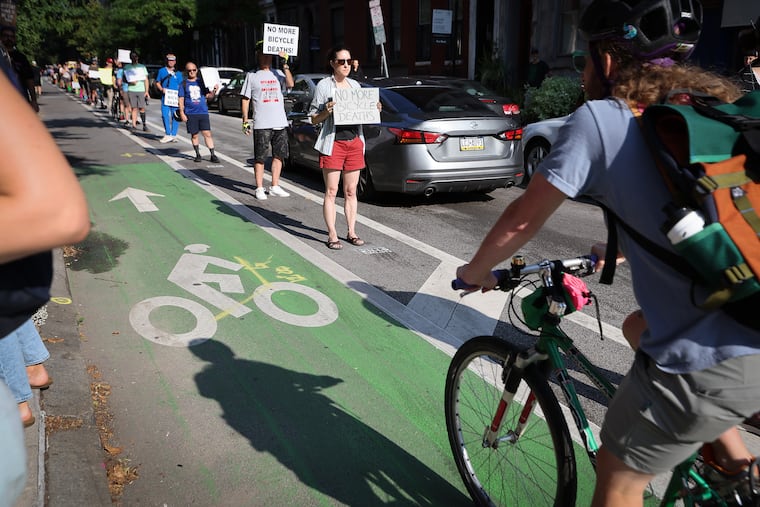
The lawsuit from Friends of Pine and Spruce opposing protected bike lanes is misguided and full of flawed reasoning. They claim barriers for bike safety somehow hinder emergency vehicles, but what really blocks ambulances and fire trucks? Traffic. Double-parked cars. Gridlock. Not concrete lane dividers. Blaming bike infrastructure for safety delays ignores the actual problem: Our streets are jammed with cars, many of them parked illegally. Protected bike lanes bring order and predictability, reducing chaos and making it easier, not harder, for emergency vehicles to move. The plan includes loading zones, so deliveries and pickups can still happen without clogging travel lanes. The mayor absolutely has the authority to prioritize public safety, and that’s exactly what this is — making streets safer for cyclists, drivers, and first responders alike. Stop using “parking loss” as a smoke screen. Prioritizing human lives over convenient parking is not just legal, it’s necessary. Shame on you for trying to stop it.
Ashlei Tracy, Philadelphia
Job Corps shutdown
As the Department of Labor proceeds with its plan to shut down all contractor-operated Job Corps centers by June 30, thousands of young people — many from our most vulnerable communities — are being abruptly displaced. These are students who enrolled in the Job Corps to escape poverty, complete their education, and gain vocational training. Now, with little warning or support, they are being returned home with no housing, no job certification, and no meaningful path forward.
This would be troubling on its own. But the situation is compounded by the Department of Labor’s concurrent 35% budget cut. The very agencies and nonprofits that could assist these youth are already overextended, underfunded, or themselves being downsized. The result? Students who were on track to become self-sufficient, taxpaying citizens are being thrown back into the same cycles of poverty they sought to escape.
This is not just an education issue — it’s a public policy failure with long-term economic and social consequences. We must ask: Who benefits when we pull opportunity away from those who are actively working to better their lives? These young people deserve better than to be forgotten for the sake of political or budgetary expediency. I urge national leaders to immediately pause this shutdown, allow transfers to open centers, and fully fund the support networks needed to help these students complete what they started. The cost of abandoning them now will far exceed the cost of supporting them to success.
Ashley Ulmer, Wilmington
More transparency
You’d never know it, but right now is when issues are being decided on the future of policing in Philadelphia. The police union and the city are currently hunkered down in an obscure process mandated by state law. But their agenda goes well beyond wages and benefits. In fact, its most far-reaching items extend to the basic accountability and oversight of police, the public servants who set the tenor of fundamental freedoms — or lack of — in any democracy. Yet we the people are barred, while union members can observe. Public employee unions may argue that’s proper. Negotiations are solely between labor and management and generally private, which makes sense. But not for police.
Not when community trust has shrunk so that in many neighborhoods, residents withhold cooperation in solving even violent crimes. Not when the Citizens Police Oversight Commission, which is supported overwhelmingly by Council and voters, will likely be blocked from pursuing independent investigations of misconduct since the union prefers police investigating police. Not when, according to The Inquirer, 85% of fired officers are reinstated through (a flawed version of) arbitration. And not when the union presses for more secrecy around police actions like a fog machine spewing over our city.
Stephen Strahs, LiveFree Philly, Philadelphia
What divides
I read the op-ed “Confronting what divides us” and note a glaring omission regarding our collective history. While “dissent” of a very limited nature may be an original part of that history, we should never forget that only the landed gentry of Western European descent were permitted any voice at all. Everyone else was other, less than, and voiceless. The “thread” holding “us” together was then, as now, the ability to target a minority group as a common enemy; our country’s native inhabitants were an initial target and remain so in many communities. Each time there is full humanity granted to a target group, an ensuing backlash occurs. Until we learn to accept our history, we will continue to have only false dissent among the landed Western European descendants and their ilk, and too many will continue to turn on our neighbors to avoid being othered.
Mara Obelcz, Hatfield
Improve options
As a culinary student in University City, I see the contrast between its booming food scene and the struggle many residents and peers face in getting affordable groceries. This issue needs attention. University City has students, families, and longtime residents who rely on nearby grocery stores, but affordable options are limited. Many have to travel far or rely on corner stores with few healthy choices, doing nothing positive for food insecurity. A solution is to expand community food programs, like farmers markets that take SNAP benefits, and bring more grocery stores to underserved areas. Universities like Penn and Drexel have the power and resources to help, and they should step up to support the whole community, not just their students. Everyone in West Philadelphia deserves access to healthy, affordable food from students, to visitors, to longtime residents. I urge local leaders and organizations to work together on real solutions.
Taft Nnochirionye, Philadelphia
Lifeline scholarships
Nearly 200,000 students — many living in Philadelphia — attend Pennsylvania’s lowest-performing schools. Too often, these students face daily obstacles, economic hardship, and violence. Rather than fixate on “getting kids out,” what if, instead, we see these students as the change from within that Philadelphia desperately needs? The easiest way to support the city’s youth is through Lifeline Scholarships, which provide financial support that makes private education feasible for low-income students attending underperforming schools. Though these students might move to another school, their families remain in the same communities. The goal of this program is not to “steal” kids from the public school system, but to invest in Philadelphia’s future.
Even if our students leave for college, they stay close. About half of college-bound students enroll in a college fewer than 100 miles from home. Because of the increased cost of living, more than half of college-educated students return to live in their childhood homes. If we invest in our kids, they will return those skills to Philadelphia. The city needs a young, skilled workforce now more than ever. Our city is hemorrhaging residents, especially young people, at an alarming rate.
As young people seek better opportunities elsewhere, this brain drain robs our city of its best and brightest. Imagine a city where this success comes home. Returning to their neighborhoods with their newly acquired skills, these students will positively impact those neighborhoods. Lifeline Scholarships retain and cultivate Philadelphia’s raw talent. This program will provide a lifeline to not only children and families but also Philadelphia, allowing our community to stay together, grow, and flourish so that our city can return to the fantastic place it once was.
Kristie Dugan, president, Little Flower Catholic High School
Join the conversation: Send letters to letters@inquirer.com. Limit length to 200 words and include home address and day and evening phone number. Letters run in The Inquirer six days a week on the editorial pages and online.