Letters to the Editor | Nov. 23, 2025
Inquirer readers on the need to control U.S. healthcare costs and President Trump's saber-rattling toward Venezuela.
Public option
The recent government shutdown was initiated by a Democratic Party trying to protect the 22 million Affordable Care Act participants from the financial impact of ending government subsidies that would more than double insurance premiums. Conversely, Republicans are intent on sunsetting COVID-era ACA subsidies that cost $30 billion per year. What both parties will acknowledge is that the cost of healthcare coverage continues to accelerate at a rate that is unsustainable.
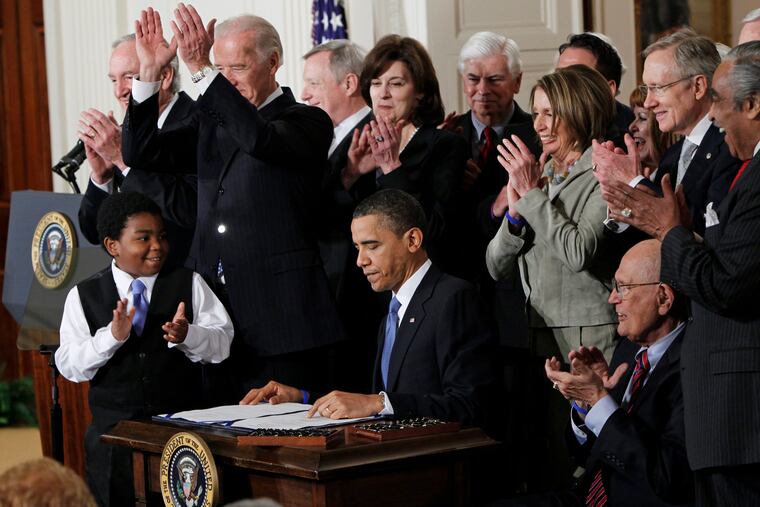
When President Barack Obama crafted the ACA, he envisioned a public option. A public option is healthcare provided by the government. That means government hospitals, clinics, doctors, nurses, technicians, and administrators. During the incubation of the ACA, the Obama administration realized a public option was far too controversial to be passed by Congress. So it birthed an insurance-based ACA that would use the existing U.S. healthcare structure. The problem is that medical costs and insurance premiums have far outstripped inflation since the passage of the ACA. The ACA has little control over these costs, and therefore, government subsidies are the only option to mitigate the impact on those among us who are most vulnerable to price increases. We cannot depend on the private sector to control the costs of healthcare. ACA government subsidies are a short-term solution. Donald Trump’s direct payments will do nothing to mitigate healthcare’s accelerating costs. Like it or not, the United States will have to implement a public option to control costs and provide a healthcare safety net. The current course and speed are simply unaffordable and will contribute to bankrupting the country.
Here’s the good news: We can use the U.S. Department of Veterans Affairs healthcare infrastructure as the base on which we can make the public option a reality. The VA currently provides service to over nine million vets at a cost of $68 billion a year. There are over 170 VA medical centers, 1,300 outpatient clinics, and other sites. This is a start. Compare that with ACA subsidies of $138 billion in 2025 before factoring in the average individual annual cost of $7,428 (in 2025). Yes, this is a national health system where the government can control healthcare costs. Yes, this will reduce one’s healthcare choices. Yes, this will be an affordable healthcare safety net alternative to the current unsustainable and unaffordable healthcare system.
William F. Spang Jr., Philadelphia
Art of deflection
After the horrific attacks of Sept. 11, 2001, the Bush administration announced that Saddam Hussein, president of Iraq, had weapons of mass destruction and needed to be removed. Thus, the ensuing Iraq War, the removal of Hussein, the loss of over 100,000 civilian lives, and 4,400 American troops, only to discover there were no such weapons of mass destruction. Further investigation determined George W. Bush had plans to attack Iraq even before the terrorist attacks of 9/11. Why? Iraq contained massive reserves of oil.
Fast-forward to 2025, and the Trump administration is beating the war drums against Nicolás Maduro and Venezuela. Claiming it is responsible for the flow of fentanyl, the president has launched dozens of airstrikes against supposed drug boat smugglers without evidence or with congressional input. New measures are being planned for possible attacks within Venezuela and perhaps boots on the ground. “I have not ruled out using troops,” Donald Trump recently asserted. Our largest aircraft carrier has been stationed just off the Venezuelan coast. Venezuela happens to have the largest oil reserves in South America. There is scant evidence that Venezuela is involved in drug smuggling, unlike neighboring Colombia and its infamous drug cartels. Why no military actions against it? As the Epstein files near release and flagging poll approval numbers, Trump desperately needs a diversion. Venezuela could be just the ticket. Fool me once, shame on you; fool me twice, shame on me. Let’s not be fooled again.
Angus Love, Narberth
Join the conversation: Send letters to letters@inquirer.com. Limit length to 150 words and include home address and day and evening phone number. Letters run in The Inquirer six days a week on the editorial pages and online.